Government Museum and Art Gallery, Chandigarh
On April 10, 1948, barely eight months after the partition of British India, officials in a divided Punjab sat down to split the contents of the Central Museum in Lahore. Pakistan kept sixty percent. India received the rest -- 627 Gandhara sculptures among them, stone Buddhas carved two thousand years ago where Greek and Buddhist civilizations once overlapped. These sculptures had no home. They traveled from Amritsar to Shimla to Patiala, refugees of a sort, waiting for a city that did not yet exist. When Chandigarh rose from the plains as India's great modernist experiment, Le Corbusier designed a building to receive them. The Government Museum and Art Gallery opened in 1968, and those wandering sculptures finally stood still.
Where East Meets West in Stone
The Gandhara collection is the museum's beating heart. With 627 sculptures -- the second-largest such collection in India after the Indian Museum in Kolkata -- it spans centuries of artistic fusion between Greek and Buddhist traditions. Some Buddhas have long, flowing hair; others sport mustaches with tightly curled locks. The earliest followers of the Buddha worshipped only symbols: a footprint, a wheel. When they finally chose to depict him in human form, they borrowed from the Greek gods -- broad shoulders, idealized features, draped robes. The result was something entirely new: Hellenistic grace channeling Buddhist devotion. Standing figures of the goddess Hariti and her consort Panchika share gallery space with these Buddhas, including an inscribed and dated image of Hariti from Skarah Dheri that helps scholars anchor the entire collection in time.
Le Corbusier's Concrete Cathedral
The building itself is an artifact. Designed by Le Corbusier between 1960 and 1962, with associate architects Manmohan Nath Sharma, Pierre Jeanneret, and Shiv Dutt Sharma, it is one of only three museums the Swiss-born French architect ever created -- the others being Sanskar Kendra in Ahmedabad and the National Museum of Western Art in Tokyo. Construction ran from 1962 to 1967. The exposed concrete is unadorned and deliberately stark, broken only by a mural in the reception area painted by Satish Gujral, one of India's finest contemporary artists. Pivoted entrances, metal-panelled doors, fixed furniture, and sculpturesque concrete gargoyles define the Modernist vocabulary Le Corbusier imposed on Chandigarh. Three levels hold 62,500 square feet of space: galleries, conservation laboratories, a library rich in art and architectural history, and an auditorium whose interior detailing embodies the Modernist tradition the architect introduced to the city.
Miniatures, Manuscripts, and Metal
Beyond the Gandhara galleries, the museum unfolds into a survey of subcontinental artistic traditions. Pahari miniature paintings -- primarily from the Kangra school, with representations from every other Pahari tradition -- hang alongside Rajasthani, Sikh, and Mughal works. The colors remain vivid: the reds and golds of court scenes, the greens of forest landscapes, the precise linework of devotional imagery. Eighteenth- and nineteenth-century manuscripts in Devanagari, Gurmukhi, and Persian script from Kullu, Kashmir, Rajasthan, and Punjab document the literary cultures that produced them. Medieval metal sculptures from Kangra, Nepal, Tibet, and southern India represent both Buddhist and Hindu traditions. A 12th-century Jain sculpture of the deity Padmavati, large and finely carved, stands among works from Agroha, Pinjore, and sites across Haryana and Punjab. Coins trace Indian history from the Mauryan and Gupta empires through the Delhi Sultanate, Mughal rule, Sikh power, and the British Raj.
The Living Canvas
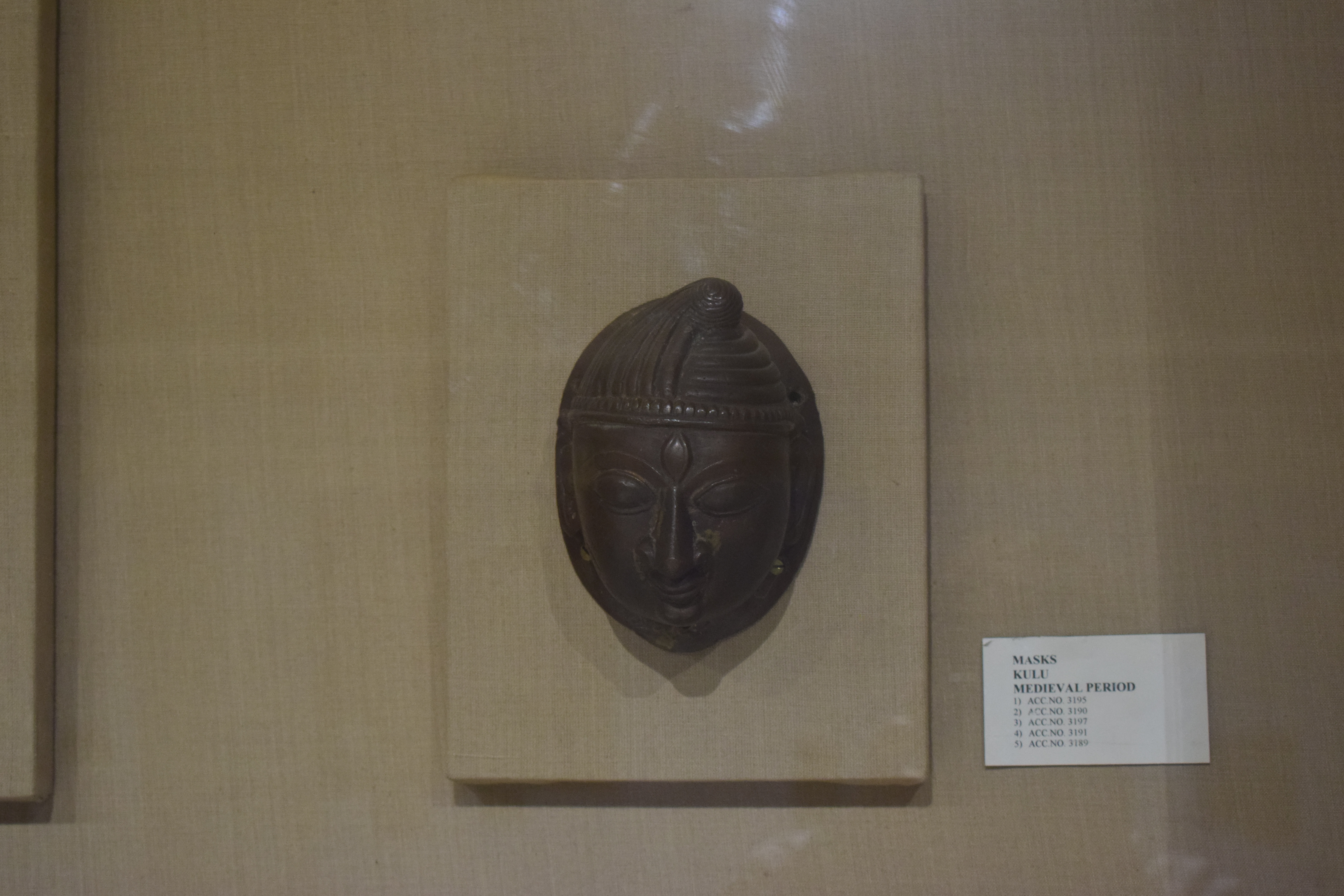
The contemporary art collection reads like a roll call of modern Indian masters: Abanindranath Tagore, Amrita Sher-Gil, M.F. Husain, F.N. Souza, Raja Ravi Varma, Nandalal Bose, Nicholas Roerich, Tyeb Mehta, Bhupen Khakhar, and Akbar Padamsee, among others. Dr. M.S. Randhawa, Chandigarh's first Chief Commissioner and the man who inaugurated the museum in 1968, personally drove the acquisition of these works, determined that the new city's museum would stand alongside the best in North India. Textiles from across the subcontinent -- Chamba rumals from Himachal Pradesh, Kantha embroidery from Bengal, Phulkari from Punjab, and Thangkas from Tibet and Nepal -- add tactile richness to what is primarily a visual collection. Patua scrolls from Bengal, metal Kullu masks, and folk sculptures from Bastar round out a portrait of India's artistic diversity.
Blueprints of a City That Almost Wasn't
Across from the main gallery, the Architecture Museum -- established in 1997 -- preserves the documentary history of Chandigarh's creation. Drawings and sketches by Maciej Nowicki, Albert Mayer, Le Corbusier, Jane Drew, Maxwell Fry, and Pierre Jeanneret chart the evolution of a city designed from scratch on the post-Partition plains. Models of two Le Corbusier buildings that were never constructed -- the Governor's Palace and the Museum of Knowledge, intended for the Capitol Complex -- offer a glimpse of a Chandigarh that might have been. Heritage furniture designed and used by the architects survives here, alongside early maps of post-Partition East Punjab. The Natural History Museum, founded in 1973 by Dr. Randhawa himself, rounds out the complex with four sections covering early human settlements in the region, biological evolution, dinosaurs of the Indian subcontinent, and human evolution.
From the Air
Located at 30.749°N, 76.787°E in Sector 10 of Chandigarh, near Sukhna Lake. The Le Corbusier Capitol Complex is visible to the north. Best viewed at 3,000-5,000 ft AGL. Nearest airport is Chandigarh International (VICG), approximately 8 nm southeast. The planned grid of Chandigarh's sectors is clearly visible from altitude.