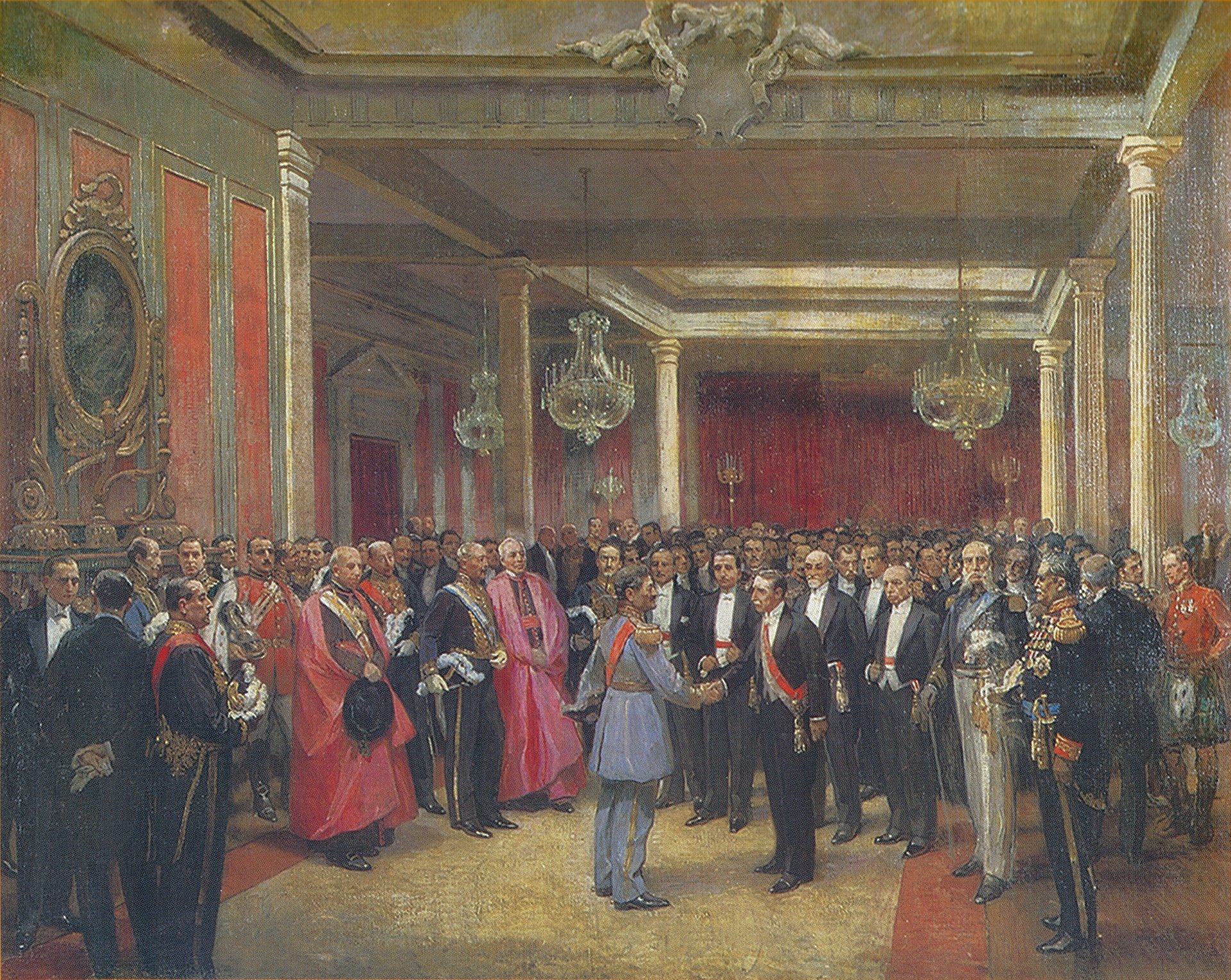
Government Palace, Peru
A Bohemian crystal chandelier weighing two thousand kilograms hangs from the ceiling of the Peace Room. Below it stretches a dining table that seats 250, its carved chairs stamped in gold with the coat of arms of Francisco Pizarro. This is the Government Palace of Peru — a building where the founder's heraldry decorates the furniture, where a room named for an Inca rebel leader replaced one named for the conquistador who destroyed the Inca empire, and where Handel's Royal Fireworks Suite plays every time the mounted guard changes at noon.
Pizarro's Footprint
The palace sits on the northern edge of Lima's Plaza Mayor, on land that held a large huaca — a sacred Andean shrine — incorporating a temple to Taulichusco, the last pre-colonial ruler of the Rímac Valley. Pizarro built his residence here in 1535, the year he founded Lima. When the Viceroyalty of Peru was established in 1542, the house became the Viceregal Palace, known as the Casas Reales. Forty-three viceroys occupied it over the next three centuries. The building was damaged by earthquakes in 1687 and 1746, and Antonio de Ulloa, arriving as a young Spanish naval lieutenant in 1740, described a structure whose grandeur had been diminished by seismic damage and years of neglect. Fire gutted it in 1884 during the presidency of General Miguel Iglesias, and fire struck again in 1921.
A Polish Architect and a French Blueprint
The current building dates largely from the 1920s and 1930s, a collaboration between two European architects working in South America. Phase one was designed by French architect Claude Antoine Sahut Laurent, who created the Neo-Plateresque main portico on Palacio Street and the Golden Hall, the palace's grandest room. Inspired by the Hall of Mirrors at Versailles, the Golden Hall features walls of tall mirrors and gold-leaf relief, a vaulted ceiling combining indigenous and European motifs, and four bronze and crystal chandeliers hanging above Louis XIV-style furnishings. When Sahut Laurent died in 1932, construction halted. Phase two fell to Polish architect Ricardo de Jaxa Malachowski, who completed the Neo-Baroque facade overlooking the Plaza Mayor in 1938 under President Oscar R. Benavides. The result is a building that blends French grandeur with Andean identity — plaster reliefs by Daniel Casafranca depicting the Incas share wall space with European sculptures representing the four seasons.
The Room That Changed Its Name
In the 1970s, President Juan Velasco Alvarado renamed the Pizarro Room as the Túpac Amaru II Room, replacing the conquistador's portrait with a large painting of the 18th-century indigenous rebel who led the greatest uprising against Spanish colonial rule. The gesture was deliberate: Velasco's military government championed indigenous identity and land reform, and erasing Pizarro's name from the palace's most prominent dining room was part of that project. The room itself, dating from the 1920s, features a central rotunda with a wooden cupola, stained glass, and a throne gifted by Japanese Emperor Akihito. It once seated 172 for state dinners. That the same room has carried the names of both the conqueror and the rebel who tried to overthrow his legacy says something about how Peru negotiates its layered history.
Dragoons at Noon
The Changing of the Guard is the palace's most public spectacle. Every day at noon, on the esplanade facing the Plaza de Armas, the ceremony unfolds with the precision of a military tradition that stretches back to the viceregal Halberdier Corps. On the first and third Sundays of each month, the Dragoon Guards of the Presidential Life Guards Regiment "Mariscal Nieto" perform a full mounted ceremony. The regimental band trots past the palace entrance as Handel's La Réjouissance from the Royal Fireworks Suite fills the square. Mounted officers in ceremonial dress canter past the president, sabers are drawn, and the old guard yields to the new. On other days, the ceremony is performed on foot, rotating among different military and police units. Dedicated stands outside the palace allow the public to watch.
Five Centuries at One Address
The Government Palace has served every head of state Peru has known — from Pizarro through 43 viceroys to every president of the republic. Set against the Rímac River, which once flooded the grounds and consumed the convent orchards next door, the palace has been earthquake-damaged, fire-gutted, rebuilt, and reimagined across nearly five centuries without ever moving from the spot Pizarro chose. The Jorge Basadre Room preserves two presidential carriages used for official occasions until 1974. The Peace Room commemorates the mediation of a treaty between Honduras and El Salvador in 1980. Pizarro's coat of arms remains on the main portico. The building is at once museum, working government seat, and physical argument that power in Peru has always been exercised from this one piece of ground.
From the Air
Located at 12.045°S, 77.030°W on the northern edge of Lima's Plaza Mayor, directly along the Rímac River. From 2,000–4,000 feet AGL, the palace's large footprint and courtyard gardens are visible as the dominant structure on the plaza's north side. The daily Changing of the Guard ceremony at noon is visible as crowd activity on the esplanade. Jorge Chávez International Airport (SPJC/LIM) is approximately 10 km west. The Historic Centre of Lima, a UNESCO World Heritage Site, surrounds the palace.