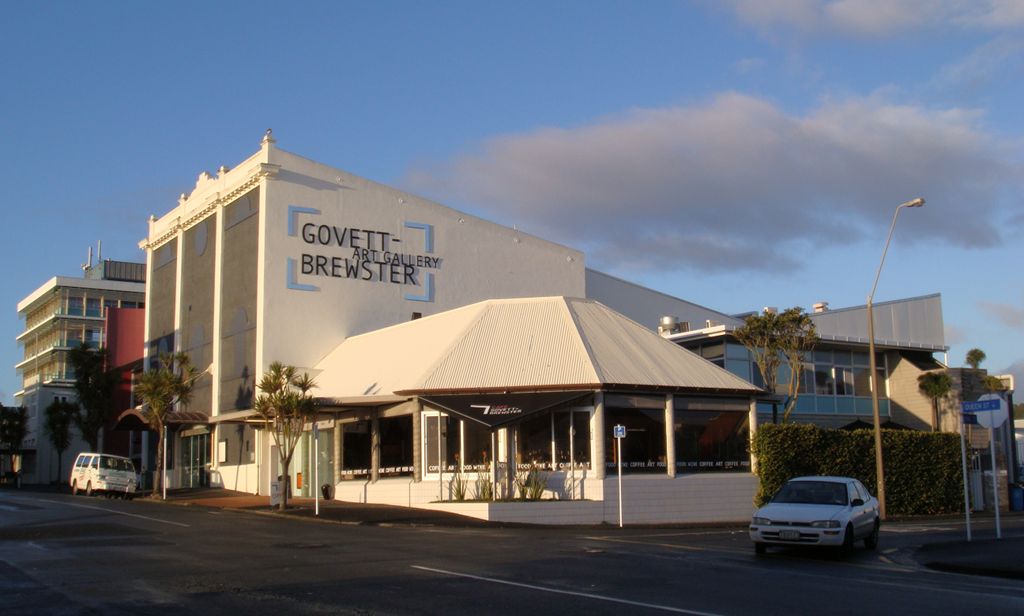
Govett-Brewster Art Gallery
In 1967, a 24-year-old Australian schoolteacher named John Maynard arrived in New Plymouth with a job title that sounded routine -- gallery director -- and a mandate that was anything but. Monica Brewster, a local resident, had transferred 50,000 pounds in stocks and securities to the city five years earlier with a single instruction: build an art gallery. The city fathers might have imagined something dignified and predictable. Maynard had other plans. After touring New Zealand's art scene, he concluded that "artists are where the action is," and set about converting an old Regent cinema into something that would make New Plymouth, a coastal town of modest size beneath the volcanic cone of Mount Taranaki, a genuine force in contemporary art.
A Cinema Reborn
The Govett-Brewster Art Gallery opened on 22 February 1970, and its inaugural exhibition announced its intentions with blunt clarity. Leon Narbey's installation Real Time used life itself as its basic material -- no paintings on walls, no sculptures on pedestals. Art critic Hamish Keith declared it was "setting New Zealand art off to the kind of start it should have in the Seventies." The collection policy Maynard developed was equally uncompromising: the gallery would focus on new forms of art and sculpture from New Zealand and the Pacific Rim, and it would deaccession works that no longer served its mission. This was not a gallery interested in accumulating prestige through safe acquisitions. It was a gallery that wanted to stay dangerous.
The Kinetic Visionary
Born in Christchurch in 1901, Len Lye was largely self-educated and driven by an obsession with motion and energy as artistic mediums. His restlessness carried him from the South Pacific to London to New York, where he became known for intensely creative filmmaking and kinetic sculpture -- art that moved, hummed, and sometimes startled viewers with its mechanical life. Lye died in 1980, but his connection to New Zealand endured through the Len Lye Foundation, which found a permanent home at the Govett-Brewster. In 1998, the gallery expanded specifically to house the Foundation's collection. Then, in 2015, the Len Lye Centre opened as a purpose-built extension designed by Andrew Patterson of Pattersons Associates -- the first gallery in New Zealand dedicated to a single artist. Its shimmering stainless steel facade became an instant landmark on Queen Street, a piece of kinetic architecture that would have pleased Lye himself.
Ambition at the Edge
What makes the Govett-Brewster remarkable is not just its collection but its location. New Plymouth sits on the western coast of the North Island, population around 57,000, dwarfed by Auckland and Wellington. Yet the gallery has consistently punched above its weight, staging exhibitions that draw international attention: Emanations, a survey of cameraless photography curated by Geoffrey Batchen in 2016; a major Vincent Ward retrospective in 2011; shows dedicated to contemporary art from Japan and Korea. The gallery earned the Arts Foundation of New Zealand's Governor's Award in 2009 and a Best Design Award for its brand identity in 2016. Monica Brewster, who made a second bequest of 72,000 pounds in 1970 to seed a permanent collection, died in 1973 knowing her gift had become something far more audacious than a provincial gallery.
Layers of Restlessness
Twelve directors have led the gallery since Maynard's departure in 1971, and the institution's willingness to take risks has never quite settled into complacency. Cheryll Sotheran, Gregory Burke, Rhana Devenport -- each brought a different curatorial sensibility, but the thread connecting them has been an appetite for art that challenges rather than reassures. The gallery has published extensively, from exhibition catalogs to standalone texts like Erika Balsom's An Oceanic Feeling: Cinema and the Sea. In 2016, the publication Now Showing documented 45 years of exhibition-making at the Govett-Brewster, a history that reads less like an institutional timeline and more like a series of provocations launched from an unlikely outpost.
From the Air
Located at 39.06S, 174.07E in central New Plymouth on the Taranaki coast of New Zealand's North Island. Mount Taranaki's volcanic cone dominates the skyline to the southeast. The gallery sits near the waterfront in the city center. Nearest airport is New Plymouth Airport (NZNP), approximately 11 km northeast. Approach from the Tasman Sea side for dramatic views of the coastline against the mountain backdrop. Recommended viewing altitude 3,000-5,000 feet.