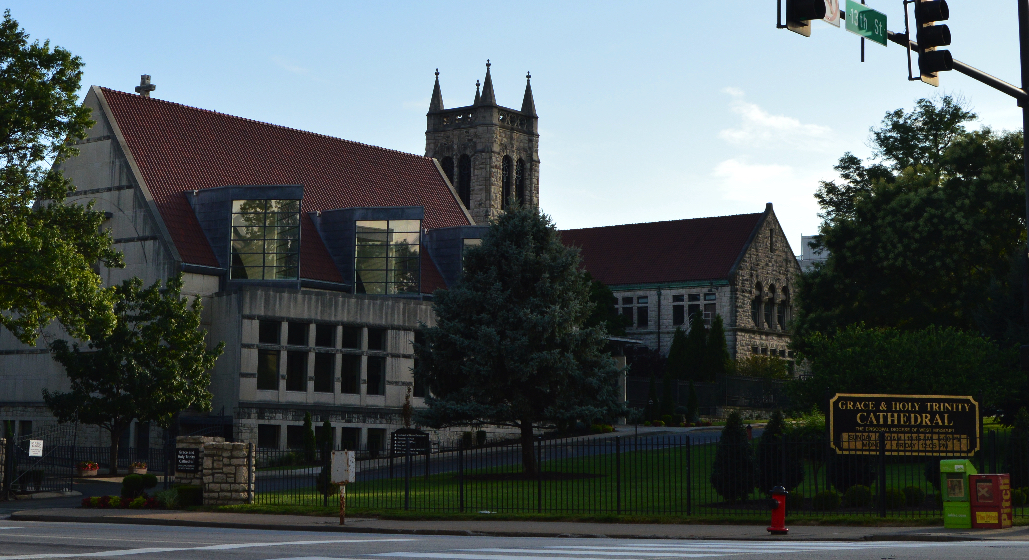
Grace and Holy Trinity Cathedral
The walls were never supposed to look like this. When architect Frederick Elmer Hill of the legendary firm McKim, Mead & White designed the nave of Grace Church in 1893, he envisioned marble wainscoting, ornately carved door frames, and a mosaic chancel floor. The money ran out. The plans were forgotten. But step inside Grace and Holy Trinity Cathedral in Kansas City's Quality Hill neighborhood today, and those plain walls dissolve into irrelevance the moment sunlight hits the stained glass. This cathedral holds one of the most important collections of stained glass windows in the United States, an accidental gallery assembled across half a century by a congregation that may not have finished its walls but never stopped filling its windows with light.
Three Names, One Parish
The cathedral's history is a story of reinvention. It began on July 20, 1870, as Saint Paul's Church, only to be renamed Grace Church in 1873 after a two-year campaign by Senior Warden John R. Balis. The congregation built a wood frame structure in 1874, then began its permanent stone home at 415 West 13th Street. Hill designed the nave in the transitional Norman Gothic style, with rounded window frames evoking Norman England and pointed Gothic arches at the chancel. The interior was completed in December 1894 and consecrated in May 1898. In November 1917, Grace Church merged with Trinity Church, founded in 1883, becoming Grace and Holy Trinity Church. When its rector, Robert Nelson Horatio Spencer, became the Third Bishop of the Diocese of West Missouri in 1930, he worked to elevate his former parish. On October 29, 1935, Grace and Holy Trinity Church was consecrated as the Cathedral of the Diocese.
A Gallery in Glass
The cathedral's stained glass collection spans decades and continents. A 1901 window by Otto Heinigke and Owen Joshua Bowen is the only example of their work in a church west of the Mississippi. A 1911 window from Duffner and Kimberly, designed by J. Gordon Guthrie, ranks among the largest single windows that firm ever produced. Most remarkable is a window designed in 1912 by Mary Fraser Wesselhoeft, an American stained glass artist, and fabricated in Berlin by Gottfried Heinersdorff in January 1913. It is believed to be the only example of Heinersdorff's work on the North American continent. Two Tiffany Studios windows grace the nave: a 1930 window illustrating Psalm 42 that floods with color at sunset, and a rare 1935 window made after the firm had declared bankruptcy in 1932. Three windows by Boston artist Charles Jay Connick, installed between 1943 and 1945, complete this extraordinary survey of the art form.
The Tower That Took Forty Years
Just as the nave's interior went unfinished, so did its planned tower. For decades it sat as a two-story stump above the Kansas City skyline. In 1936, Henry DeLancy Ashley, who had served 51 consecutive years on the parish vestry through all three incarnations of the church, launched a campaign to complete it with an initial donation of $100. The Kansas City firm of Wight & Wight redesigned the tower, with William Drewin Wight as principal architect. It was finished in May 1938. Ashley died on February 9 of that year, never seeing the completed structure he had championed. His legacy was more than the tower itself: he had served the parish through its transformation from Grace Church to Grace and Holy Trinity Church to Grace and Holy Trinity Cathedral, stubbornly insisting that the building be completed.
Stone, Mortar, and Survival
On the cold night of January 22, 1986, a portion of the exterior stonework on the north wall collapsed. Investigation revealed that the original mortar, mixed with high proportions of sand and lime and very little cement, had deteriorated to the consistency of sand. The stability of all four nave walls was called into question. A major structural repair required the congregation to abandon its primary worship space for 20 months while the roof was independently supported and the walls stabilized. The nave reopened on September 13, 1987. A German-Canadian organ by Gabriel Kney, installed in 1981 as his Opus 94, survived the upheaval and continues to fill the 138-foot-long, 75-foot-high nave with sound. The cathedral's dimensions remain impressive: 60 feet wide, with original oak pews and a chevron-patterned oak floor that has supported Kansas City's Episcopalian community for more than 130 years.
From the Air
Located in the Quality Hill neighborhood of downtown Kansas City at 39.098N, 94.589W, near the intersection of West 13th Street and Broadway. The cathedral tower is visible from the air amid the downtown skyline. Union Station and the Liberty Memorial are approximately 1 mile to the south. Nearest major airport: Kansas City International (KMCI). Recommended viewing altitude: 2,000-3,000 feet AGL for downtown detail.