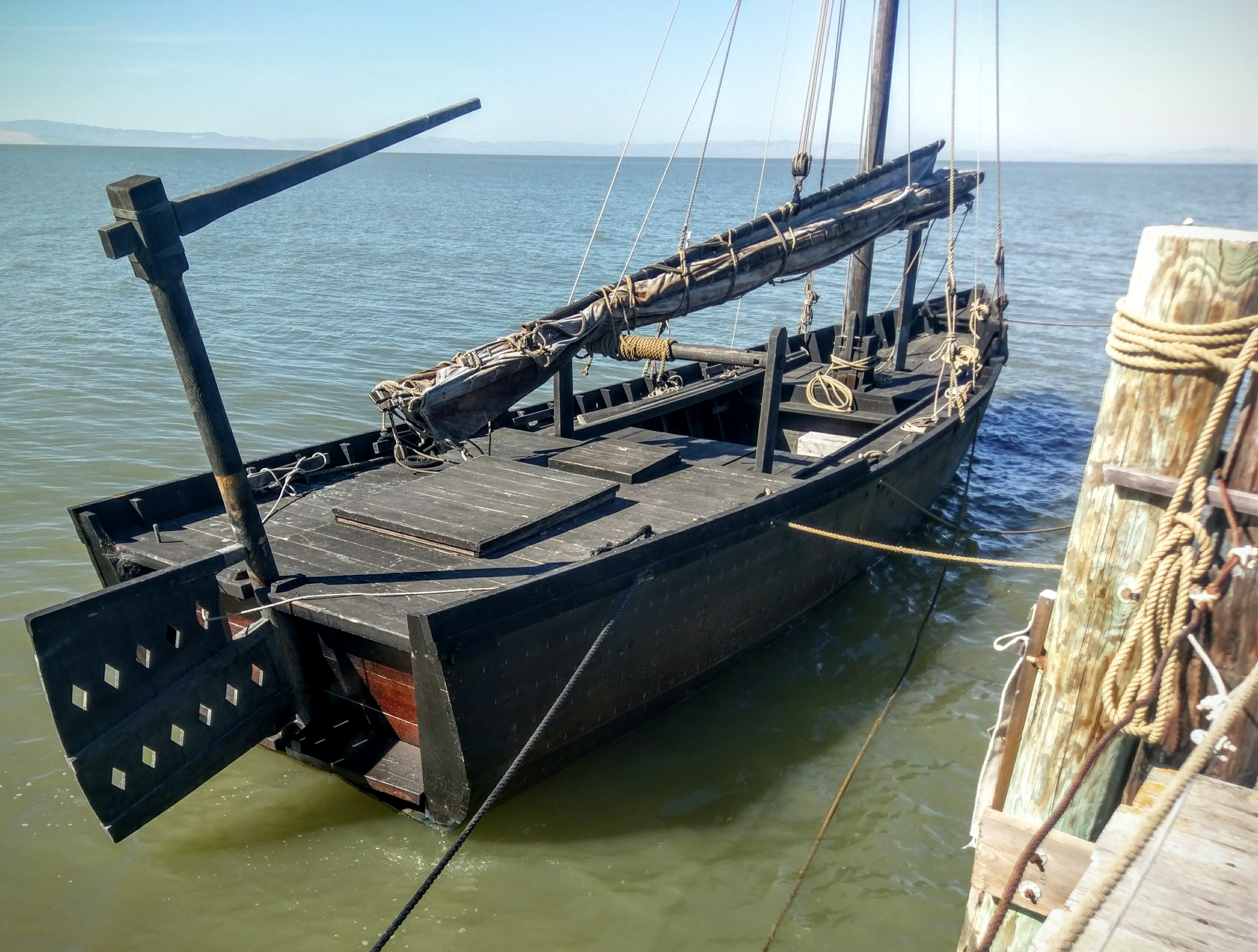
Grace Quan: The Junk That Remembers
Twice a year, a flat-bottomed wooden boat with a single batten sail crosses fifteen nautical miles of San Francisco Bay, traveling between Hyde Street Pier and China Camp State Park in San Rafael. The Grace Quan is not old. Built in 2003 by volunteers who sealed her planks with a traditional caulk of lime and linseed oil, she is a replica -- a careful reconstruction of the Chinese shrimp-fishing junks that once worked these waters by the dozens. What makes the voyage matter is not the boat itself but what it carries: the memory of a thriving immigrant industry that California spent a century trying to forget.
The Guangdong Fleet
Chinese fishermen from Guangdong province arrived on San Francisco Bay in 1871, two years after Italian fishermen had begun harvesting shrimp in these same waters. They brought traditional bag nets from China and a knowledge of shallow-water fishing refined over generations. Within a decade, immigrant Chinese fishermen dominated the Northern California shrimp trade. By the end of the nineteenth century, dozens of junks built right here in California -- flat-bottomed vessels designed for the bay's shallow tidal flats -- worked the waters around San Rafael, Richmond, Hunters Point, and Redwood City. The fishermen established villages along the shoreline, communities built around the catch and the seasonal rhythms of the bay. It was a substantial industry, not a footnote.
A Quiet Erasure
The decline came in layers. The Great Depression collapsed the export market that had sustained the larger operations. War and revolution in China severed the remaining trade routes. After World War II, regulations reduced what had been a commercial fishery to a bait-fishing operation, a fraction of its former scale. The villages emptied. The junks rotted or were scrapped. Third-generation fisherman Frank Quan kept working the nets at China Camp into the twenty-first century, living in the remains of what had once been a thriving settlement. He fished there until he died at age ninety -- the last practitioner of a tradition that had sustained communities across the bay for generations. As historian Phil Choy of the Chinese Historical Society of America observed, the very existence of this industry challenges the perception that all Chinese immigrants "were laundrymen and houseboys and cooks. They had know-how. They were enterprising and resourceful."
Built by Hand
The idea for Grace Quan began in 1995, when John C. Muir -- later a Curator of Small Craft at the San Francisco Maritime National Historical Park -- was an undergraduate who stumbled across a photograph of a Chinese junk sailing the San Francisco waterfront. The image sparked a question: could one be built again? It took years to organize, but in 2003 the junk took shape as a joint project between China Camp State Park and the Maritime Park. Volunteers worked the planking and caulking by hand. The finished vessel carries a traditional yuloh, a Chinese sculling oar used from the stern, along with a pair of bow oars for maneuvering around fixed nets when the wind dies. She is small and functional, a working boat rather than a showpiece.
Sailing the Forgotten Shore
In 2014, the Grace Quan undertook a voyage around the bay, stopping at the sites of historic Chinese shrimp-fishing villages: Richmond, Hunters Point, Redwood City. Most of these places bear no visible trace of the communities that once anchored them. Rene Yung, director of the community cultural group Chinese Whispers, described the trip as a tribute to "this pioneer community and San Francisco's maritime heritage." He framed the broader context plainly: "The historic Chinese immigrant experience in America was marked by oppression and erasure of their contributions from national memory. The once-thriving Chinese shrimping industry and community around San Francisco Bay is one of these forgotten stories." The Grace Quan sails as a counter to that forgetting -- not a monument but a working vessel, doing what her predecessors did, crossing the same water under the same wind.
From the Air
Located at 38.00°N, 122.49°W at China Camp State Park on the western shore of San Pablo Bay, near San Rafael, California. From the air, look for the small cove and historic fishing village structures at China Camp along the bay shoreline. The Grace Quan docks at Hyde Street Pier (San Francisco Maritime National Historical Park) in winter and at China Camp in summer. Nearest airports: KOAK (Oakland International), KSFO (San Francisco International). The bay's shallow tidal flats visible from altitude were once the prime shrimping grounds for dozens of junks. Marin County's green hillsides contrast sharply with the bay waters below.