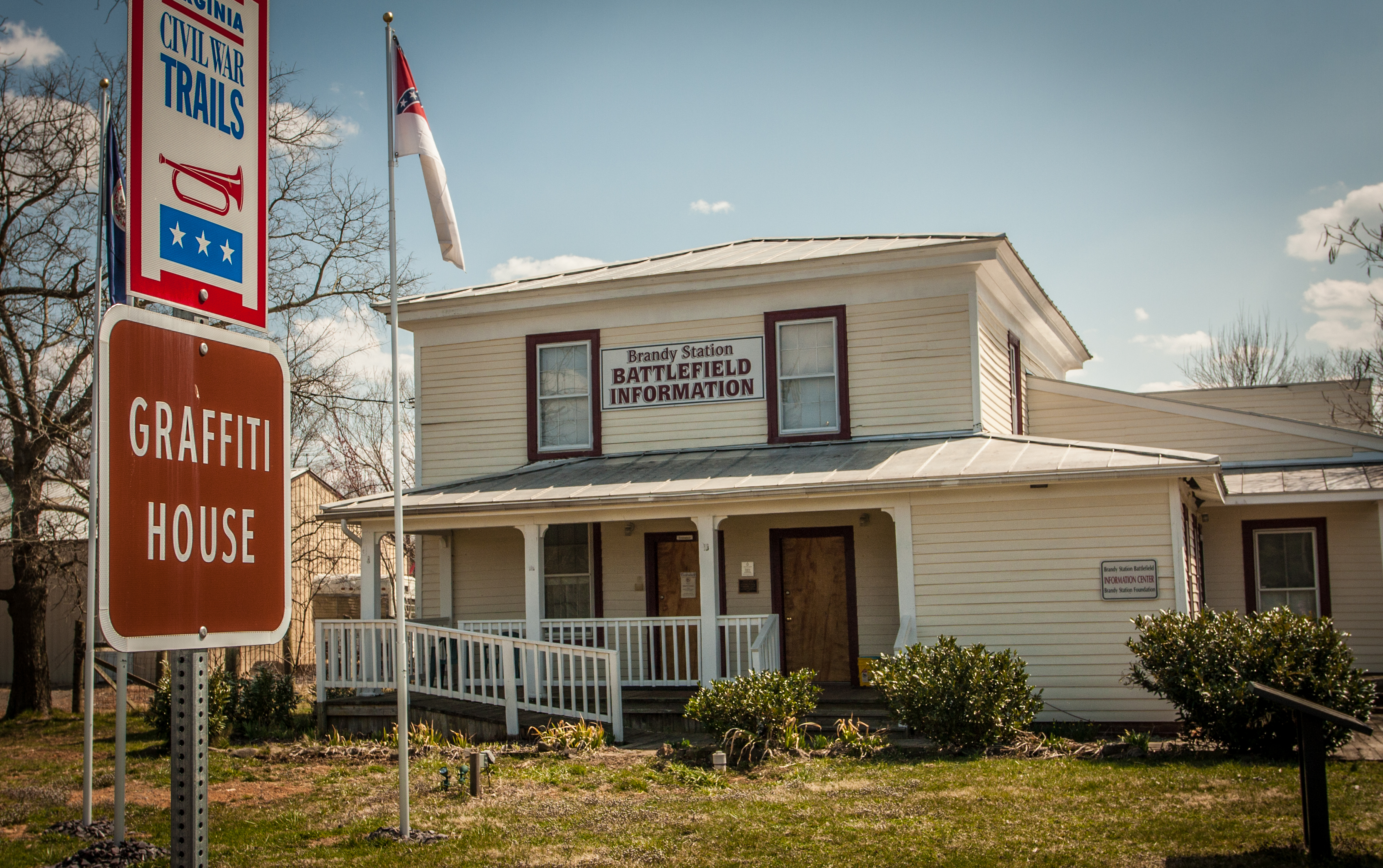
Graffiti House
Somewhere on the second floor, a man in a bowler hat with mutton chops faces the rear end of a horse and declares that he "smells a rebel." Nearby, a young woman in a fancy dress walks a plank with the caption "I am turned over to Lt. Gale." J.E.B. Stuart signed his name. So did privates, corporals, and sergeants from batteries and regiments on both sides of the war. For over a century, these drawings and inscriptions lay hidden under paint and wallpaper in a small house at 19484 Brandy Road, Brandy Station, Virginia. A 1993 renovation stripped back the layers and revealed one of the most remarkable collections of Civil War soldier graffiti ever found.
A House Between the Armies
Built around 1858, the house sat near the Orange and Alexandria Railroad depot and the Carolina Road, a location of relentless strategic value during the Civil War. It was owned by James Barbour, brother of the railroad's president John S. Barbour Jr., though the Barbour family's main residence stood on a ridge to the south, a property that Confederate General Stuart himself occupied during the war. James Barbour served on Lieutenant General Richard S. Ewell's staff until January 1863. Because of its proximity to the railroad, the house changed hands repeatedly between Union and Confederate forces. It served as a field hospital during the Battle of Brandy Station on June 9, 1863, and likely received wounded soldiers evacuated by train after First Bull Run as early as 1861.
The Maryland Scroll and Breathed's Battery
The single most striking artifact on the walls is the Maryland Scroll, an elaborate inscription created on March 16, 1863, the day before the Battle of Kelly's Ford. Nearly every identified name from Breathed's Battery of the Stuart Horse Artillery appears on this scroll: privates like Harry Wagner, Uriah Haller, Thomas "Herb" Greenwell, Henry "Hal" Hopkins, and George McCabe Jr. These artillerymen, camped in the area between engagements, left a collective signature that reads like a muster roll drawn in charcoal. Corporal Fayette Gibson and Sergeant Henry Thomas added their names alongside the privates. The battery's commander, Captain James Breathed, is one of only two identified subjects among the drawings on the walls.
Voices from Both Sides
The graffiti spans the war's chronology in Culpeper County. The earliest known inscriptions date to the Second Manassas Campaign in August 1862. By winter 1863-64, when the Army of the Potomac camped in Culpeper County, Federal soldiers added their own marks. Captain Edwin Dillingham of the 10th Vermont Infantry and Colonel John Egbert Farnum of the 70th New York Infantry left their names. Private Dan Quinlan of Massachusetts Light Battery C signed in alongside Confederate cavalrymen from the 12th Virginia Cavalry. One anonymous inscription reads "How are you Fort Sumter," attributed to the 2nd New York Militia. Another simply notes "Remember the Baltimore Artillery, September the 2nd, 1863." Units from the Louisiana Tigers, Hill's Corps, and the Stuart Horse Artillery all left their marks on these plaster walls.
Hidden, Found, and Preserved
After the war, the house returned to civilian life. New paint covered the walls. Wallpaper went up. The soldiers' marks disappeared from sight and memory for 130 years. When renovation work in 1993 peeled back those layers, the graffiti emerged as if the soldiers had just stepped out. The Brandy Station Foundation purchased the house in 2002 and has since operated it as a museum and visitor center for the Brandy Station battlefield. New inscriptions were still being discovered as recently as December 2010. Robert Peed of the Norfolk Light Artillery signed his name in five separate locations throughout the house. Sergeant Allen Bowman of the 12th Virginia Cavalry signed in two. Private William Haney is believed to have served in four different units during the war, and likely left his mark while serving with the 24th Battalion Partisan Rangers. Each name is a thread connecting the present to a specific person who stood in that room during the most turbulent years in American history.
From the Air
The Graffiti House sits at 38.504N, 77.891W at the eastern end of the village of Brandy Station in Culpeper County, Virginia. From the air, Brandy Station is a small cluster of buildings along the Norfolk Southern railroad line (the former Orange and Alexandria Railroad) between Culpeper and the Rappahannock River. Fleetwood Hill, focal point of the Battle of Brandy Station, rises just to the west. The house is a small structure near the railroad and is not individually distinguishable from altitude, but the village and surrounding battlefield landscape are recognizable. Nearest airports: Culpeper Regional (KCJR) approximately 5nm south, Warrenton-Fauquier (KHWY) approximately 15nm northeast. The Culpeper Battlefields State Park encompasses much of the adjacent battlefield.