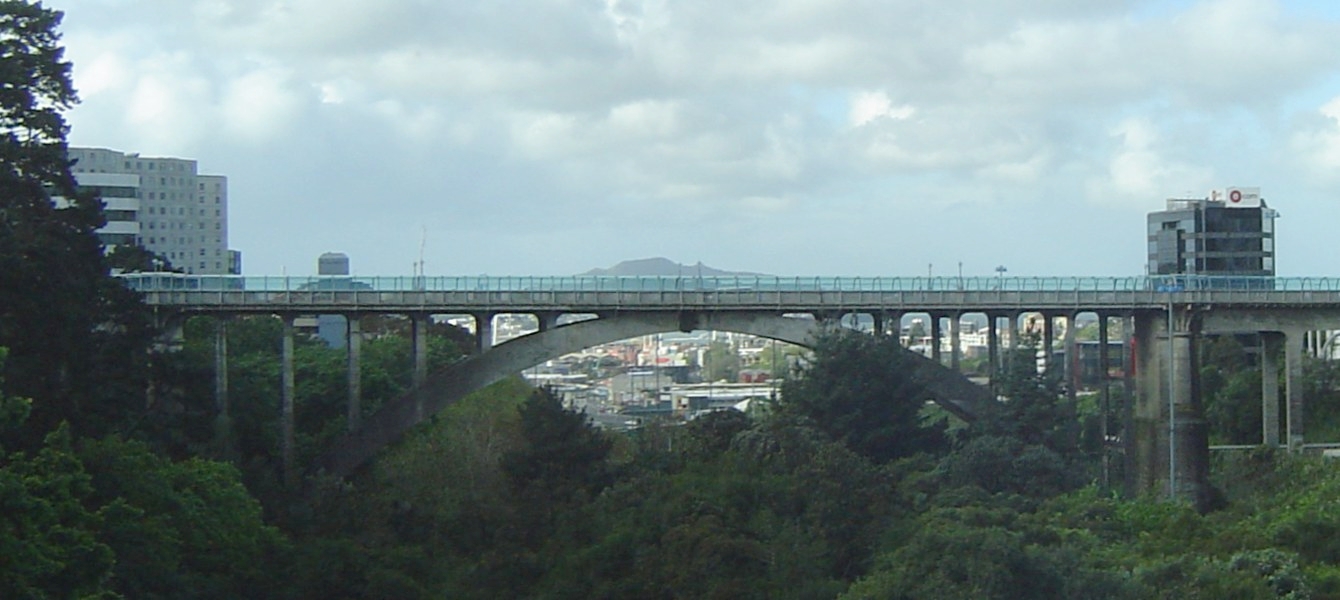
Grafton Bridge
On opening day in April 1910, two steam rollers were driven slowly across the new Grafton Bridge while spectators held their breath. Reinforced concrete was still a relatively untested building material, and the arch spanning Grafton Gully -- 97.6 meters across, soaring 43 meters above the valley floor -- was the largest of its kind in the world. The city's doubt ran deeper than ceremony. The original construction contract stipulated no progress payments, a clause so punishing that the building company went bankrupt before the bridge was finished. Auckland City Council had to complete the project itself, pushing the final cost to around 33,000 pounds. The bridge they doubted has now outlasted nearly everything built alongside it.
The Wobbly Predecessor
Grafton Bridge was not Auckland's first attempt to span the gully. In 1884, a cable-stay pedestrian bridge connected St Martins Lane to Bridge Street in Grafton, designed by City Engineer Edward Anderson. The structure was adequate when new but grew unstable as maintenance lapsed. By the time the bridge approached twenty years old, police had to station themselves at each end after rugby matches, preventing rowdy crowds from jumping or stamping on the deck and causing it to sway alarmingly. The city needed something more permanent, and city engineer W. E. Bush recommended reinforced concrete over the cheaper steel option, arguing that the higher upfront cost would be offset by dramatically lower maintenance. He was right -- the concrete bridge required almost no maintenance for its first quarter century.
A Record in Concrete
The bridge that rose between 1908 and 1910 bore a striking resemblance to Washington D.C.'s Taft Bridge, which had taken a full decade to build. Grafton Bridge was completed in two years. The single arch, the engineering confidence it represented, and the sheer visual drama of a concrete span rising above a leafy gully made it an instant landmark. In a 2006 poll of 600 University of Auckland engineering alumni, the bridge ranked third among New Zealand's greatest engineering achievements, behind only Manapouri Power Station and the America's Cup yacht Black Magic. Heritage New Zealand lists it as a Category 1 historic place, and the IPENZ Engineering Heritage Register recognizes it as nationally significant. The concrete that skeptics distrusted has proved remarkably durable.
Cracks and Repairs
The bridge's reputation for low maintenance held until 1936, when cracks worsened and a large chunk of concrete fell away near the Grafton side. Repairs addressed the immediate problem, and the bridge continued carrying traffic for decades. When engineers surveyed the structure for a major upgrade in the 2000s, they found roughly 2,800 faults -- primarily minor -- and needed to replace only two pieces of reinforcing steel. The upgrade, designed by Beca Group, aimed to raise the weight limit from 13 to 40 tons and ensure the bridge could withstand a thousand-year earthquake. Carbon fibre wrapping reinforced critical steelwork, new anchors stabilized the main piers, and footpaths were improved. The cost came to approximately $7.3 million -- a significant investment in a structure nearly a century old, but a fraction of what replacement would have cost.
Buses, Not Cars
Since 2009, Grafton Bridge has served a different purpose than its builders imagined. As part of the Central Connector project linking downtown Auckland with Newmarket, the bridge became a dedicated bus corridor during weekday hours, banning private vehicles from 7am to 7pm. The transformation was dramatic: a bridge that had carried 13,000 vehicles per day now prioritized up to 1,500 daily bus trips serving as many as 65,000 passengers. Compliance was rocky at first. After an initial warning period, Auckland City Council began ticketing offenders and issued 831 infringement notices in the first five days alone. The bridge that once proved itself to doubting crowds with steam rollers now serves a city that has reimagined its purpose entirely -- from engineering marvel to public transit backbone, its concrete arch as sound as ever.
From the Air
Grafton Bridge (36.8598S, 174.766E) spans Grafton Gully just east of Auckland's CBD. From the air, the single concrete arch is visible crossing the tree-filled gully, connecting Karangahape Road on the west to Grafton Road on the east. The Auckland Domain lies immediately to the southeast. Auckland Airport (NZAA) is 21km south. The bridge is best appreciated from low altitude where the arch structure and the depth of the gully are apparent.