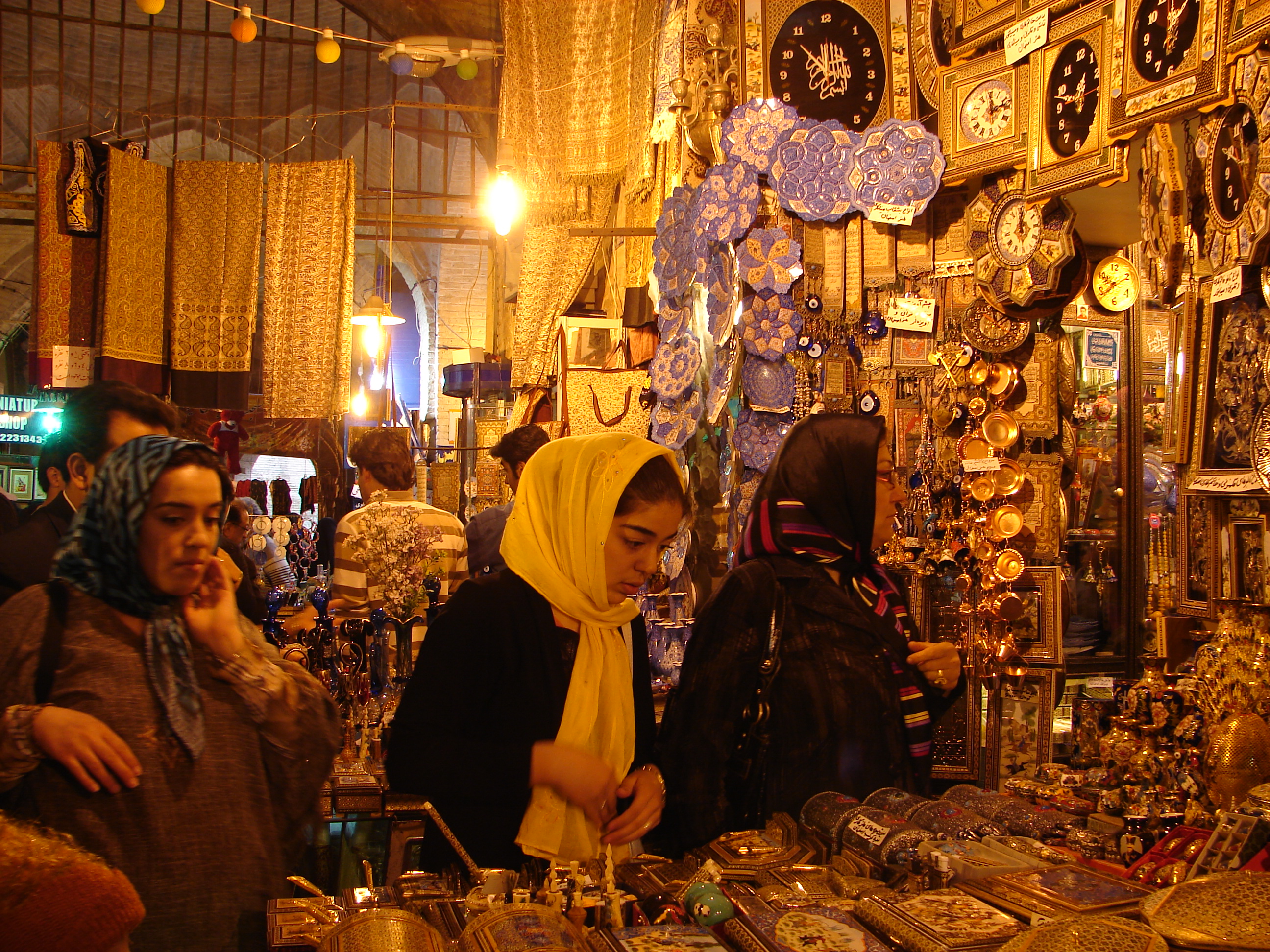
Grand Bazaar, Isfahan
Two kilometers of vaulted brick ceilings, and not a single break to the sky. The Grand Bazaar of Isfahan -- known locally as Bazar-e Bozorg -- holds the distinction of being the longest roofed market in the world, a claim that has less to do with superlatives and more to do with what happens beneath those arches. For nearly a thousand years, this corridor has channeled the sounds, smells, and negotiations of Persian commerce through a space where architecture and daily life have become inseparable.
A Corridor Between Eras
The bazaar functions as a literal bridge between Isfahan's two great periods. At its southern end stands Naqsh-e Jahan Square, the vast public plaza that Shah Abbas I commissioned in 1598 when he made Isfahan his capital. At its northern end lies Kohneh Square and the Jameh Mosque, one of Iran's oldest mosques, anchoring the Seljuk city that preceded the Safavids by centuries. Walk the bazaar's full length and you travel through time -- from the 17th-century imperial capital to the 11th-century trading hub where the market first took root. The current entrance gate, the Qeysarieh portal built in 1620, marks the threshold between these worlds with an ornamental archway that announces the shift from open square to enclosed labyrinth.
Under the Arches
Light enters the bazaar through small oculi cut into the vaulted ceilings, dropping circles of sunlight onto carpets, copperwork, and spice mounds below. The effect is cathedral-like. Isfahan's carpet merchants occupy some of the bazaar's most prominent arcades, selling rugs with over 600 knots per square inch -- roughly one knot per square millimeter. Miniature paintings on camel bone share shelf space with hand-printed Isfahan cloth, its elaborate designs pressed onto beige fabric using techniques passed down through generations. The bazaar is not a museum, though. Haggling remains the standard transaction, and tea appears as reliably as prices do. Vendors sit cross-legged in stalls that their families may have occupied for decades, the rhythm of commerce unchanged even as the goods evolve.
Destruction and Persistence
The site has been destroyed several times over its history. What stands today is largely a 17th-century reconstruction, though the bazaar's bones -- its layout, its relationship to the mosque and the squares -- preserve patterns laid down during the Seljuk period in the 11th century. This persistence is not accidental. In traditional Middle Eastern urban planning, the bazaar always grew near the mosque, and Isfahan's bazaar is no exception. Commerce and worship reinforced each other, the mosque providing the social anchor that drew foot traffic, the bazaar providing the economic engine that sustained the neighborhood. Destroying one without the other made little sense, so both were rebuilt together, again and again.
Longest, Not Largest
A common confusion worth clarifying: Isfahan's Grand Bazaar is the world's longest roofed market, measured by the unbroken length of its main corridor. The world's largest roofed market belongs to Tabriz, a UNESCO World Heritage Site covering over one square kilometer. Isfahan wins on linearity -- its two-kilometer spine draws you forward in a single direction, a journey with a beginning and an end. Tabriz wins on area, sprawling outward in a dense network of interconnected halls. Both are extraordinary. But Isfahan's bazaar offers something the Tabriz market does not: a walk that begins at one of history's great public squares and ends at one of Iran's oldest mosques, threading through centuries of unbroken trade.
From the Air
Located at 32.66N, 51.68E in central Isfahan, Iran. The bazaar runs north-south between the clearly visible Naqsh-e Jahan Square and the Jameh Mosque complex. Best viewed at 3,000-5,000 feet AGL. The nearest airport is Isfahan Shahid Beheshti International Airport (OIFM), approximately 20 km to the northeast. The bazaar's two-kilometer roofline is visible as a continuous built structure cutting through the dense urban fabric of old Isfahan. The Zagros mountain foothills rise to the west.