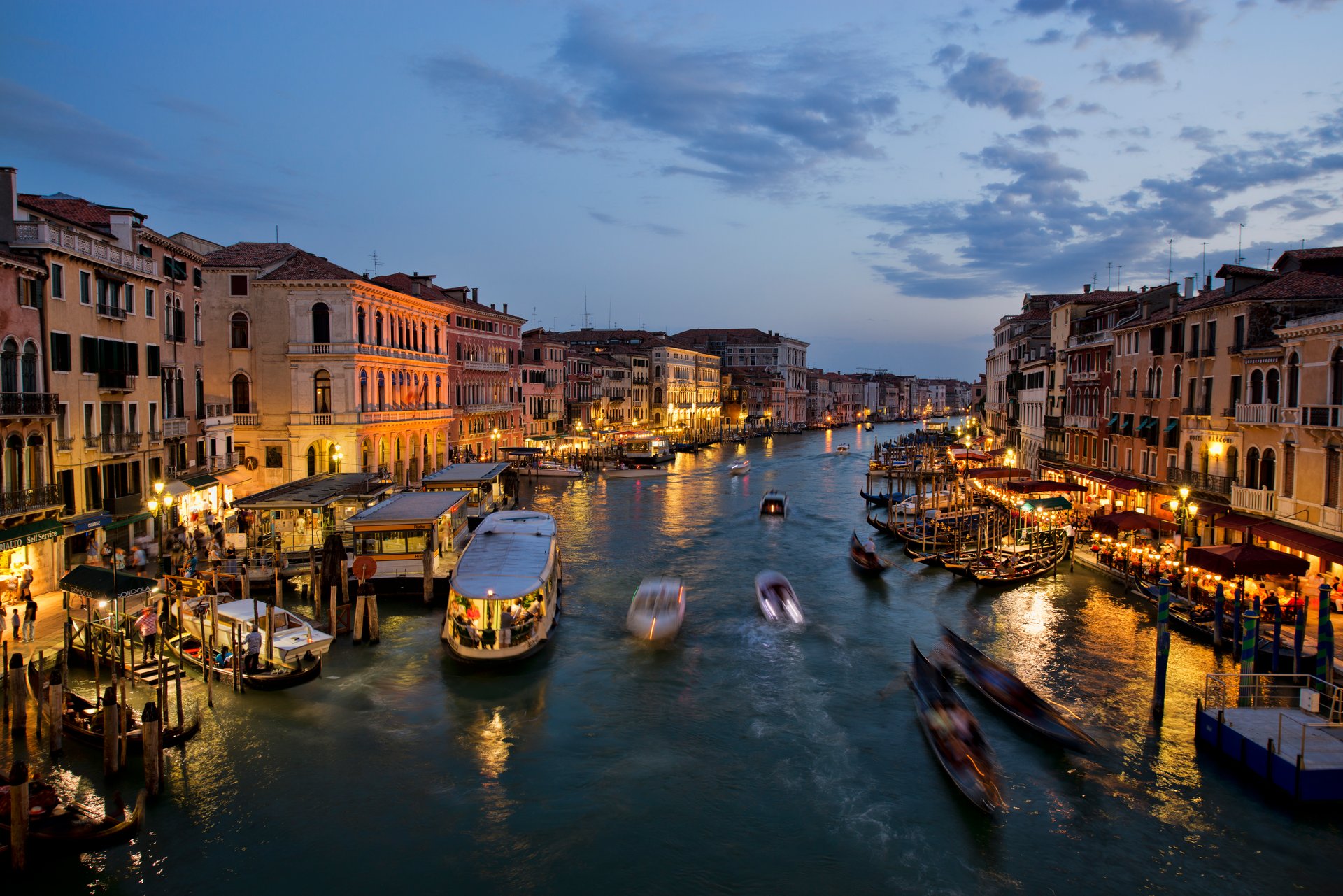
Grand Canal (Venice)
Four bridges cross the Grand Canal. For most of Venice's history, there was only one -- the Rialto. That single crossing tells you something about the canal's role: it was never meant to be crossed. It was meant to be traveled. The Grand Canal is 3.8 kilometers of water highway, carving a reverse-S through the six districts of Venice, and every palazzo lining its banks faces the canal like a merchant facing a customer. The facades are the point. Gothic tracery, Renaissance columns, Baroque flourishes -- each one a family's argument, rendered in Istrian stone and pink Verona marble, for why they mattered more than their neighbors.
An Ancient River's Ghost
The Grand Canal probably follows the course of a vanished river, likely a branch of the Brenta that once emptied into the lagoon. Before Venice existed, Adriatic Veneti lived along its banks in stilt houses, fishing and trading salt. When the doge moved his seat from Malamocco to the safer cluster of islands called Rivoaltus in the early ninth century, trade followed. The deep channel offered what the shallow lagoon could not: anchorage for seagoing vessels. Merchants built fondaco houses along the banks -- hybrid structures combining warehouse below with residence above, their facades divided into an airy central loggia flanked by solid walls. The Fondaco dei Turchi, dating to the thirteenth century, preserves the type, though it was heavily restored in the nineteenth. These buildings established the pattern: the canal as stage, the facade as performance.
A Parade of Palazzos
More than 170 buildings line the Grand Canal, most dating from the thirteenth to the eighteenth century. The Ca' d'Oro -- the Golden House, named for the gilding that once covered its facade -- exemplifies the Venetian Gothic style with its delicate tracery and open loggias. Ca' Foscari, now part of the university, served as the doge's residence for state occasions. Ca' Rezzonico houses a museum of eighteenth-century Venice, its ballroom ceiling painted by Tiepolo. The Palazzo Dario, with its Renaissance facade of colored marble roundels, carries a reputation for cursing its owners with financial ruin and violent death that has kept it unsold for decades. Each palazzo tells a family story: the Barbarigo who displayed Titian paintings in their windows, the Venier who kept a pet lion in their courtyard, the Guggenheim who filled an unfinished palazzo with modern art. The competition was relentless, and the canal was the arena.
Four Bridges, Four Centuries
The Rialto Bridge dominated the canal crossing for centuries. The current stone version, designed by Antonio da Ponte, was completed in 1591 after a competition that rejected proposals from Michelangelo and Palladio. Its single bold arch, lined with shops, remains the canal's most recognizable structure. Not until 1854 did Venice add a second crossing -- the Ponte dell'Accademia, originally built in iron, later replaced with a wooden bridge intended to be temporary. It is still there. The Ponte degli Scalzi, near the train station, arrived in 1934. The newest, Santiago Calatrava's controversial Ponte della Costituzione, opened in 2008 to connect the train station with Piazzale Roma, where the mainland road ends. Its modernist steel-and-glass design drew immediate criticism for clashing with Venice's historic fabric and for accessibility problems that required retrofitting.
Water Traffic and Ritual
The Grand Canal carries Venice's daily life. Vaporetti -- water buses -- run its length on schedules as fixed as any bus route, packed during commuter hours with workers heading to the Santa Lucia train station or the Piazzale Roma car park. Delivery barges supply restaurants and shops with everything from produce to furniture, navigating between water taxis and the gondolas that tourists hire at prices that would have startled the aristocrats who once rode them as everyday transport. On the first Sunday of September, the canal transforms for the Regata Storica, a boat race preceded by a costumed historical procession commemorating Catherine Cornaro's arrival in 1489 after abdicating as Queen of Cyprus. Gondoliers in period dress follow a replica of the Bucintoro, the doge's ceremonial galley. On November 21, a temporary pontoon bridge spans the canal so pilgrims can walk to Santa Maria della Salute, the massive baroque church built to thank the Virgin Mary for ending the plague epidemic of 1630-1631.
From the Air
The Grand Canal (45.442N, 12.326E) is the most visible feature of Venice from the air, its distinctive reverse-S curve unmistakable from altitude. It runs from the Santa Lucia train station in the northwest to the San Marco basin in the southeast. The Rialto Bridge, roughly at the canal's midpoint, is identifiable by its single arch. Venice Marco Polo Airport (LIPZ/VCE) lies 8 km north. The canal is best viewed from 1,500-4,000 feet, where its full S-curve and the palazzo-lined banks become clear against the surrounding rooftop maze.