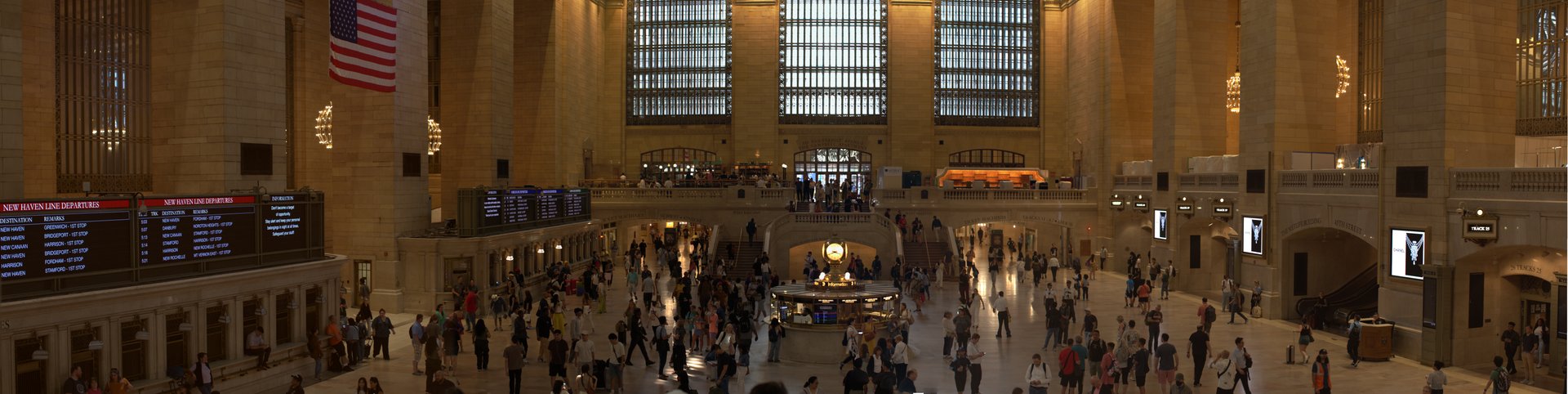
Grand Central Terminal
Every train at Grand Central Terminal departs one minute later than its posted schedule. The extra minute is intentional, designed to slow down passengers making last-second dashes for closing doors. It is a small, humane detail in a building that has always trafficked in grand gestures. When the terminal opened in 1913, workers had excavated 3.2 million cubic yards of earth at depths of up to ten stories. Over 10,000 laborers built it. The celestial ceiling of the Main Concourse, painted with 2,500 stars, was installed backwards -- a mirror image of the sky -- and nobody fixed it because the error had already been gilded. Grand Central is a building that does everything on an enormous scale, including its mistakes.
A Rivalry Carved in Stone
Grand Central Terminal exists because of a grudge. The New York Central Railroad needed a station that could compete with Pennsylvania Station, the majestic Beaux-Arts hub being built on Manhattan's west side for arch-rival Pennsylvania Railroad by McKim, Mead and White. New York Central hired Reed and Stem for the overall design and Warren and Wetmore for the exterior, creating the Beaux-Arts facade on 42nd Street that has become one of the most recognized buildings in the world. The project was an engineering marvel as much as an architectural one. Burying the tracks and platforms underground allowed the railroad to sell air rights above -- an innovation that created Terminal City, a commercial district of hotels, offices, and apartment buildings that transformed Midtown Manhattan. Passenger traffic on commuter lines more than doubled in the seven years following the terminal's completion, and by 1918, the railroad was already proposing an expansion.
The Fight to Save It
In 1947, over 65 million people passed through Grand Central, an all-time record. But by the late 1960s, the railroad was hemorrhaging money. New York Central merged with Pennsylvania Railroad in 1968 to form Penn Central, and the new corporation proposed what the old Pennsylvania Railroad had already done to the original Penn Station: tear Grand Central down and replace it with a skyscraper. The New York City Landmarks Preservation Commission, which had designated the terminal a landmark in 1967, refused to approve the demolition. Penn Central sued. The case traveled all the way to the Supreme Court of the United States, which ruled in 1978 in favor of the city in Penn Central Transportation Co. v. New York City -- a decision that became a cornerstone of American preservation law. Grand Central was saved, but the victory was bittersweet. Penn Central went bankrupt in 1970, and through the decade the terminal deteriorated into a grimy, advertisement-cluttered shell of itself.
Bare Bulbs and Red Caps
Grand Central's designers embedded innovations that were radical in 1913 and remain distinctive today. Ramps replaced staircases throughout the building, allowing passengers and luggage to flow smoothly between levels. At its opening, the terminal could theoretically accommodate 100 million passengers per year. All the light fixtures are bare bulbs -- at the time of construction, electric light was still novel enough that exposed bulbs served as a showcase of modernity. More than 500 red-capped porters once worked the platforms, handling luggage and providing information. A smaller team of twelve green-capped porters delivered telegrams, phone messages, and eventually packages. The terminal also housed its own fire department: the Metro-North Fire Brigade, which today handles 1,600 to 1,700 calls a year from a bay next to Track 14, using electric carts including an ambulance no wider than a hospital bed, a pumper carrying 200 gallons of water, and a rescue truck with forcible-entry tools.
The $113.8 Million Ceiling
In 1995, the Metropolitan Transportation Authority began a $113.8 million renovation of the terminal's interior. Decades of grime were stripped from the celestial ceiling, revealing the original teal and gold. A monumental curved staircase was added on the east side of the Main Concourse to match the existing West Stairs. The re-dedication ceremony on October 1, 1998, marked Grand Central's return as a functional showpiece rather than a fading relic. Subsequent years brought further investment. In September 2020, the skyscraper One Vanderbilt opened next to the terminal, along with a pedestrian plaza that permanently closed a section of Vanderbilt Avenue to cars. In January 2023, the $11.1 billion Grand Central Madison station opened beneath the terminal, connecting the Long Island Rail Road to the east side of Manhattan for the first time. LIRR trains now arrive on platforms more than 90 feet below the Metro-North tracks, in a project that had been under development since 2007.
Cathedral of Commuting
Grand Central Terminal is one of the ten most-visited tourist attractions in the world. Tourism is not new -- the 1900-1910 predecessor station was second only to the U.S. Capitol Building in visitor count. About 67 million riders enter and exit annually, making it the third-busiest train station in North America after Penn Station and Toronto Union Station. The terminal has served as a backdrop for literature, film, and television. J.D. Salinger set scenes from The Catcher in the Rye here. Nuclear physicist Leo Szilard wrote a short story about it in 1948. Almost every scene filmed in the train shed is shot on Track 34, one of the few platforms without columns blocking the camera's view. The lease on the building, renegotiated in 2006, runs until 2274 -- a quarter-millennium bet that Grand Central will still be worth operating. Given that the terminal survived demolition, bankruptcy, grime, and a Croatian nationalist bomb in 1976, the bet seems reasonable.
From the Air
Coordinates: 40.7528°N, 73.9772°W. Located at 42nd Street and Park Avenue in Midtown Manhattan. The Beaux-Arts facade faces south on 42nd Street. Visible from altitude as part of the Midtown Manhattan skyline, with the MetLife Building directly to the north and One Vanderbilt to the west. Nearest airports: KLGA (LaGuardia, 11 km NE), KJFK (JFK International, 24 km SE), KEWR (Newark Liberty, 17 km W). Best viewed at 2,000-4,000 ft AGL approaching Midtown from the south over the East River.