Grand Concourse (Bronx)
Louis Aloys Risse dreamed big. An immigrant from Lorraine, France, the civil engineer looked at the rough terrain of the Bronx in 1890 and envisioned a grand boulevard that would rival the Champs-Elysees -- not in Paris, but in the northernmost borough of New York City. Construction began in 1894, and when the Grand Concourse opened to traffic in November 1909, it measured 180 feet across and stretched four miles north from Bronx Borough Hall, divided into three roadways by tree-lined medians. The $14 million project was built during the height of the City Beautiful movement, and for decades it delivered on every ounce of that ambition.
The Park Avenue of the Bronx
The opening of the Independent Subway System's Concourse Line in 1933 transformed the boulevard from an impressive road into a destination. By the mid-1930s, nearly three hundred apartment buildings had risen along the Concourse, their lobbies gleaming with Art Deco and Art Moderne details that rank among the finest examples of those styles anywhere in the United States. Five- and six-story buildings with wide entrance courtyards lined the boulevard, offering middle-class families something Manhattan could not: modern apartments with private bathrooms, central heating, and a sense of arriving. In 1934, almost 99 percent of Bronx residences had private bathrooms -- a higher rate than any other borough. The 1939 WPA Guide to New York City called the Concourse "the Park Avenue of middle-class Bronx residents," and noted that signing a lease there was "considered evidence of at least moderate business success."
A Boulevard Burns
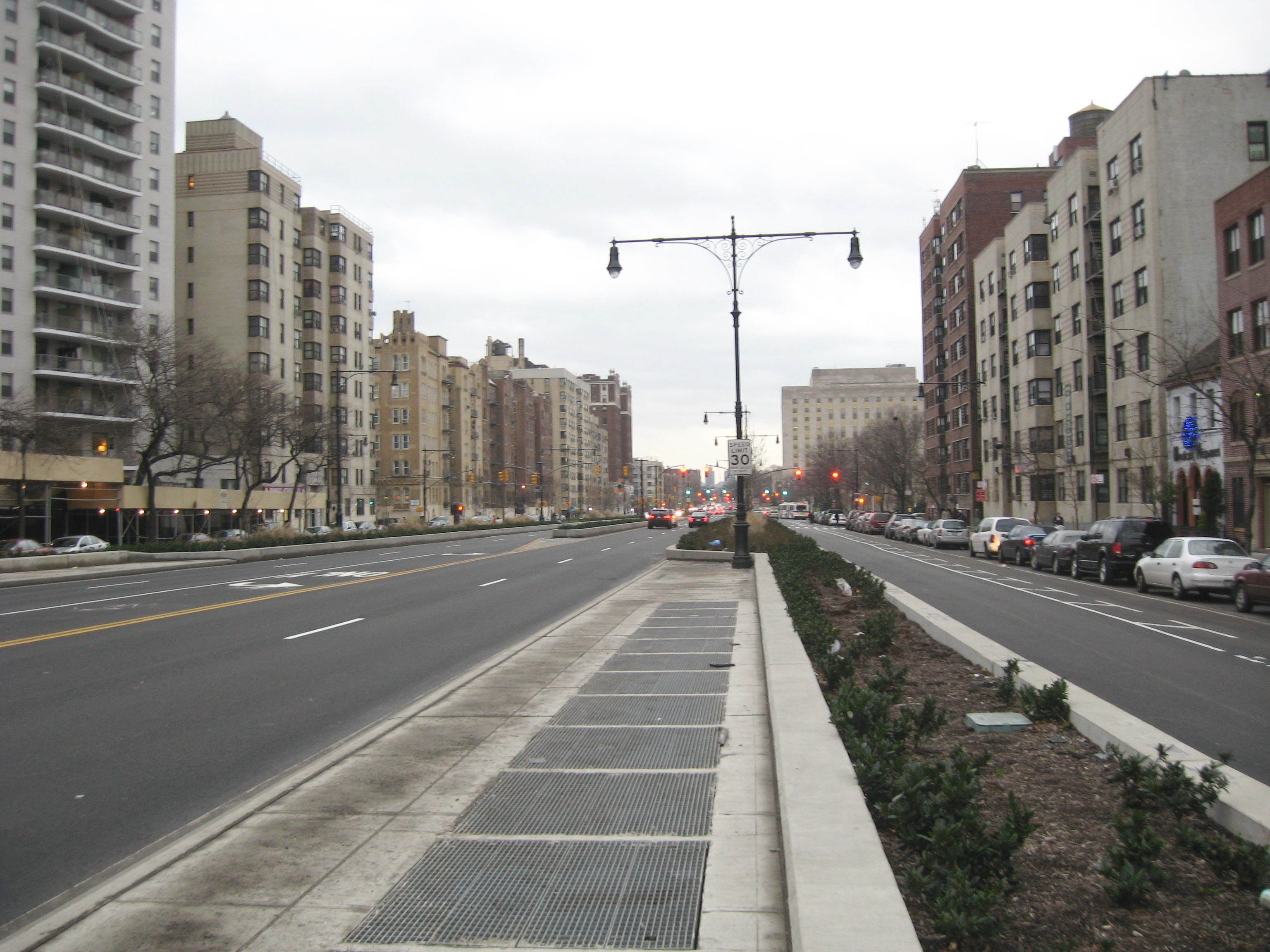
The unraveling began in the 1960s. Disinvestment, redlining, and urban renewal policies destabilized the South Bronx. White flight drained the Concourse of its middle-class residents, accelerated by the construction of the Interstate Highway System that made suburban living newly accessible. African American and Puerto Rican families moved in for blue-collar jobs that were themselves migrating to the suburbs, the South, and overseas. Landlords stopped maintaining buildings. Arson and vandalism gutted entire blocks. The city stripped the boulevard itself of its elegance: the Parks Department ripped out the grass medians and replaced them with cement painted green, a grim simulacrum of what had been. Traffic lights were timed to give drivers a "green wave" through intersection after intersection, turning a pedestrian promenade into what the New York Times called "a driver's paradise." By 1991, twelve pedestrians died on the Concourse in a single year, rivaling Queens Boulevard's reputation as the "Boulevard of Death."
Landmarks in Stone
Even during the worst years, the Concourse's architecture survived. The Bronx General Post Office at 558 Grand Concourse, built in 1937, preserves New Deal-era frescoes by Ben Shahn and Bernarda Bryson Shahn inside its lobby. The Bronx County Courthouse at 851, designed by Joseph Freelander and Max Hausle, has anchored the boulevard since 1934. Loew's Paradise Theater at 2403, built in 1929 and designated a New York City Landmark, once offered moviegoers an atmospheric experience meant to evoke an Italian garden. At the far northern end, Poe Cottage -- the last home of Edgar Allan Poe, built in 1812 -- sits on the Concourse as a reminder that the borough's literary history predates the boulevard by nearly a century. In 2011, the Landmarks Preservation Commission designated the stretch from 153rd to 167th Streets as the Grand Concourse Historic District.
Restoration and Renewal
Recovery came slowly, building by building. During the 1980s, landlords began rehabilitating their properties. The Bronx Museum of the Arts relocated to a former synagogue at 167th Street in 1982, planting a cultural anchor in a neighborhood that needed one. A demonstration project by the Department of Transportation rebuilt the section between 161st and 167th Streets starting in 1999, proving that the boulevard could be reimagined for pedestrians. Subsequent phases extended the reconstruction northward, restoring tree-lined medians and wider sidewalks. The New York Times reported residents who believed the renewal would bring "community-oriented" working-class people rather than the wealthier gentrifiers transforming other neighborhoods -- though high-rises with doormen, gyms, and rooftop terraces on the lower Concourse suggest that prediction may not hold everywhere. Risse's boulevard endures, its Art Deco facades now cleaned and landmarked, its story a compressed version of everything the Bronx survived and is still becoming.
From the Air
Located at 40.831N, 73.921W in the Bronx. The Grand Concourse is clearly visible from the air as a wide north-south boulevard running from Mott Haven to Van Cortlandt Park. From altitude, note the distinctive width compared to surrounding streets. Nearby airports include LaGuardia (KLGA) to the east and Teterboro (KTEB) to the northwest. Best viewed at 2,000-4,000 feet AGL. Yankee Stadium at 161st Street serves as a useful visual reference at the southern end.