Grand Duchy of Finland
Finland became a nation by accident of diplomacy. In 1807, Napoleon and Tsar Alexander I met at Tilsit and carved up spheres of influence across Europe. Sweden, which had ruled Finland for six centuries, backed the wrong side. Russia invaded in 1808, and by 1809 the war was over. But instead of absorbing Finland into the Russian administrative machine, Alexander did something unexpected: he granted the conquered territory its own laws, its own senate, its own customs system, and its own taxes. The Grand Duchy of Finland was born, an autonomous state within the Russian Empire, and it would spend the next 108 years quietly building the institutions of a country that did not yet know it would one day be independent.
The Oath at Porvoo
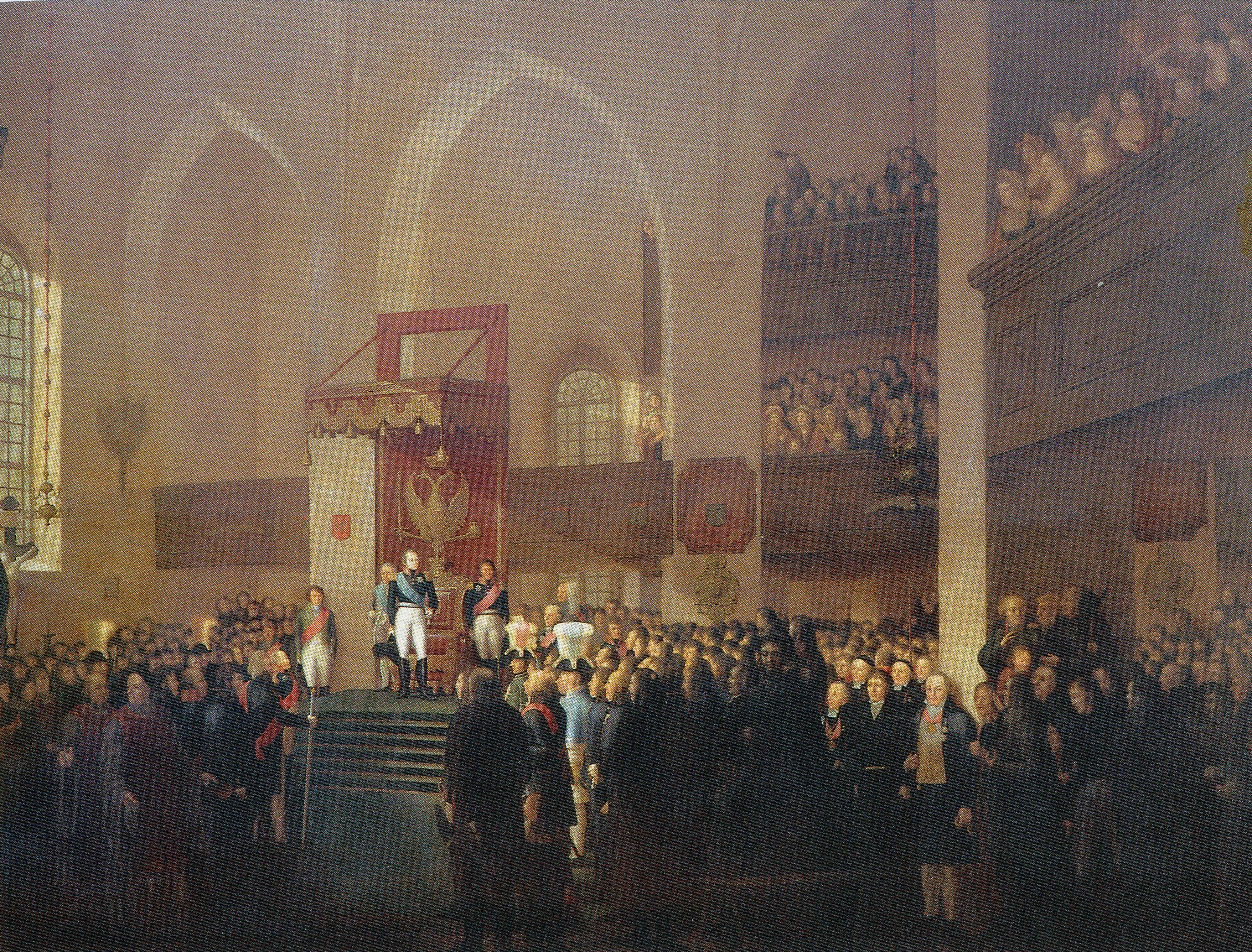
On March 29, 1809, the four Estates of occupied Finland assembled at the Diet of Porvoo to pledge allegiance to their new sovereign. Alexander I stood before them and made a promise: Finnish laws, liberties, and religion would remain unchanged. It was a remarkable bargain. Finland kept its Swedish-era legal system, its Lutheran church, and its local governance. Taxes collected in Finland stayed in Finland. Finns were exempt from conscription into the Russian army. The tsar replaced the Swedish king as sovereign, but the machinery of daily life continued largely as before. A Governor-General represented imperial authority in Helsinki, while the Finnish Senate, established the same year, became the country's primary governing body.
A Nation Finds Its Voice
Under Russian protection, paradoxically, Finnish culture flourished. The capital moved from Turku to Helsinki in 1812, and Alexander I commissioned the architect Carl Ludvig Engel to redesign the city center in neoclassical style. Johan Vilhelm Snellman and the Fennoman movement championed the Finnish language, which had long been subordinate to Swedish among the educated classes. In 1863, Alexander II opened the Diet of Finland in a speech that signaled a new era of reform. Finnish gained equal legal status with Swedish. The economy industrialized. Population grew from 863,000 in 1810 to nearly three million by 1910. The autonomy that had begun as a political convenience was becoming the foundation of a national identity.
The Tightening Grip
The relationship between Finland and Russia began to curdle in the 1890s. Nikolai Bobrikov arrived as Governor-General in 1898 with orders to bring Finland into closer alignment with the empire. The February Manifesto of 1899 asserted Russian authority over Finnish legislation. Finnish conscripts were to serve in Russian units. The Russian language was imposed in government offices. Finns resisted through what became known as passive resistance: petitions, civil disobedience, and quiet obstruction. In 1904, a Finnish nationalist assassinated Bobrikov on the steps of the Senate building in Helsinki. The Russification policies ebbed and flowed over the following years, but the trust that Alexander I had established at Porvoo was broken.
From Duchy to Republic
When revolution swept Russia in 1917, Finland saw its chance. The Grand Duchy's institutions, preserved and strengthened across a century of autonomy, provided the scaffolding for an independent state. On December 6, 1917, the Finnish Parliament declared independence. What followed was not smooth: a brutal civil war in 1918 tore the young nation apart before it could settle into the democracy it would become. But the foundation had been laid during those 108 years as a grand duchy. The senate, the legal system, the customs service, the schools, the sense of being Finnish rather than Swedish or Russian, all of it had grown in the peculiar greenhouse of imperial autonomy. Alexander I could not have known that his promise at Porvoo was planting the seeds of a sovereign nation.
From the Air
Located at 64.00°N, 26.00°E in central Finland. The Grand Duchy encompassed all of modern Finland. Key historical sites include Helsinki (EFHK), where the Senate Square and neoclassical center designed by Engel remain; Porvoo (approximately 50 km east of Helsinki), site of the 1809 Diet; and Turku (EFTU), the former capital. From altitude, the vast lake district and boreal forests that characterize Finland's interior are clearly visible. Recommended viewing altitude: 10,000-20,000 ft for regional perspective.