Grand Duchy of Oldenburg
How does a small north German state with three widely scattered territories and one vote in the Bundesrat end up supplying monarchs to half of Europe? The Grand Duchy of Oldenburg existed for just over a century, from 1815 to 1918, ranking a humble tenth among the German states. But its ruling family had been quietly placing relatives on foreign thrones for generations. By the late nineteenth century, members of the House of Oldenburg sat on the thrones of Denmark, Norway, Sweden, Greece and Russia. And through a Greek prince named Philip who married a young English princess named Elizabeth in 1947, the Oldenburg bloodline reached as far as the throne of the United Kingdom.
Born at the Congress of Vienna
When the Congress of Vienna sat down in 1815 to rebuild Europe after Napoleon, the old Duchy of Oldenburg was restored and merged with the Principality of Birkenfeld, a small territory in the southwest. The combined state was elevated to a grand duchy, ranking it among the second-tier members of the new German Confederation. The territories were geographically absurd: the core around Oldenburg city, plus Eutin on the Baltic coast and Birkenfeld in the Rhineland, three separate pieces of Germany with one ruling family in common. Curiously, the first two grand dukes refused to use their grand-ducal title in practice, continuing to style themselves merely as dukes, and it was not until 1829 that the newly acceded Augustus actually called himself grand duke. The state ran on enlightened despotism in the older style, with no privileged nobility, an independent peasantry, and important towns balancing the ruler's power.
The Reluctant Constitution
The Revolutions of 1848 did not catch fire in Oldenburg the way they did elsewhere, but the message was clear. In 1849 Grand Duke Augustus granted a constitution of unusually liberal character, modified slightly in 1852 but still among the most progressive in the German Confederation. The administrative system was overhauled in 1855 and 1868. Government oversight of church affairs was established in 1863. In the same year, Grand Duke Peter II, who had succeeded his father in 1853, briefly entertained a family claim to the vacant duchies of Schleswig and Holstein, but in 1867 he abandoned it in favor of the Kingdom of Prussia in exchange for slight compensation. The next year, having sided with Prussia against Austria in the Seven Weeks War of 1866, he joined the new North German Confederation. In 1871 his grand duchy became a constituent state of the German Empire under Wilhelm I.
Rulers of Half a Continent
The Oldenburg dynastic project had begun centuries earlier, when Count Christian became King Christian I of Denmark in 1448, founding a royal line that held the Danish throne continuously to 1863 and is still tied to the current Danish monarchy through the Glucksburg branch. From the Danish line came kings of Norway and, briefly, of Sweden. From the Holstein-Gottorp branch came Tsar Peter III of Russia in 1762, founding the Romanov-Holstein-Gottorp line that would rule until Nicholas II abdicated in 1917. When Europe needed a king for newly independent Greece in 1863, the powers chose Prince William of Denmark, a Glucksburg, who became King George I of the Hellenes. His grandson Prince Andrew of Greece and Denmark fathered Prince Philip, who in 1947 married the future Queen Elizabeth II, bringing the Oldenburg bloodline into the British royal family. The current British monarch is, in strict patrilineal terms, a member of the House of Oldenburg.
Three Pieces of Empire
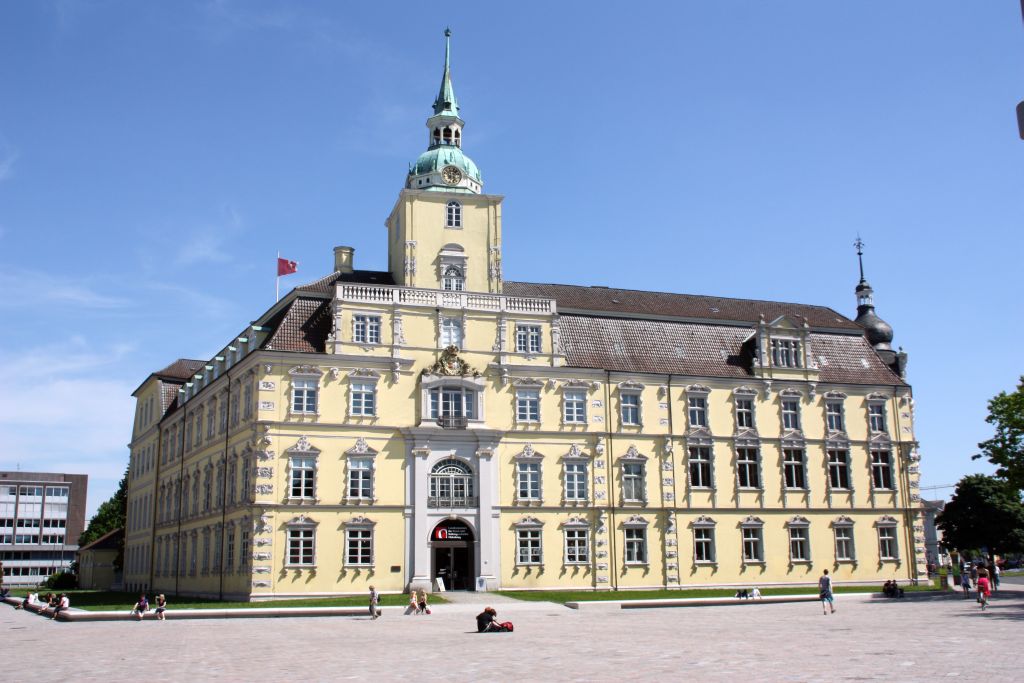
On the map the Grand Duchy looked improbable. The core territory around Oldenburg city was prosperous flat marshland and farmland between the Weser and the Ems. Eutin sat far to the northeast near the Baltic, a princely retreat surrounded by lakes. Birkenfeld lay isolated in the southwestern hills near the Saar. The three pieces of the state never shared borders. Each had its own administrative quirks. Each carried different religious and cultural traditions. The Grand Duke ruled them all from a Renaissance castle in Oldenburg city that his ancestor Anton Gunther had built back in 1607, anchoring a town that had grown into a substantial regional center of around fifty thousand by the late nineteenth century.
The Last Grand Duke
In November 1918, as the German Empire collapsed in the wake of military defeat, every ruling prince in Germany abdicated within days of each other. The last Grand Duke of Oldenburg was Frederick Augustus II, who stepped down on 11 November, the same day the armistice was signed in a railway carriage in the forest at Compiegne. Oldenburg became the Free State of Oldenburg within the new Weimar Republic. The grand-ducal court that had quietly provided spouses and rulers for half the courts of Europe simply ceased to exist. Frederick Augustus retreated into private life. The next year he crossed into the Netherlands, taking with him a third of the Oldenburg Grand Ducal Picture Gallery including paintings by Rembrandt. The royal house that had reached as far as Buckingham Palace and the Winter Palace ended in a small Lower Saxon city that today most travelers cannot find on a map without help.
From the Air
Capital city of Oldenburg at 53.14 N, 8.21 E. The historic grand duchy comprised three non-contiguous territories: the main Oldenburg land in Lower Saxony, Eutin near the Baltic, and Birkenfeld in the southwest near the Saar. Recommended viewing altitude 4,000-10,000 feet over the main territory. Nearest commercial airport is Bremen Airport (EDDW) about 25 nautical miles east-southeast. The historic Schloss Oldenburg, Renaissance castle of 1607, remains a visible landmark in the city center on clear days.