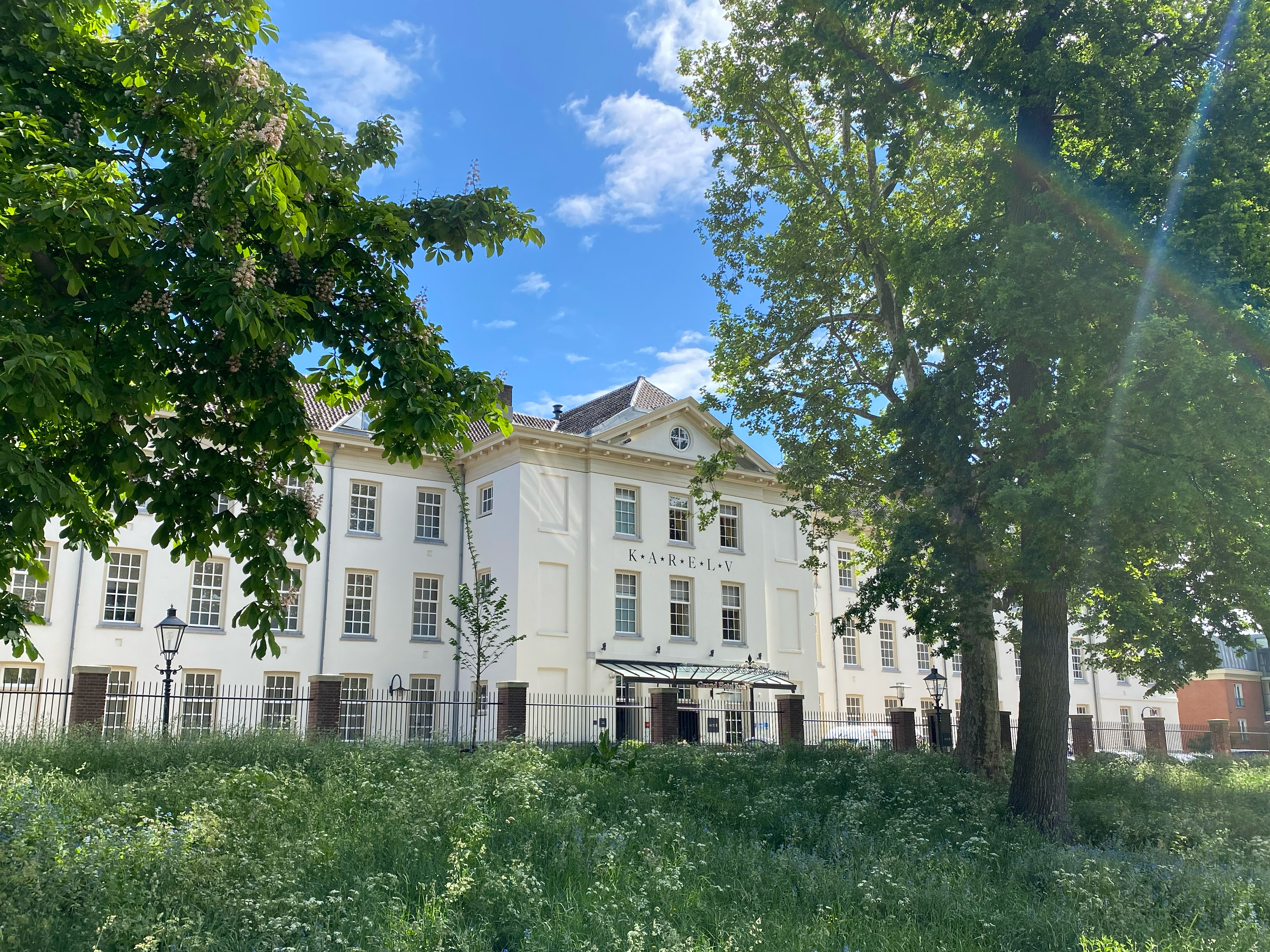
Grand Hotel Karel V
In 1992, an army of plasterers and stonemasons walked into a vacant military hospital in central Utrecht and began undoing two centuries of medical use. The old wards had to become bedrooms again. The chapter room of a fourteenth-century monastery, which had survived the wards as a kind of architectural fossil, had to become a restaurant. And somewhere in the garden, under a paving stone scheduled for replacement, the workers were going to dig down and find the bones of Roman soldiers. The Grand Hotel Karel V, which opened in 1999, occupies a complex of buildings so layered in history that the staff describe directions by century: ground floor, fourteenth century, that way to the Napoleonic wing.
Layers Underground
The site begins with the Romans. When workers excavated the garden wing in 2007, they uncovered a Roman cemetery dating from between 40 BC and 275 AD, almost certainly tied to Traiectum, the Roman fort that gave Utrecht its name. The discovery gave the new wing its name as well. The architects, Heine and van de Rijt with Hylkema Consultants, redesigned the extension as a contemporary pavilion - clean lines and modern materials in pointed contrast to the older buildings - and renamed it the Roman Wing. Its formal opening in November 2008 featured marching Roman soldiers in costume, which was either a charming flourish or a slight overreach depending on how seriously you take such things. Inside, glass cases display objects pulled from the cemetery soil. The wellness center in the basement leans into the theme with a sauna, steam room, and pool styled as Roman baths.
A Monastery and an Emperor
On top of the Roman layer, in 1348, the Teutonic Knights built the Duitse Huis. The bailiwick used the complex as a working monastery for centuries before Charles V - the namesake of the modern hotel - visited Utrecht in 1545. He stayed at the Duitse Huis, which had partially converted to hospital use by then, while the chapter of the Order of the Golden Fleece met in the refectory. A fireplace in that room was carved with the double-headed eagle of his empire. When renovators broke into the walls of the old refectory in the 1990s, they found fragments of that sandstone fireplace. A new one was built in the same spot, decorated with the coat of arms and motto of Charles V - a deliberate echo, set into the dining room of what is now Bistro Karel 5.
Napoleon's Hospital
The next layer is medical and Napoleonic. In 1807, Louis Bonaparte - Napoleon's brother and briefly king of Holland - bought the property and announced plans to turn it into a military hospital. The Teutonic Order moved out. After Napoleon's fall, William I of the Netherlands kept the medical use and built a new hospital along the Geertebolwerk, completed in 1823 and very advanced for its time. The building remained a military hospital for the next 167 years. Generations of Dutch soldiers passed through its wards: the wounded of the wars in the East Indies, the sick of the long peace, the casualties of the 1940s. The hospital finally moved to a new site in the Uithof in 1990, leaving the complex empty and, briefly, occupied by squatters.
Wards Become Suites
When the Bailiwick of Utrecht repurchased the property in the late 1980s - exercising an option that dated back to an agreement made in 1808 - the question was what to do with all of it. The order itself only needed a fraction of the buildings for its modern role as a charity. The rest had to find a use. The decision to convert the hospital into a hotel was practical, but the execution was painstaking. The hospital's high-ceilinged wards were partitioned into rooms and suites, but the old fabric was preserved wherever the building inspectors allowed. The hotel that emerged in 1999 has 121 rooms across three wings: Medieval in the center, Napoleonic to the west, Roman to the south. At its formal opening ceremony on 10 September 2000, attended by the mayor of Utrecht and a representative of the queen, the Karel V received its fifth star, the first five-star rating in the Utrecht region.
Lost Stars and Conference Rooms
The restaurant story is more turbulent. Bistro Karel 5 occupies the former convent kitchen, with a terrace open in good weather. The dining areas extend into the medieval chapter room and refectory of the old monastery, which means guests eat under fourteenth-century beams. Restaurant Karel 5, the more formal sibling, earned a Michelin star in 2005 and held it through 2013, when a change in chefs cost it the recognition. Gault Millau still rated the kitchen at 14 points in mid-2014. The auditorium seats 114, the wellness center in the Roman basement keeps the bath theme going, and the conference facilities have an unobtrusive sound system - the kind of detail you only notice when it is missing. Outside, the gardens that survived the military centuries and the Roman cemetery are still there, walking distance from the Dom and the rest of the medieval city, an unusual amount of green for an address this close to Utrecht's center.
From the Air
Located at 52.09 degrees N, 5.12 degrees E, in the historic core of Utrecht just inside the medieval city wall along the Geertebolwerk. From altitude, look for the green pocket of the hotel's gardens within the dense red-tiled fabric of the old city, a few hundred meters southwest of the Dom Tower. Best viewing altitude 2,000 to 3,000 feet. Nearest airports: Schiphol (EHAM) about 35 km northwest, Rotterdam The Hague (EHRD) about 50 km southwest, Hilversum (EHHV) about 20 km north.