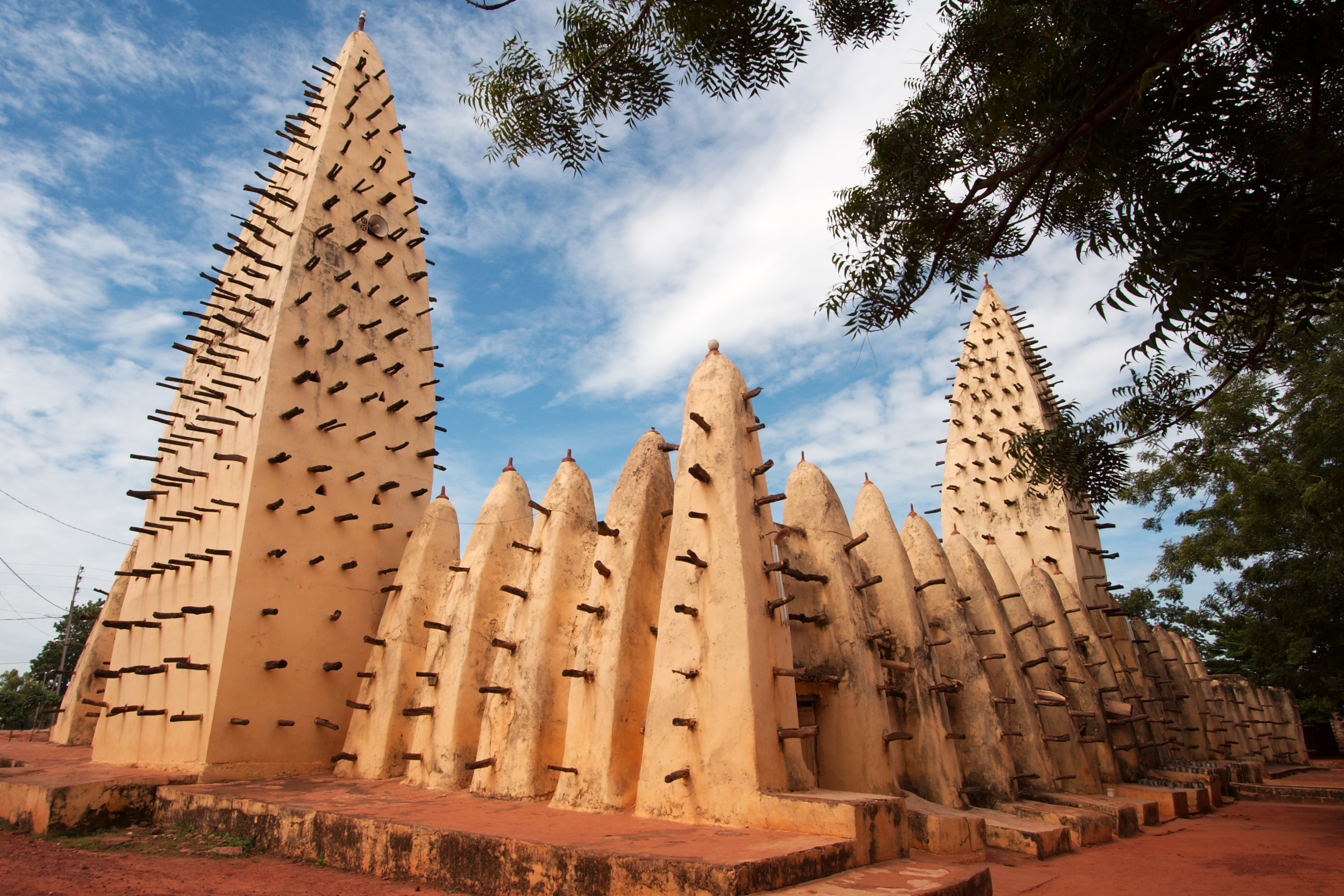
Grand Mosque of Bobo-Dioulasso
The deal was straightforward: military help in exchange for a mosque. At the end of the 18th century, the Kingdom of Sia faced annihilation. Tieba Traore, king of the rival Kenedougou Kingdom, had mobilized his forces and was marching toward the capital. Desperate, the King of Sia turned to Almamy Sidiki Sanou, a local Islamic religious leader whose influence extended beyond prayer. Sanou agreed to help, but he had a condition. Build me a mosque, he said. The Kenedougou army was stopped roughly 30 kilometers from the capital. The mosque followed, rising from the red earth of what would become Burkina Faso's second-largest city.
Twenty Years of Mud and Patience
Construction began in 1812 and was not completed until 1832. Twenty years is a long time to build a mosque, but this was not a project of stone and mortar. The Grand Mosque was raised from banco, a mixture of mud brick, earth, and water that forms the basis of Sudano-Sahelian architecture across the Sahel. Wooden beams called toron project from the exterior walls, serving a purpose that is both practical and beautiful: they function as permanent scaffolding for the annual replastering that these earthen buildings require, while giving the facade its distinctive bristled texture. Two conical minarets rise above the roofline, echoing the forms of the Great Mosque of Djenne in neighboring Mali, the most famous expression of this architectural tradition. Over nearly two centuries, the mosque has been expanded and renovated repeatedly, including the addition of a tin roof over part of the courtyard in 1983.
Where the Bobo Speak Dioula
Bobo-Dioulasso's name translates roughly as "home of the Bobo people who speak Dioula," a linguistic fingerprint of the city's layered identity. Founded as Sia in the 15th century, the settlement grew along trade routes connecting the gold-rich forests to the south with the trans-Saharan networks stretching north through Mali. Dioula-speaking merchants brought Islam and commercial sophistication. The Bobo people contributed deep roots and agricultural knowledge. The Grand Mosque sits at the intersection of these traditions, a physical monument to the cultural negotiation that built the city. Today Bobo-Dioulasso is Burkina Faso's second-largest city and widely considered its cultural capital, hosting the National Culture Week festival every two years since 1983.
Architecture That Breathes
The prayer hall tells the mosque's story in two chapters. The older eastern section contains seven transverse aisles, its thick walls keeping the interior cool even during the hottest months. The newer western extension adds two more aisles, broadening the space for a growing congregation. Light enters through small openings in the banco walls, creating a dim, meditative atmosphere. The wooden beams embedded in the walls are not merely decorative. In Sudano-Sahelian architecture, buildings are understood as living structures that require constant care. Each rainy season tests the plaster, each dry season bakes cracks into the surface. The toron beams allow workers to climb the walls and apply fresh coats of mud and shea butter, a communal maintenance ritual that renews both the building and the social bonds of the community tending it.
Still Standing in the Sahel
Burkina Faso has endured political upheaval, droughts, and security crises in recent decades, yet the Grand Mosque remains a functioning house of worship and a point of civic pride. The site of the historic Kingdom of Sia, including the mosque, has been placed on UNESCO's Tentative List for World Heritage consideration. Unlike preserved monuments frozen behind velvet ropes, this mosque is maintained the way it was built: by hand, with local materials, by people who gather to pray inside it. The annual replastering is not heritage conservation in the bureaucratic sense but a living practice, passed from one generation of builders to the next. The wooden poles protruding from the walls are not artifacts. They are tools, waiting for the next pair of hands.
From the Air
Located at 11.18°N, 4.30°W in Bobo-Dioulasso, Burkina Faso's second-largest city. The mosque is in the city center and best identified by its two prominent conical minarets rising above the surrounding low-rise buildings. Bobo-Dioulasso Airport (ICAO: DFOO) is approximately 8 km to the northeast. Best viewed at 3,000-5,000 feet where the mud-brick structure contrasts with the surrounding urban fabric. The dry Sahelian landscape makes the city's green spaces and the mosque's distinctive silhouette more visible.