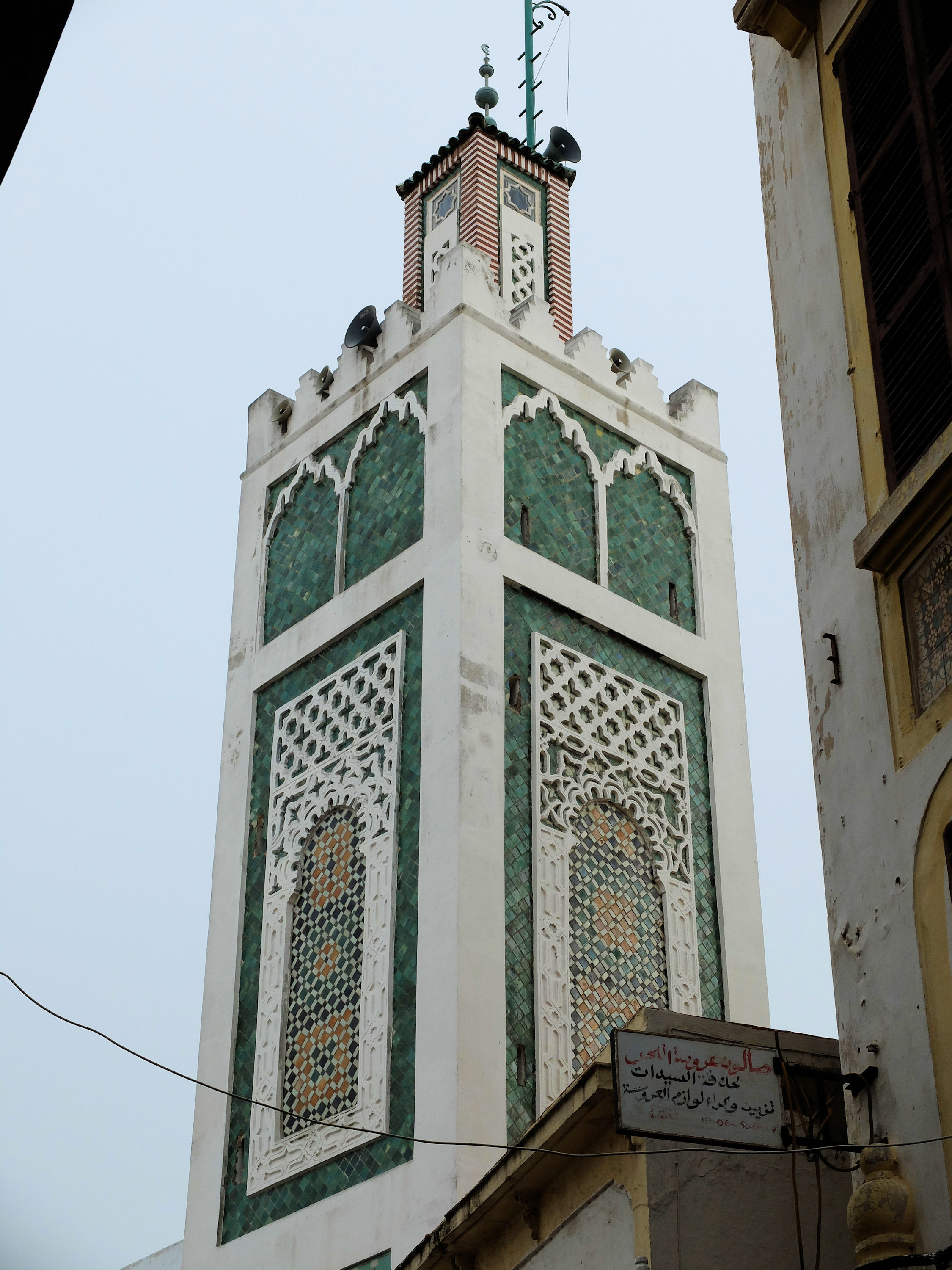
Grand Mosque of Tangier
Dig down through the layers of the Grand Mosque of Tangier and you hit Hercules. The site is believed to have originally held a Roman temple dedicated to the mythological hero, followed by a 5th-century Christian church, then a Marinid-era mosque, then a Portuguese cathedral after the conquest of 1471, and finally the current mosque, rebuilt in the early 19th century under the Alaouite dynasty. Each faith claimed the same ground, each demolished or repurposed what came before. The site itself has never been anything but sacred.
From Temple to Cathedral to Mosque
The sequence of buildings on this site mirrors the sequence of powers that have controlled Tangier. Roman Tingis had its temples; the late Roman and Byzantine periods left a church. When Islam arrived in North Africa, a grand mosque was established here during the Marinid dynasty in the 13th to 15th centuries. Then came the Portuguese, who besieged Tangier repeatedly throughout the 15th century before finally conquering it in 1471. They immediately converted the mosque into a cathedral, replacing the crescent with the cross. When Morocco eventually recovered the city, the site returned to Islamic worship. The current building dates from the reign of Sultan Moulay Slimane in the early 19th century, with a restoration ordered by Mohammed VI in 2001.
Green Tiles and Geometric Light
The mosque's minaret is typical of Alaouite-era design, inheriting the traditional square-shaft form of Moroccan minaret architecture. A large square tower rises from the mosque's western corner, crowned by merlons and topped by a smaller secondary shaft. Its facades carry geometric motifs and blind arches outlined in white stucco, with the spaces between filled with green tiles and multicolored tile mosaics. The entrance portal, much of which still dates from Moulay Slimane's time, is decorated with radiating geometric patterns in green and topped with a wooden canopy. The effect from street level is of a building that announces its presence through pattern and color rather than sheer height, drawing the eye upward through layers of geometric complexity.
A Courtyard of Arches
Inside, the mosque follows the traditional Moroccan plan: a square courtyard with a central fountain, surrounded by indoor galleries and the main prayer hall. The galleries and prayer hall are hypostyle spaces marked by rows of arches -- two aisles deep on the southwest and northeast sides, one row deep on the entrance side. The main prayer hall extends three aisles from the courtyard toward the qibla wall and the mihrab, the niche that indicates the direction of Mecca. Behind the mihrab, rooms historically used as a library, an imam's chamber, and a funeral mosque are accessed from within the building. A 1962 extension reaches toward the southwest, adding modern space to the historic core. The architecture is modest compared to the great mosques of Fez or Marrakesh, but its layered history gives it a gravity that transcends its physical scale.
Sacred Ground at the Crossroads
Tangier has always been a city at the crossroads -- of continents, of religions, of empires. The Grand Mosque embodies that condition more completely than any other building in the city. It sits in the old medina, surrounded by the dense fabric of streets that has changed remarkably little since medieval times, while the Strait of Gibraltar gleams just to the north, Europe visible on clear days as a faint line on the horizon. That a single site should have served Roman paganism, Christianity, and Islam across nearly two millennia is not unusual in the Mediterranean world, but it is concentrated here with particular intensity. The ground itself seems to insist on worship, regardless of the form that worship takes.
From the Air
Coordinates: 35.766N, 5.824W. The Grand Mosque sits in Tangier's old medina, identifiable by its minaret rising above the dense historic quarter. The medina is near the port on the southern shore of the Strait of Gibraltar. Nearest airport: GMTT (Tangier Ibn Battouta, 15 km southwest). The Strait of Gibraltar and the Spanish coast are visible to the north. Cape Malabata lies to the east.