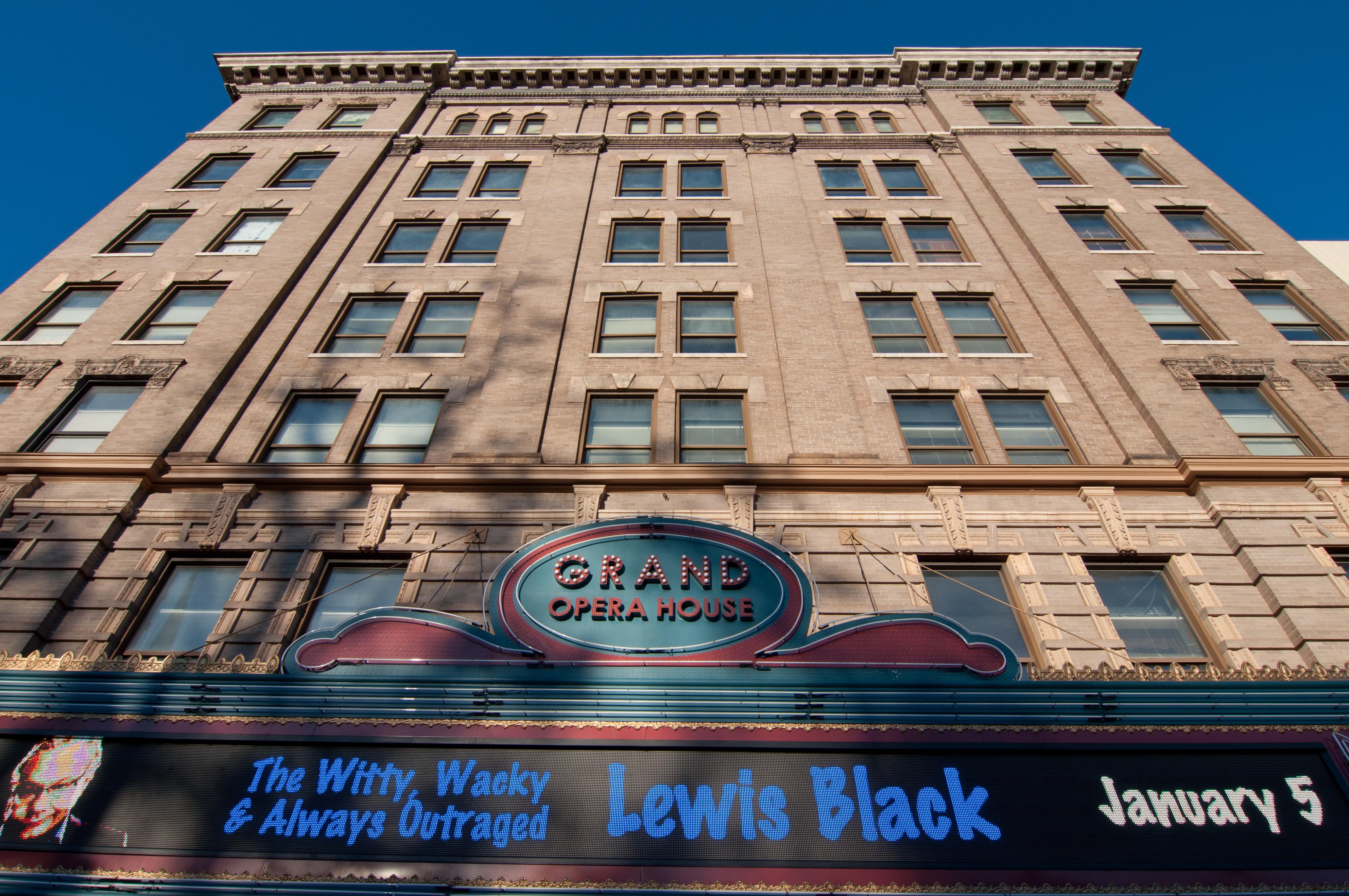
Grand Opera House
Somewhere beneath the stage of Macon's Grand Opera House, a trap door still drops open on cue. Harry Houdini cut nine of them into the floorboards during his engagements here, and at least one remains operational, pressed into service each year during performances of The Nutcracker. It is a fitting ghost for a building that has spent 140 years refusing to disappear. Originally called the Academy of Music when it opened in 1884, the Grand boasted the largest stage in the southeastern United States and 2,418 seats, enough to hold nearly one-fifth of Macon's entire population at the time.
A Theatre for a Fifth of the City
The Academy of Music arrived in Macon during the Gilded Age, when Southern cities competed fiercely to prove their cultural credentials. The sheer scale of the building made a statement: 2,418 seats in a city of roughly 13,000 people. The stage was the largest in the Southeast, built to accommodate the grand touring productions of the era. From its opening, the Academy attracted the leading performers of the day. Sarah Bernhardt, the most famous actress in the world, performed here. So did Lionel and Ethel Barrymore. In 1905, the building received a dramatic renovation that added the present seven-story facade, and the theatre reopened under its current name: the Grand Opera House.
Houdini's Doors
The most enduring legend of the Grand belongs to Harry Houdini, who performed at the theatre during the height of his fame. Houdini cut nine trap doors into the stage floor for his illusions, mechanical secrets hidden in plain sight. Local lore holds that the doors were installed specifically for his act, and at least one has been preserved and remains functional. It drops open during holiday productions of The Nutcracker, a ballet that borrows a bit of the magician's theatrical DNA every December. The Grand's connection to Houdini is more than a footnote; it speaks to the caliber of performer this stage once drew, and the physical traces they left behind.
From Vaudeville to the Silver Screen
By the 1930s, vaudeville was fading across America, and the Grand adapted. In 1936, the theatre converted to a movie house. It earned a singular distinction in 1945 when it hosted Macon's only Hollywood premiere: God Is My Co-Pilot, a World War II aviation drama based on the memoir of Colonel Robert Lee Scott Jr., a Georgia native. The Grand also welcomed other luminaries over the decades, from comedians Will Rogers and the team of George Burns and Gracie Allen to entertainer Bob Hope. But the economics of downtown movie palaces eventually proved unsustainable, and by the 1960s the Grand had gone dark.
Saved from the Parking Lot
The plan was straightforward and final: tear it down and pave it over. The Grand Opera House came within inches of becoming a parking lot in the 1960s. Instead, the building was listed on the National Register of Historic Places in 1970, and Mercer University stepped in to claim it as the school's performing arts center. Mercer invested in modernizing the facility while preserving its character. Today the Grand hosts Broadway touring companies, concerts by the Macon Symphony Orchestra, community theatre productions, and the annual Nutcracker where Houdini's trap door still gets its moment. The Allman Brothers Band and Ray Charles have both played the Grand in its modern era, connecting the theatre to Macon's deep musical roots.
From the Air
The Grand Opera House sits at 32.839°N, 83.628°W in downtown Macon, Georgia, on Mulberry Street. From the air, Macon's downtown district hugs the western bank of the Ocmulgee River, with Mercer University's campus visible to the west. The nearest airport is Middle Georgia Regional Airport (KMCN), approximately 5 miles south of downtown. Robins Air Force Base (KWRB) is located about 15 miles to the south-southeast.