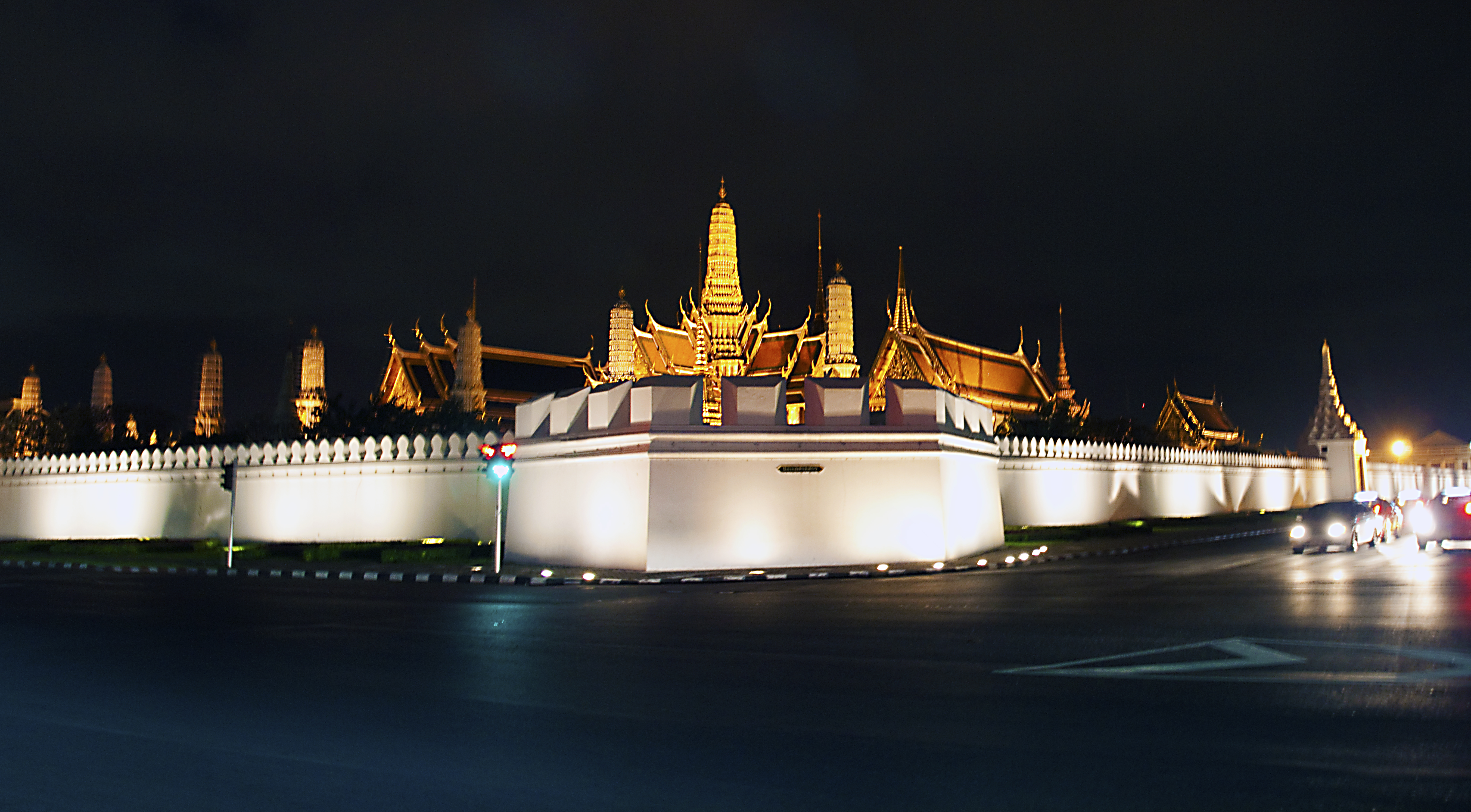
Grand Palace
The Chinese merchants did not leave willingly. In 1782, when General Chakri seized the throne and declared himself Rama I, he chose the east bank of the Chao Phraya River for his new capital -- and the Teochew community already living there had to relocate downstream to what would become Chinatown. On the cleared ground, Rama I ordered construction of a palace complex to rival the one his kingdom had lost when Ayutthaya fell to the Burmese fifteen years earlier. What rose from that riverside plot was not a single building but an entire walled city: the Grand Palace, a 218,400-square-meter labyrinth of throne halls, courtyards, temple spires, and guarded quarters that would house kings, concubines, ministers, and the most sacred Buddhist relic in Thailand.
A Capital Built on Memory
Rama I modeled the Grand Palace on the destroyed royal compound at Ayutthaya with deliberate precision. The proximity to the river, the arrangement of separate courts divided by walls and gates, the open field to the north for royal ceremonies -- all mirrored the old capital's layout. Even the landing pavilion for royal barge processions was placed in the corresponding position. Construction began on 6 May 1782, using conscripted corvee labor to raise wooden structures that were gradually replaced with masonry over the following years. The king held his full coronation ceremony in 1785, once the ceremonial halls were complete. For the next 150 years, the Grand Palace would function as both the administrative center of Siam and the private world of its monarch -- a city within a city, governed by its own set of palace laws that established hierarchy among the thousands of inhabitants living within its whitewashed castellated walls.
Courts Within Courts
The palace divides into four distinct zones, each with strictly defined functions and access. The Outer Court, in the northwest, once held royal offices, a theatre, stables for the king's elephants, barracks, the royal mint, and an arsenal. To the northeast sits the Temple of the Emerald Buddha, or Wat Phra Kaew -- the most sacred Buddhist temple in Thailand. Built in 1783 in the tradition of royal chapels dating back to Sukhothai, the temple houses the Emerald Buddha, a 66-centimeter jade figure whose seasonal garments are changed by the king himself three times a year. The Middle Court contains the great throne halls: the Phra Maha Monthien buildings at its center, the traditional Phra Maha Prasat group, and the Chakri Maha Prasat Hall, whose hybrid architecture layers a Thai multi-tiered roof atop an Italian Renaissance-style facade. The Inner Court, at the south end, was once reserved exclusively for women -- the king's harem -- sealed off from the rest of the compound.
Two Centuries of Layering
Each successive king left his mark, and the result is a compound whose architectural incoherence is itself a kind of history. Rama II expanded the palace southward to the walls of Wat Pho, increasing its area and adding new fortifications. Rama IV gave the complex its formal name -- Phra Boromma Maha Ratcha Wang, the Grand Palace -- when he elevated his brother to Second King in 1851. But it was Rama V, King Chulalongkorn, who transformed it most dramatically. Having traveled to Europe and been impressed by Western architecture, he commissioned buildings that fused European neoclassical design with Thai rooflines and ornamentation. The Chakri Maha Prasat Hall, completed in 1882, embodies this fusion so thoroughly that Thais nicknamed it the farang wearing a chada -- a Westerner wearing a traditional Thai crown. By the 1920s, however, the king and court had moved to newer palaces, including the Dusit Palace built in 1903. The revolution of 1932 ended absolute monarchy, and the Grand Palace became a ceremonial stage rather than a seat of power.
Ceremony and Eight Million Visitors
The Grand Palace remains the site where Thai kingship performs itself. Coronation ceremonies, royal funerals, and state functions still unfold within its walls. King Vajiralongkorn's coronation in May 2019 followed rituals that have taken place in these same halls for over two centuries. More than eight million visitors pass through the complex each year, navigating the eclectic collision of gilded spires, mosaic-encrusted prangs, and marble-floored European halls. The temple cloisters surrounding Wat Phra Kaew are decorated with murals depicting the Ramakien, the Thai version of the Ramayana, stretching across 178 panels. Guards still patrol the gates, dress codes are enforced -- no bare shoulders, no shorts -- and the compound closes for ceremonies without notice. The palace is a museum, but not entirely. It is a working institution that still operates on the calendar of a monarchy that began here in 1782, on ground cleared by a king who wanted to build something that would outlast the kingdom he had lost.
From the Air
Located at 13.7501N, 100.4920E on the east bank of the Chao Phraya River in the Phra Nakhon District of Bangkok. The compound's whitewashed walls and golden spires are visible from 2,000-3,000 feet. The adjacent Sanam Luang open field and the curving river provide clear landmarks. Nearest airports: Don Mueang (VTBD) approximately 15 nm north; Suvarnabhumi (VTBS) approximately 18 nm east-southeast.