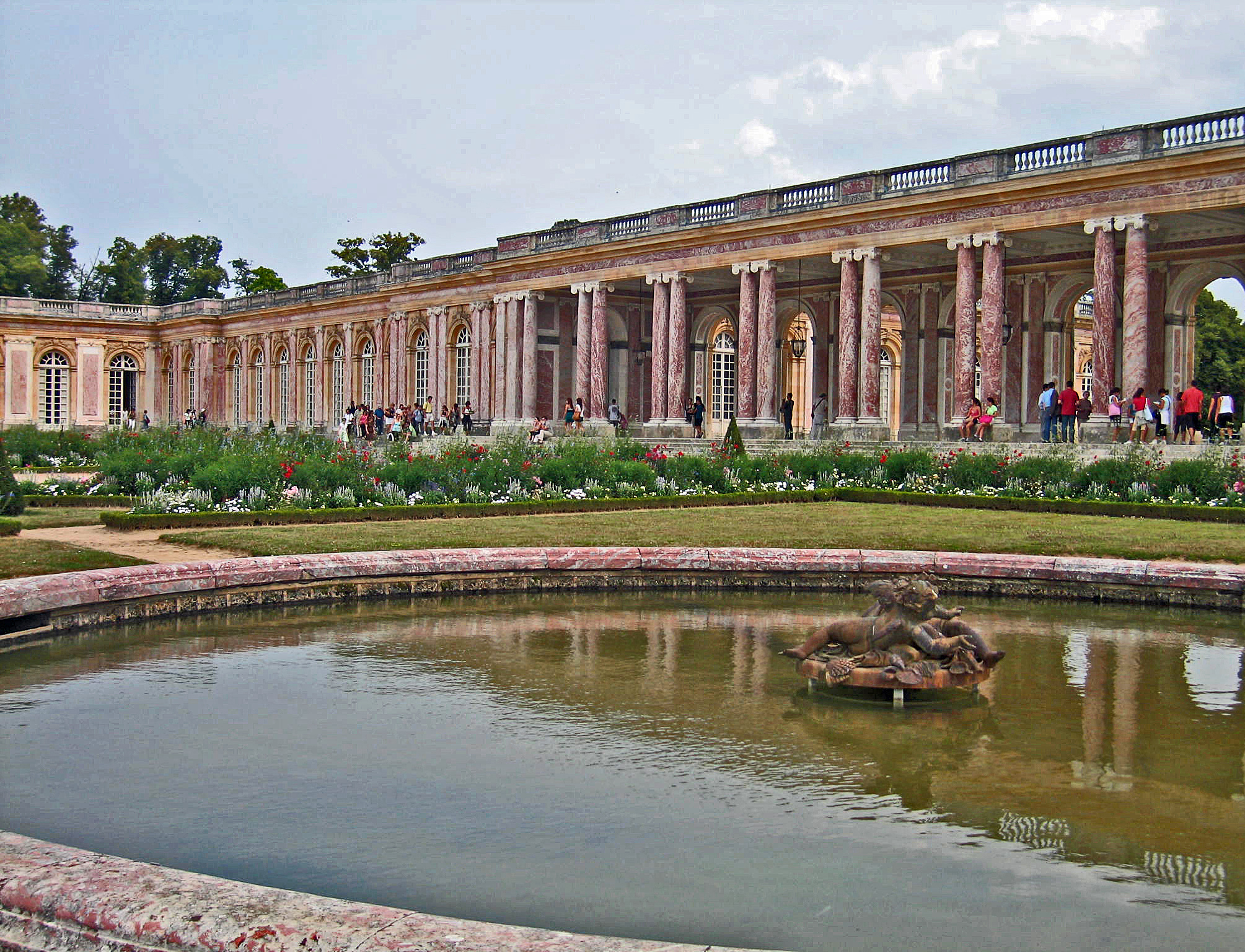
Grand Trianon
Louis XIV built the most opulent palace in Europe and then built a second one to get away from it. The Grand Trianon, a single-story chateau of pink Languedoc marble on the northwestern edge of the Versailles estate, was designed as the opposite of everything the main palace represented. Where Versailles meant gilt, heavy ornamentation, and the crushing formality of court etiquette, the Trianon meant white walls, delicate carved wood boiseries, and meals taken at leisure with chosen company. The king reportedly ordered his architects to "Paint everything white. No gilt or color for the walls of Trianon." It was the most powerful man in France's way of admitting that even he needed somewhere to breathe.
The Porcelain Experiment
The first building on the site was stranger than anything that followed. Between 1663 and 1665, Louis XIV purchased the hamlet of Trianon on the outskirts of Versailles. In 1670, he commissioned architect Louis Le Vau to design a pavilion clad in white and blue Delft-style porcelain tiles, manufactured at Rouen, Lisieux, Nevers, and Saint-Cloud. The Trianon de Porcelaine was elegant and exotic, a nod to the European fascination with Chinese ceramics. It was also spectacularly impractical. Porcelain does not weather well in the climate of the Ile-de-France. Within sixteen years, the tiles had deteriorated so badly that Louis ordered the entire structure demolished. The lesson was clear: beauty that cannot endure serves no one. In its place, architect Jules Hardouin-Mansart built a structure twice the size, using pink marble from Languedoc, begun in June 1687 and finished in just seven months.
Architecture of Escape
Hardouin-Mansart's plans changed constantly during that frantic summer of 1687. At least three different structures were built at the center of the new building and torn down again before the architect settled on the open-air peristyle, a screen of pink marble columns facing onto the garden that became the Trianon's signature feature. Louis vetoed the original Mansard roof, calling it too heavy. The long interior gallery was built on the path of the king's favorite outdoor walk at the old porcelain pavilion, a gesture of continuity amid reinvention. The interiors departed radically from Versailles. Where the palace used variegated marbles, rich colors, and gilding, the Trianon's walls were covered in delicately carved wood paneling with plaster friezes and capitals of refined, almost feminine delicacy. The contrast was deliberate. Versailles performed power. The Trianon performed taste.
A Parade of Power
The list of residents reads like a compressed history of France. Louis XIV lived there from 1691 to 1703. His son, the Grand Dauphin, occupied it until 1711. Peter the Great of Russia stayed in 1717, studying the palace and gardens so intently that his own Peterhof Palace would be modeled on Versailles. Napoleon, after the Revolution left the building neglected for years, made it one of his residences and furnished it in the Empire Style, living there with his second wife Marie Louise of Austria. Louis Philippe I and Queen Maria Amalia were the last royals to reside at the Trianon. In 1873, the building served an entirely different purpose: Marshal Francois Achille Bazaine was imprisoned there on charges of surrendering his army to the enemy, and his trial took place in the very peristyle that Louis XIV had designed for evening promenades.
The Word That Wounded a Nation
In 1920, the Grand Trianon hosted the negotiations and signing of the Treaty of Trianon, which dismembered the Kingdom of Hungary after World War I. The treaty left Hungary with less than one-third of its prewar territory. To Hungarians, the word Trianon remains one of the most emotionally charged terms in their political vocabulary, a single word that carries the weight of national trauma. Louis XIV's retreat, built for intimate suppers and quiet walks through marble colonnades, became the site of a diplomatic act whose consequences shaped Central European politics for the next century. Charles de Gaulle ordered a renovation of the building in 1962, and today the Grand Trianon serves as one of the French Republic's presidential residences, used to host foreign dignitaries. Visitors to Versailles who make the walk to the Trianon discover a building that proves a counterintuitive truth: sometimes the most telling expression of power is the decision to set it aside.
From the Air
Coordinates: 48.815N, 2.105E. The Grand Trianon is located in the northwestern corner of the Versailles estate, visible as a low pink marble structure set within its own gardens. Recommended viewing at 2,000-4,000 ft AGL. Nearest airports: Toussus-le-Noble (LFPN) and Paris Orly (LFPO).