Graniteville Train Crash: The Night Invisible Death Came to a Mill Town
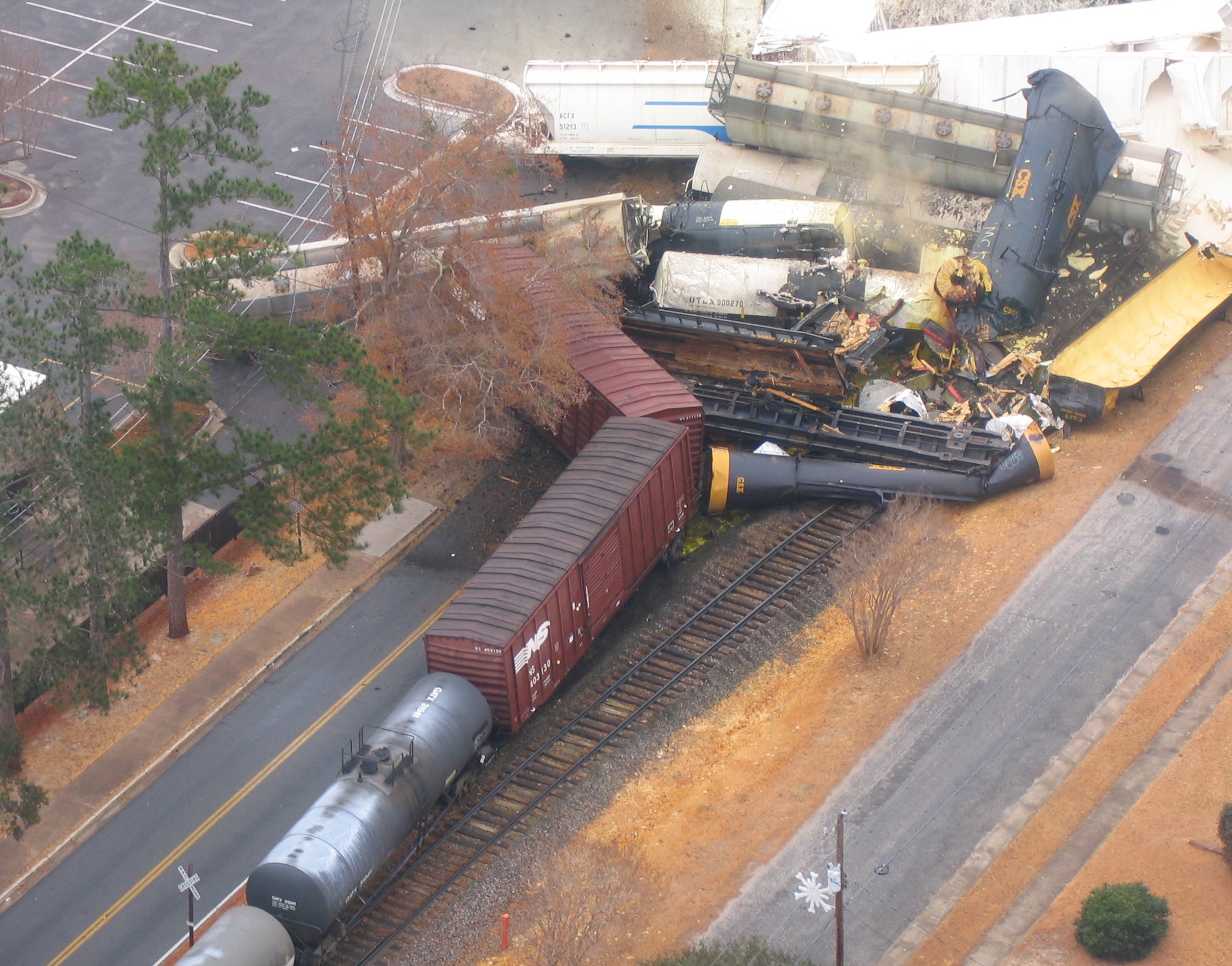
A single railroad switch, left in the wrong position, changed everything. At 2:39 on the morning of January 6, 2005, Norfolk Southern freight train 192 barreled through the darkness of rural South Carolina at 47 miles per hour and slammed into a parked local train on a siding near the Avondale Mills textile plant in Graniteville. The collision ruptured a tank car carrying 90 tons of liquid chlorine. Within seconds, an invisible green-yellow cloud began spreading through the sleeping town. The engineer of train 192, Christopher Seeling, died on impact. Eight more people would die from chlorine exposure in the hours and days that followed. More than 250 others were treated for toxic inhalation, and 5,400 residents within a one-mile radius were evacuated from their homes. The cause was almost absurdly simple: a switch that should have been set for the mainline had been left aligned for the siding.
Two Thirty-Nine in the Morning
The chain of failure began the day before. On January 5, a Norfolk Southern local train, P22, had used the industrial siding near the Avondale Mills plant for its daily operation. The regularly assigned conductor and engineer were both off duty that day, replaced by standby employees. When P22 finished its work and parked on the siding, the crew left the switch aligned for the siding rather than restoring it to the mainline position, as federal rules required. There were no signals, no electronic monitoring, no derails to protect the mainline in this stretch of non-signaled territory. When train 192 came through in the small hours of January 6, its crew had no warning. The locomotive struck the parked train head-on. Three of the derailed tank cars carried chlorine; one ruptured immediately, releasing approximately 60 tons of the toxic gas in the first minutes, with another 30 tons escaping over the following three days before a patch could be applied.
The Invisible Cloud
Chlorine is heavier than air. The released gas settled into a dense, low-hanging cloud that crept through the streets and yards of Graniteville, seeping into homes where people slept. At sufficient concentration, chlorine burns the lungs from the inside, filling them with fluid. Residents woke to a choking, acrid smell and struggled to breathe. Some stumbled outside into air that was worse. Emergency responders arriving at the scene found a landscape of confusion and fear. The evacuation that followed displaced thousands. Local businesses, schools, and homes within the evacuation zone stood empty for days. Studies conducted afterward found that residents exposed to the chlorine suffered lasting lung damage, with an 18 percent increase in rapid lung function decline in the years following the disaster. The long-term health toll extended far beyond the nine who died.
A Mill Town's Mortal Wound
Graniteville had been a textile town since 1845, when William Gregg built one of the South's first cotton mills there. Avondale Mills had operated the Gregg plant for decades, and it accounted for 40 percent of the company's total sales. The chlorine cloud engulfed the plant, contaminating the facility and forcing its closure. For a company already struggling against global competition in a shrinking American textile market, the loss was fatal. In May 2006, Avondale Mills CEO Robert Williams Sr. announced that every plant, office, and sales operation would close by July 25, throwing more than 4,000 workers across four states out of work. Stephen Felker Jr., the company's manager of corporate development, put it plainly: "We were prepared to weather the storm of global competition. What we weren't prepared for was an event such as this derailment, which was completely beyond our control." Avondale reached a $215 million insurance settlement, but the company declared the amount inadequate and shut down anyway. Graniteville residents believed the owners simply took the money rather than rebuilding.
Reckoning and Recovery
The legal aftermath stretched for years. Norfolk Southern initially estimated costs between $30 and $40 million. Evacuated residents who did not seek medical attention were offered $2,000 plus $200 per person per day of evacuation. The more serious claims took far longer. In 2008, Norfolk Southern and Avondale Mills reached a confidential out-of-court settlement. That same year, the U.S. EPA sued the railroad for Clean Water Act violations after Horse Creek, the nearby waterway, was poisoned by chlorine and thousands of gallons of diesel fuel from ruptured locomotive tanks. In 2010, Norfolk Southern agreed to pay a $4 million penalty, stock nearby Langley Pond with 3,000 fish to replace those killed by the spill, and plant vegetation along Horse Creek to reduce erosion. Texas folk artist Doug Burr memorialized the disaster in his 2007 song "Graniteville," a fictionalized account of a husband trying to wake his wife to escape the spreading gas. The locomotive that led train 192 that night, NS 6653, was eventually repaired and rebuilt, renumbered as NS 6900, and returned to service on tracks that still run through the town it shattered.
From the Air
Located at 33.56N, 81.81W in Aiken County, South Carolina, along the Norfolk Southern rail corridor. From the air, the rail line and the former Avondale Mills site are visible just north of the small town center. Horse Creek runs nearby to the south. The nearest airports include Aiken Municipal Airport (KAIK) approximately 12 miles to the southeast and Augusta Regional Airport (KAGS) about 15 miles to the southwest across the Savannah River in Georgia. Best viewed at 2,000-3,000 feet AGL. The rail infrastructure threading through this small rural community tells the story of industrial dependence that made the 2005 disaster so devastating.