Grasslands National Park
In 1874, geologist George Mercer Dawson knelt in the eroded clay of the Killdeer Badlands and lifted something remarkable from the earth: western Canada's first dinosaur remains. Three years later, these same badlands sheltered a different kind of history when Sitting Bull led nearly 5,000 Sioux across the border following their victory at Little Bighorn. Today, Grasslands National Park preserves both stories in 907 square kilometers of rolling prairie and wind-carved coulees, the only protected fragment of a grassland ecosystem that once stretched from Texas to the Saskatchewan plains.
Where the Sea of Grass Still Waves
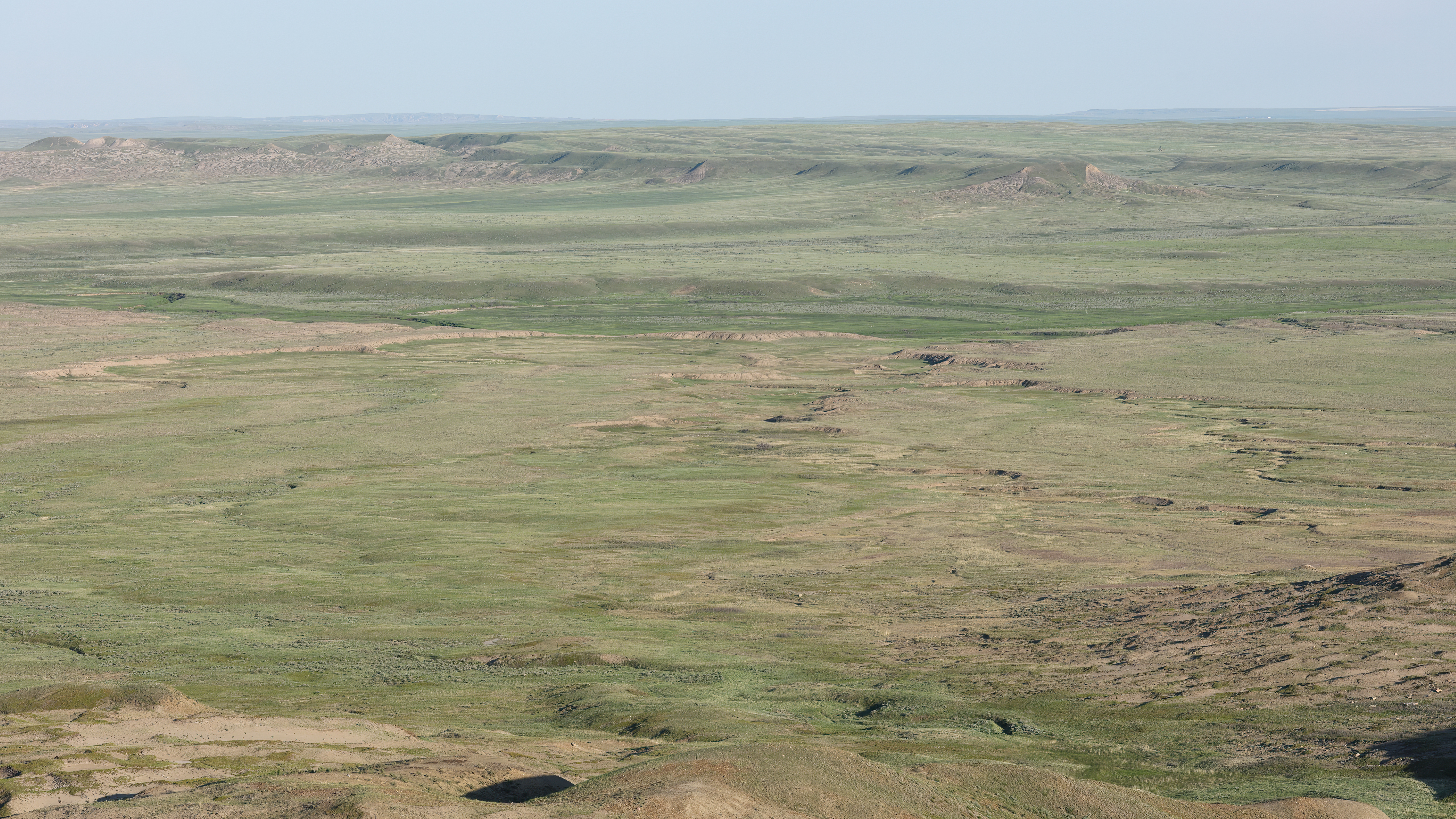
The mixed-grass prairie that survives here represents something increasingly rare: a landscape that looks much as it did when vast bison herds darkened the horizon. Blue grama grass and needlegrass bend under winds that never seem to stop, while silver sagebrush dots the hillsides with dusty green. This is the northern tip of North America's great grassland belt, protected now because so little remains. The park stretches across two separate blocks, the West Block near Val Marie accessible from Swift Current, and the wilder East Block near Wood Mountain, each preserving different faces of the same ancient prairie.
Creatures of the Open Country
The park shelters Canada's only black-tailed prairie dog colonies, their intricate burrow systems punctuating the grassland like a subterranean city. In 2006, seventy-one plains bison arrived from Elk Island National Park in Alberta. By 2015, they had grown to over 300 animals roaming a 181-square-kilometer enclosure in the West Block. The park's recovery efforts brought back another ghost in 2009: black-footed ferrets, reintroduced after a 70-year absence to hunt among the prairie dog towns. Burrowing owls nest in abandoned burrows, while ferruginous hawks circle overhead and prairie rattlesnakes sun themselves on the exposed rocks of the badlands.
Sculpted by Ice and Time
Glacial meltwater carved this landscape into its present form, cutting the dramatic Frenchman River Valley and exposing the layered badlands of Rock Creek. Seventy Mile Butte rises from the grassland as a navigation landmark visible for miles. In the East Block, the exposed Cretaceous-Paleogene boundary marks the ancient catastrophe that ended the age of dinosaurs. The semi-arid climate here produces extremes: cold, windswept winters give way to summers where nearby Val Marie sometimes records the hottest temperatures in Canada. That same village also claims more sunny days than anywhere else in the country.
A Dark Sky Refuge
After sunset, the park transforms under night-lighting practices that keep the land genuinely dark. Without the glow of cities, the Milky Way arcs overhead in stunning clarity, and nocturnal hunters emerge to patrol the grassland. The park's dark-sky agreement protects not just the astronomy, but the natural rhythms of swift foxes, coyotes, and the greater short-horned lizards that depend on darkness. Visitors camping in the Frenchman Valley can fall asleep watching satellites trace silent arcs through a sky unpolluted by artificial light.
From the Air
Located at 49.17N, 107.56W in southwestern Saskatchewan near the Montana border. The West Block lies one hour south of Swift Current, visible as a broad valley cutting through rolling prairie. The East Block near Wood Mountain features the distinctive badlands of Rock Creek. Nearest airports include Swift Current (YYN) and Regina (CYQR, 350km east). The park sits less than 30km from the Morgan-Monchy border crossing with Montana. Best viewed from 5,000-8,000 feet AGL to appreciate the contrast between prairie grassland and eroded badlands topography.