Gray Fossil Site
In May 2000, a Tennessee Department of Transportation crew was widening State Route 75 near the small community of Gray in Washington County when their equipment struck something unusual. Beneath the asphalt and clay lay bones, thousands of them, sealed in the sediment of an ancient sinkhole pond that had been quietly preserving its dead for nearly five million years. What the bulldozers uncovered that spring is now recognized as one of the most important fossil sites in eastern North America: a window into a world where red pandas climbed hickory trees, rhinoceroses waded through warm shallows, and the Appalachian Mountains looked nothing like they do today.
The Sinkhole That Swallowed Time
The Gray Fossil Site is a deposit of laminated clay and silt sediments laid down in a lake that formed within a collapsing sinkhole during the Early Pliocene epoch, between 4.5 and 4.9 million years ago. The deposit is oval, roughly 220 meters by 180 meters, and plunges to a depth of 39 meters in places. The underlying geology belongs to the Knox Group formation, a series of Cambrian-Ordovician limestones where groundwater dissolves rock into caves and sinkholes, creating karst topography. The sinkhole at Gray was not a single dramatic collapse but a series of overlapping events that gradually formed one large basin. Boulders embedded in the lake sediments suggest the sinkhole walls once featured high overhangs from which chunks of rock occasionally broke free and tumbled into the water below. Animals and plants that fell in, or wandered in and could not climb out, were buried in fine sediment and preserved with exceptional detail.
A Warmer, Stranger Tennessee
Nearly five million years ago, what is now northeast Tennessee was far warmer and wetter than today. Dense forests of hickory, oak, and pine surrounded the sinkhole pond, and the presence of alligators, tupelo trees, and the flowering shrub Corylopsis confirms a subtropical climate. Researchers initially envisioned a closed-canopy forest, but later studies suggest the landscape may have been more of an open woodland, shaped by large herbivores, fire, and periodic drought. Into this warm world came animals that seem almost fantastical for the Appalachian region: the dwarf tapir Tapirus polkensis, present in the largest numbers of any known fossil site, from fetal specimens to elderly adults. The rhinoceros Teleoceras aepysoma, identified in 2019 as a new species distinguished by its unusually long front legs. A three-toed horse, Cormohipparion emslei. Peccaries, camels, and a mastodon so large that early researchers mistook its bones for those of a gomphothere.
Pandas and Sweaty Wolverines
Among the Gray Fossil Site's most celebrated discoveries are two carnivores described in a landmark 2004 publication: a new species of red panda, Pristinailurus bristoli, and a Eurasian badger, Arctomeles dimolodontus. The red panda's presence in ancient Appalachia stunned researchers, since modern red pandas live only in the montane forests of Asia. Then came the wolverine. Named Gulo sudorus, Latin for the sweaty wolverine, it is the oldest known fossil wolverine anywhere in the world. The name is a wry nod to the fact that five million years ago, Gray's climate was far warmer than the frigid habitats where modern wolverines roam. The site also yielded the oldest known salamanders from the Appalachian region, representing families including Ambystoma, Desmognathus, Notophthalmus, and Plethodon, a finding that underscores Appalachia's deep history as a center of salamander diversity.
From Bulldozer to Bone Lab
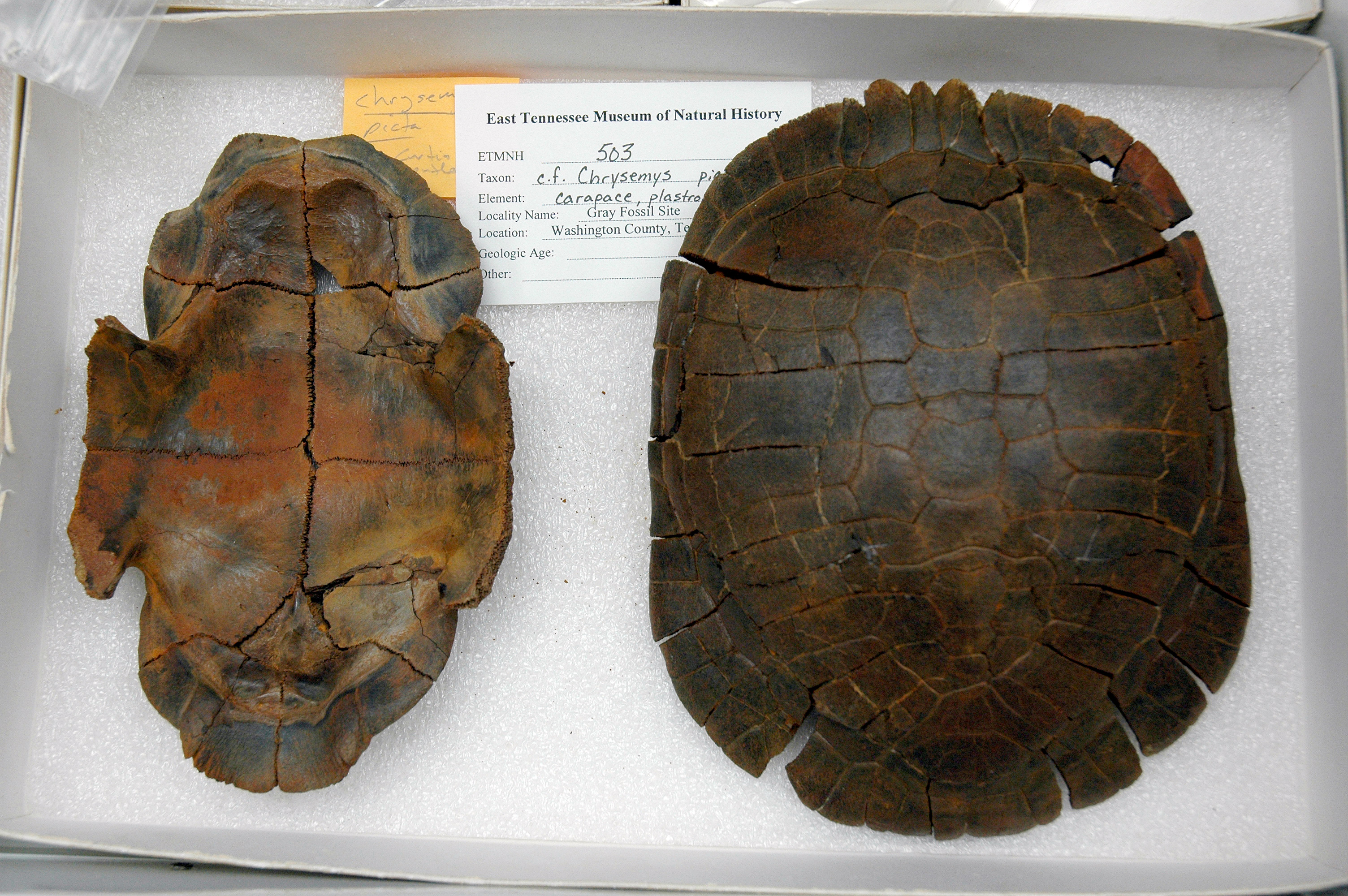
When local officials realized the significance of the find, they made a decision that shaped everything that followed: instead of rerouting the road and paving over the past, they preserved the site for research and education. East Tennessee State University took ownership, hired paleontologists and geologists, and created a new Department of Geosciences. The university established the Don Sundquist Center of Excellence in Paleontology and built a museum directly on the site. The Gray Fossil Site and Museum opened in August 2007, housing research laboratories and educational exhibits under one roof. Researchers have since identified new species of plants as well, including Cavilignum pratchettii, the first new extinct plant genus described from Gray, and the freshwater alga Stigmozygodites grayensis, named for the site in 2013. A slider turtle, Trachemys haugrudi, was named in honor of Shawn Haugrud, the site's lab and field manager. The digging continues, and every season yields new specimens from a world that vanished beneath Tennessee clay millions of years before anyone thought to look.
From the Air
Located at 36.39°N, 82.50°W near Gray in Washington County, Tennessee. The site is adjacent to State Route 75. Tri-Cities Airport (KTRI) in Blountville is approximately 15 miles to the northwest. The site itself is modest in scale from the air, an oval depression in otherwise rolling terrain, but the East Tennessee State University museum building marks the location clearly. Recommended viewing altitude: 3,000-5,000 feet AGL. The surrounding karst landscape of northeast Tennessee, with its sinkholes and cave systems, is visible in the undulating terrain patterns. The Appalachian ridges frame the valley to the east and west.