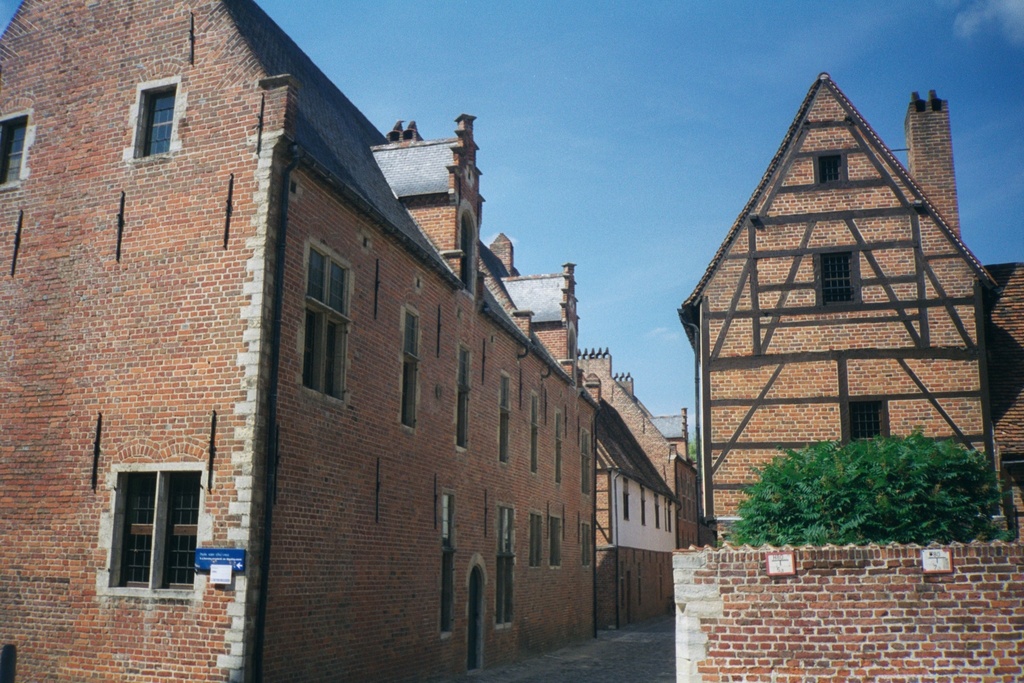
Great Beguinage, Leuven
The last beguine died in 1988. For over seven centuries, women had lived in this walled enclave in the south of Leuven, Belgium, choosing a life of prayer and work without taking permanent vows. They could leave if they wished. They could own property. They answered to no bishop. This radical experiment in female autonomy began in the early 13th century and survived plagues, religious wars, revolution, and neglect. Today the Great Beguinage stands as one of the best-preserved examples of a movement that once dotted the Low Countries with hundreds of similar communities. The University of Leuven owns the site now, and visiting academics walk the same cobbled streets where beguines once went about their contemplative lives, their prayers replaced by scholarly conversation echoing off red-brick facades.
Women Beyond the Cloister
Beguines occupied a unique space in medieval society. Unlike nuns, they took no permanent vows and could return to secular life. Unlike married women, they lived independently, supporting themselves through lace-making, textile work, and care of the sick. The movement emerged in the 12th century across the Low Countries, offering an alternative for women who wished to lead spiritual lives without the constraints of conventional monasteries. The Great Beguinage of Leuven traces its origins to before 1232, though local historians including the scholar Justus Lipsius date its founding to 1205. A Latin inscription on the beguinage church records 1234 as the foundation year. One priest who served this community was Adriaan Florensz Boeyens, spiritual tutor to the future Emperor Charles V, who would later become Pope Adrian VI.
Rise, Decline, and Persistence
The beguinage flourished in the 13th century, weathered the religious conflicts of the 16th, and reached its peak population of 360 women between 1650 and 1670. This demographic surge explains the architectural unity visible today: most houses were constructed during a single 40-year period, creating a cohesive streetscape of red brick facades with sandstone window frames and baroque dormers. By 1700, warfare and disease had reduced the population to 300. The French Revolution brought near-destruction; though the property was not sold off as many monasteries were, it was confiscated and reorganized as civil almshouses. Beguines continued living alongside the elderly and poor, their community gradually fading. The last priest of the community died in 1977 at the remarkable age of 107. The last beguine followed in 1988, ending a continuous tradition spanning 750 years.
Rescue by the University
By 1960, the beguinage was in deplorable condition. After 150 years of neglect under welfare commission management, the buildings were crumbling. A real estate developer considered purchasing the site, but abandoned plans when the Catholic University of Leuven expressed interest. The university purchased the entire quarter in 1962 and undertook a meticulous restoration lasting until 1989. Today nearly 100 houses containing some 300 apartments provide housing for visiting academics and researchers, preserving the beguinage as a living community rather than a frozen museum. The river Dyle splits into two channels within the enclosure, forming a small island connected by three bridges. Narrow cobbled streets wind between buildings that date from the 16th and 17th centuries, some still showing original timber framing.
Echoes of Earlier Ages
The quarter known as Ten Hove, meaning The Court, and the old name Aborg, meaning Old Castle, hint at even earlier history. Some scholars believe this site may have been the court of the first Lords of Leuven, and possibly the location where Emperor Arnulf of Carinthia ended the Viking invasions at the Battle of Leuven in 891. The beguinage church is an early Gothic basilica with Romanesque elements, its interior 27 meters wide, the broadest in Leuven. A small carillon in the church's fleche plays a melody every half hour on bells transferred from the Leuven library tower. The facades preserve the beguines' concern for privacy: windows on ground floors are strikingly small, and some houses still retain walls that once blocked the view into larger windows from the street. Walking here in twilight, one can almost imagine the quiet rhythms of prayer and labor that filled these lanes for seven centuries.
From the Air
The Great Beguinage lies in the southern part of central Leuven at coordinates 50.871N, 4.696E, approximately 25 kilometers east of Brussels. The enclosed medieval quarter is distinguishable from altitude by its dense cluster of red-roofed buildings bordered by the winding channels of the river Dyle. Leuven's town center and the distinctive tower of the university library lie to the north. Brussels Airport (EBBR) is 20 kilometers to the west. The beguinage occupies an area of approximately 3 hectares within the urban fabric.