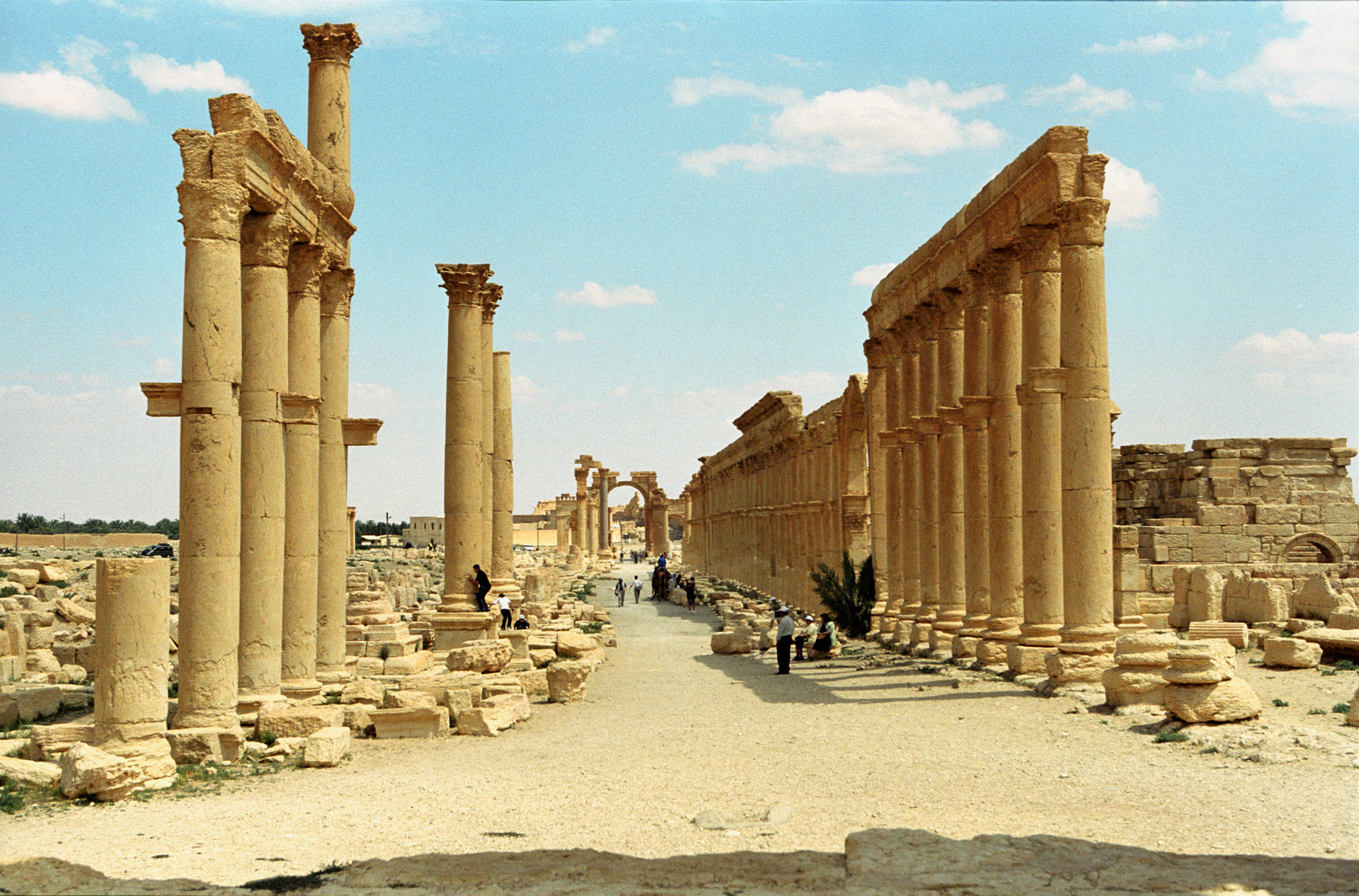
Great Colonnade at Palmyra
Walk far enough down the main street of a dead city and you start to feel the ambition that built it. The Great Colonnade at Palmyra stretches for more than a kilometer through the Syrian Desert -- a boulevard of towering limestone columns that once connected the Temple of Bel in the southeast to the West Gate and Funerary Temple in the northwest. Built in stages during the 2nd and 3rd centuries CE, this was not merely a road but a declaration: that Palmyra, a caravan oasis midway between the Roman Empire and Parthian Persia, considered itself worthy of the grandest urban architecture the ancient world could produce.
Three Avenues, One Vision
The colonnade was not built all at once. Three distinct sections were constructed separately over roughly 150 years, each aligned slightly differently -- the result of connecting existing structures rather than following a master plan. The western stretch is the oldest, running 500 meters from the West Gate near the Funerary Temple in a northwest-southeast direction. Its main avenue was 11.7 meters wide, with side streets of 7 meters. The central section connected through the Great Tetrapylon, a monumental four-columned intersection. The eastern section, the widest at 22.7 meters for the main street alone, began at the Monumental Arch and swept toward the propylaea of the Temple of Bel. Work on this final stretch started after the temple's propylaea were completed in 175 CE and continued into the early 3rd century.
Statues in Bronze, Names in Stone
The columns were not merely structural. Brackets projecting from their shafts once held bronze statues of important figures -- merchants, officials, and rulers whose likenesses gazed down at the caravans passing below. Dedicatory inscriptions discovered on columns near the theatre honor Zenobia and Odaenathus, the warrior queen and king who briefly turned Palmyra into an empire that challenged Rome itself. These inscriptions date to between 257 and 267 CE, the years when Palmyra was at the height of its power. The avenue also connected at a right angle to the Transverse Colonnade, which ran south to the Damascus Gate -- a reminder that every road in Palmyra ultimately led somewhere else, carrying the silk, spices, and textiles that made the city rich.
An Avenue Through the Desert
To appreciate the colonnade, consider its setting. Palmyra sits in the middle of the Syrian Desert, surrounded by emptiness in every direction. The nearest substantial settlement is over a hundred kilometers away. That a city here built a monumental avenue wider than many modern highways speaks to the extraordinary wealth generated by controlling the trade routes between Mesopotamia and the Mediterranean. The colonnade's western terminus, the West Gate, was constructed in the late 2nd century CE, completing a processional route that visitors would have entered from the vast desert and followed through increasingly dense urban space toward the Temple of Bel. The effect was theatrical: arrival in Palmyra was designed to impress.
Damage and Endurance
The colonnade survived seventeen centuries of earthquakes, sandstorms, and neglect before facing its most serious threat. When the Islamic State occupied Palmyra from May 2015 to March 2016, the group deliberately destroyed several of the city's ancient monuments, including the Temple of Bel and the Monumental Arch that marked the eastern entrance to the colonnade. The colonnade itself sustained damage. Yet large sections remain standing -- rows of columns still rising from the desert floor, their brackets empty of bronze but their limestone intact. UNESCO has designated Palmyra a World Heritage Site, and the colonnade, even in its diminished state, remains one of the most recognizable monuments of the ancient world. Its survival is itself a kind of statement: that some things outlast the forces that try to destroy them.
From the Air
Located at 34.55N, 38.27E in the Syrian Desert, approximately 210 km northeast of Damascus. Palmyra is strikingly visible from altitude -- a grid of ancient ruins in an otherwise featureless desert landscape. The colonnade runs northwest-southeast through the center of the archaeological site. The nearest airport is Palmyra Airport (formerly T4/Tiyas, OSTY), a military airfield approximately 60 km to the west. The ruins are best viewed from 3,000-5,000 feet, where the full kilometer-long extent of the colonnade becomes apparent.