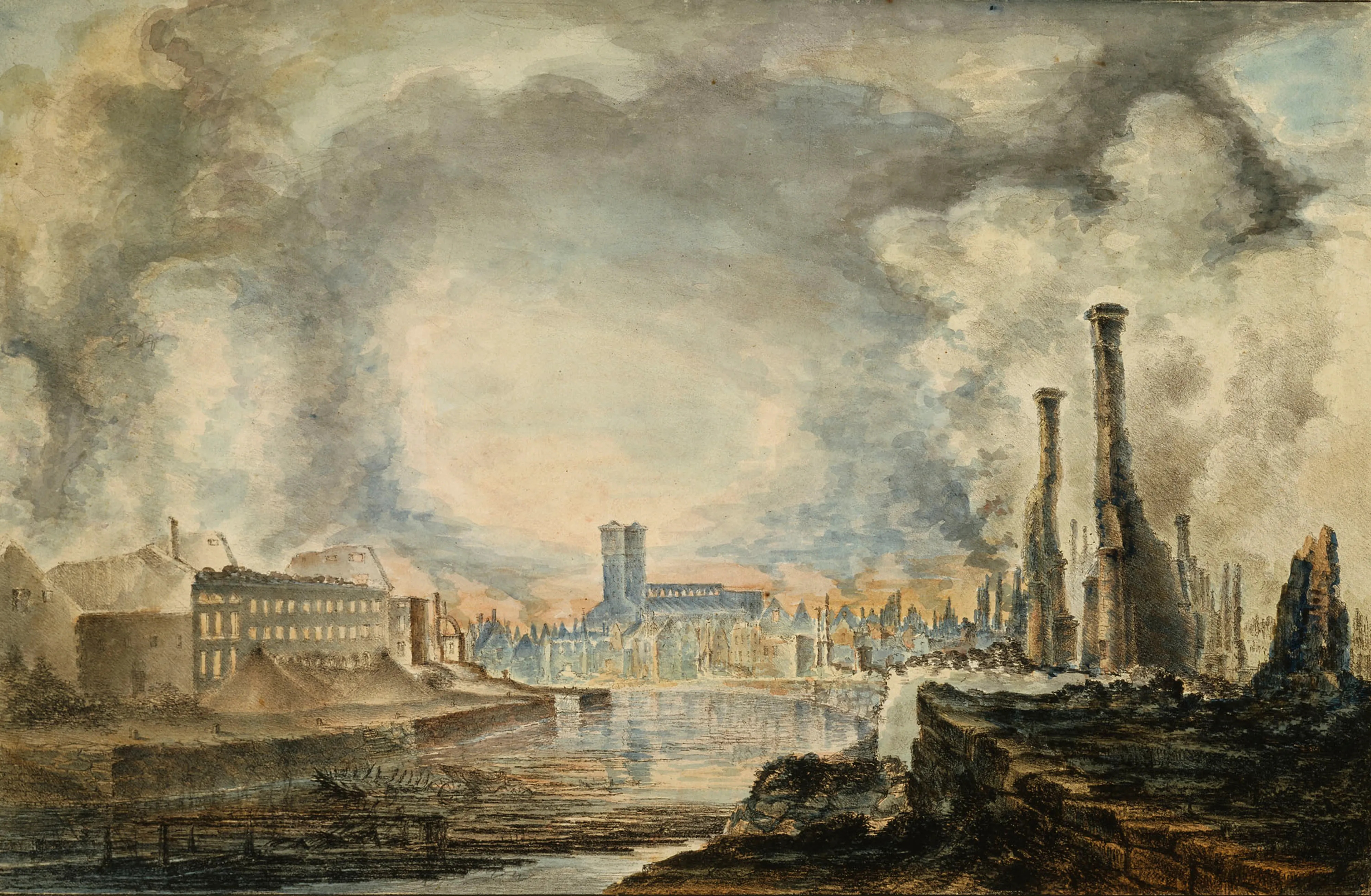
Great Fire of Turku
The astronomer Friedrich Wilhelm Argelander was charting stars from his hilltop observatory when the glow appeared. By the time he abandoned his telescope that September night in 1827, the fire had already jumped the Aura River and was consuming Turku's Cathedral Quarter. In his observation log, he wrote simply: "Today observation was interrupted by a horrible fire that reduced Turku to ashes." It was not hyperbole. By dawn, three-quarters of Finland's largest city had vanished into smoke and embers.
A Perfect Storm of Absence
The fire began around 9 p.m. on September 4, 1827, in burgher Carl Gustav Hellman's house atop Samppalinna Hill. A spark from a neighbor's chimney found dry timber primed by a scorching summer. But what turned an ordinary house fire into a national catastrophe was a remarkable coincidence: much of Turku's population was away at a market in Tampere that day. The skeleton crew left behind watched helplessly as winds rose into a fire-spreading storm. The flames raced through the northern quarter, leapt across the river, and engulfed the medieval cathedral and the Imperial Academy of Turku before midnight. By morning, 11,000 people were homeless. Only the western and southern fringes survived.
What the Flames Consumed
The physical destruction was staggering: Turku Cathedral's medieval interior gutted, the Academy's main building reduced to a shell, entire neighborhoods erased. But the fire also devoured something irreplaceable: Finland's collective memory. Most of the nation's medieval archives perished in the Academy's burning vaults - church records, legal documents, manuscripts stretching back centuries. Historians today work around a void, an archival black hole centered on that September night. Twenty-seven people died and hundreds were injured, but the true casualty count includes countless unwritten histories, unresearched genealogies, and unknowable stories from Finland's medieval past.
The Grid That Rose from Ashes
Governor-General Arseniy Zakrevskiy refused to let Turku rebuild itself into the same tinder-dry warren of wooden streets. He commissioned architect Carl Ludvig Engel to design a new city from scratch. Engel's grid plan, approved in December 1828, imposed order on chaos: wide avenues to stop fire's spread, stone buildings where wood had stood, public squares breaking up the urban fabric. The cathedral and Academy's main building, the Akatemiatalo, were salvaged and restored. But the medieval street pattern was gone forever. Turku's systematic design became a template for Finnish urban planning, its orderly blocks a direct inheritance from catastrophe.
The Survivors' Quarter
One neighborhood escaped untouched. Luostarinmaki, the Cloister Hill area on the city's edge, stood just beyond the fire's reach. Its wooden houses, artisan workshops, and narrow lanes preserved a snapshot of pre-fire Turku that the rest of the city had lost. In 1940, the entire district was protected and opened as an open-air museum. Walking its streets today offers a glimpse through time - the cramped wooden buildings, the traditional craftsmen's homes, the streetscape that once defined all of Turku before that September night rewrote the city in stone and right angles.
Argelander's Refuge
The Vartiovuori Observatory, perched on its lonely hilltop, survived because fire burns upward but struggles against elevation and distance. Argelander resumed his celestial observations on September 9, just five days after the catastrophe. While refugees huddled in the ruins below, the Academy's surviving administration moved into his small observatory building - the consistory met there, the chancellor's office operated from its cramped rooms. For months, Finland's academic leadership governed from a stargazer's perch, looking down on a city that had ceased to exist.
From the Air
Located at 60.45N, 22.27E in Turku, Finland. The former fire zone encompasses the modern city center surrounding Turku Cathedral, visible as the city's dominant medieval structure. The Aura River bisects the urban area below. The hilltop observatory site at Vartiovuori is visible southeast of the cathedral. Luostarinmaki open-air museum lies on the southern edge of the historic district. Nearest airport is Turku Airport (EFTU), 8 km north of the city center. Best viewed at 2,000-3,000 feet to appreciate the grid street pattern contrasting with the surviving medieval cathedral.