Great Hall of the People
On the evening of September 9, 1959, Mao Zedong toured the building that did not yet have a name. When the vice mayor of Beijing, Wan Li, pointed out that the massive hall still lacked an official title, Mao settled the question on the spot: the Great Hall of the People. That night, the legendary Peking opera performer Mei Lanfang took the stage in the 10,000-seat auditorium to inaugurate the building with a performance of the Drunken Beauty. The entire structure -- one of the largest legislative buildings on earth -- had been designed, approved, and constructed in roughly ten months.
Ten Months, Ten Thousand Seats
The Great Hall was born from a promise Mao made in the 1940s during the revolutionary base at Yan'an: that after victory, the Party would build a conference hall for ten thousand. The decision to actually build it came at the Beidaihe Conference in August 1958, with the demand that it be ready for the People's Republic's tenth anniversary in October 1959. Zhang Bo led the architectural design team, working through eight competing proposals before settling on a plan that Zhou Enlai insisted should convey a single message: that the people are the masters of the country. Anshan Iron and Steel produced the structural metal. The building opened as one of the Ten Great Constructions, a set of showcase projects that reshaped Beijing's monumental core in a single year.
A Building of Halls Within Halls
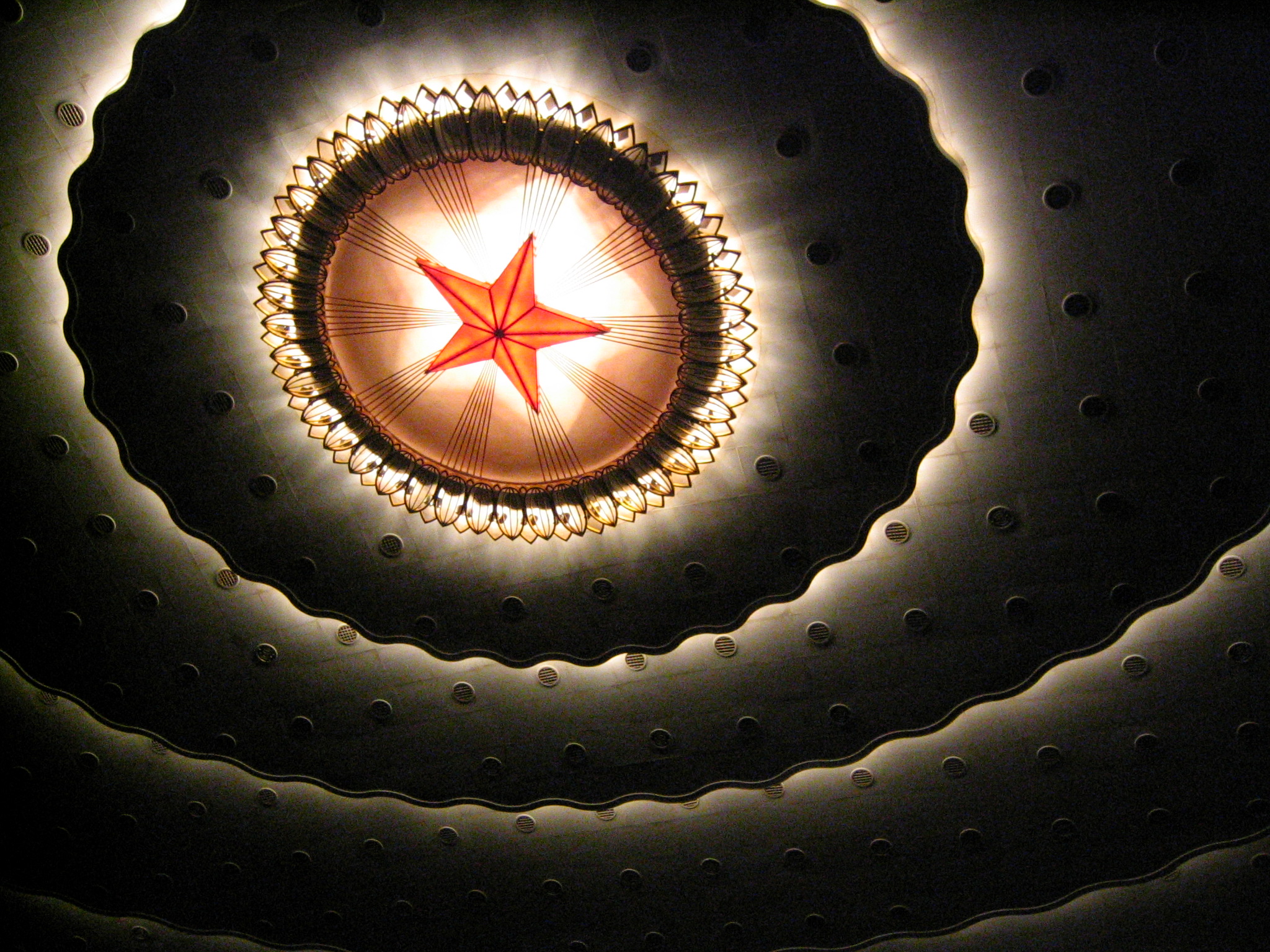
The Great Hall sprawls across the west side of Tiananmen Square in three main sections. The central section houses the Great Auditorium, with its ceiling decorated to resemble a galaxy of lights radiating from a large red star at the center, surrounded by concentric rings of lights and a wave pattern representing the people. The auditorium seats 3,693 on the main floor, 3,515 in the balcony, 2,518 in the gallery, and up to 500 on the dais. The northern section contains the State Banquet Hall, where up to 5,000 guests can dine simultaneously -- a capacity famously tested during Richard Nixon's 1972 visit. More than 30 conference halls are named after China's provinces and regions, each decorated in the local style of its namesake, from Beijing Hall to Hong Kong Hall.
Where Power Convenes
Every March, the Great Hall hosts the lianghui -- the "two meetings" of the National People's Congress and the Chinese People's Political Consultative Conference, sessions lasting two to three weeks that constitute China's most important annual legislative event. The Chinese Communist Party's National Congress convenes here every five years. The building has also hosted state funerals for leaders including Liu Shaoqi in 1982, Hu Yaobang in 1989, Deng Xiaoping in 1997, and Jiang Zemin in 2022. Mao Zedong's own funeral ceremony, notably, was held not inside the Great Hall but in Tiananmen Square itself.
Beyond Politics
The Great Hall has a quieter life beyond the political sessions. On July 4, 1986, Luciano Pavarotti became the first foreign performer to give a solo concert inside the building. In October 2003, the Irish dance phenomenon Riverdance played eleven sold-out performances -- the first Western show staged in the Great Hall. When not in use for government functions, the building opens to tourists who can walk through the auditorium and provincial halls for an admission fee. After the Cultural Revolution closed the building to the public, Deng Yingchao announced its reopening on January 27, 1979, declaring that the Great Hall of the People would once again be open to the masses. By the end of the 1980s, admission fees and kiosk revenue had made the building financially self-supporting.
From the Air
Located at 39.9033N, 116.3875E on the west side of Tiananmen Square in central Beijing. The massive rectangular building with its columned facade is clearly visible from the air, directly west of the square. The Forbidden City lies to the north. The National Museum of China sits across the square to the east. Beijing Capital International Airport (ZBAA) is approximately 30 km northeast. Best viewed at 2,000-5,000 ft AGL.