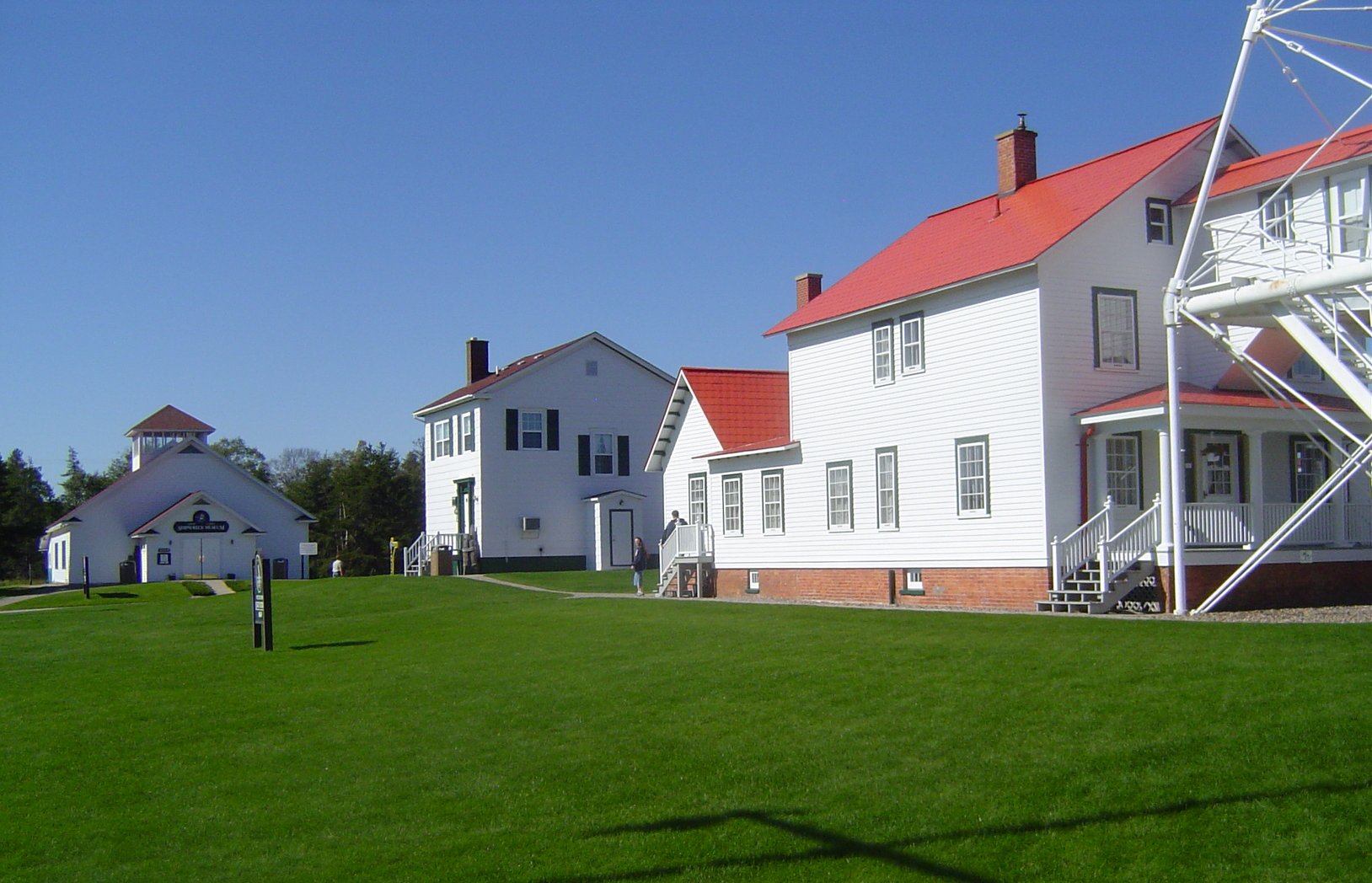
Great Lakes Shipwreck Museum
The bell weighs 200 pounds and it rings 29 times every November 10th, once for each sailor who went down with the SS Edmund Fitzgerald on that night in 1975 when Lake Superior swallowed the largest ship on the Great Lakes. The bell sits in a glass case inside the Great Lakes Shipwreck Museum at Whitefish Point, Michigan, recovered in 1995 from 530 feet below the lake's surface by a joint expedition involving the Canadian Navy, National Geographic, and a team of divers wearing atmospheric diving suits rated for crushing depth. A replica bell, engraved with the names of the 29 lost crewmen, was placed on the wreck in exchange. Forty-six family members signed the agreement that brought the original here, to this windswept spit of sand and forest at the southeastern corner of Lake Superior, where an active lighthouse has warned mariners since 1849 and where the lake has ignored the warning more than 200 times.
The Graveyard's Gatekeeper
Whitefish Point marks the course change for every vessel entering or leaving Lake Superior. Ships rounding the point transition between the relative shelter of Whitefish Bay and an 80-mile stretch of exposed shoreline running west to Munising, a corridor so lethal it earned the name Lake Superior's Shipwreck Coast. Of the roughly 550 major shipwrecks documented on Superior's bottom, at least 200 lie in the waters near Whitefish Point. The lighthouse established here in 1849 is the oldest active navigational light on Lake Superior. The present iron skeletal tower was constructed in 1861 during Abraham Lincoln's administration, and it guided ships through fog, snow, and November gales for over a century before the Coast Guard automated it in 1971. The light still flashes, but no keeper climbs the stairs. Whitefish Township placed the lighthouse on the National Register of Historic Places in 1973, beginning a new chapter in which the point's purpose shifted from guiding living sailors to remembering lost ones.
Divers, Lawsuits, and Salvaged History
The Great Lakes Shipwreck Historical Society was founded in 1978 by a group of divers drawn to the underwater graveyard off Whitefish Point. They secured a 25-year lease from the Coast Guard in 1983 and opened museum exhibits to the public in 1985. What followed was not a quiet curatorial existence. In 1992, the state of Michigan raided the museum's offices after discovering that GLSHS had removed approximately 150 artifacts from wrecks on state-claimed bottomlands, violating Michigan's Antiquities Act of 1980. A settlement loaned the artifacts back for display. Then came the bell. On July 4, 1995, an international team used the Canadian naval vessel HMCS Cormorant and deep-diving Newtsuits to recover the Edmund Fitzgerald's bronze bell from the pilot house. Experts at Michigan State University spent hundreds of hours conserving it, but the Society's decision to strip the protective coating and polish the bell to a shine sparked controversy. Plans for a touring exhibition were dropped after crew families objected to their memorial becoming a traveling trophy.
Three Stewards of a Fragile Point
When the Coast Guard transferred the Whitefish Point Light Station in 1996, the property was divided among three organizations. The GLSHS received a parcel containing most of the historic buildings for maritime interpretation. The Michigan Audubon Society's Whitefish Point Bird Observatory, which had been studying migrating raptors, owls, and songbirds since 1978, received land for research. The U.S. Fish and Wildlife Service took a parcel managed as part of the Seney National Wildlife Refuge. Governing this arrangement required a joint committee, transfer legislation with reversionary clauses, and eventually a lawsuit, a mediator, and a management plan. The tension between preservation and development played out in public hearings, court filings, and a township supervisor's resignation. By 2002, all three parties had signed the Human Use/Natural Resource Management Plan that regulates what can be built and where. Whitefish Point's ecosystem, a Wooded Dune and Swell Complex unique to the Great Lakes, supports lady slippers, starflower, bunchberry, and Labrador-tea, and in 2009 the endangered piping plover returned to nest here for the first time in at least two decades.
What Remains at the End of the Road
The museum complex sits literally at the end of Whitefish Point Road, north of the town of Paradise in Chippewa County. Visitors touring the grounds walk through layers of maritime history: the 1861 light tower, still active but closed to climbers; the lightkeeper's quarters, restored and furnished; the 1937 fog signal building that once housed steam boilers and three massive diaphone horns; a 1923 lookout tower relocated and restored by the Society; and a surfboat house displaying a full-size replica Beebe-McClellan rescue craft from the days of the U.S. Life-Saving Service. An 1861 lamp oil house and a 1910 alcohol house, both original, stand where they were built to store fuel before the light was electrified in 1931. At the center of it all is the bell, polished bronze in a quiet room, a memorial to 29 men and the hundreds of other mariners who never made it past the point. Every November, the families come back, and the bell rings.
From the Air
The Great Lakes Shipwreck Museum is located at 46.771N, 84.957W at the tip of Whitefish Point, the prominent sandy peninsula jutting into Lake Superior's southeastern corner. The lighthouse and museum complex are clearly visible from the air at the end of Whitefish Point Road. The point is unmistakable: a narrow, forested spit extending north into the lake with beach on both sides. Nearest airports include Chippewa County International Airport (KCIU) near Sault Ste. Marie about 50 miles southeast, and Newberry Airport (Y98) approximately 40 miles southwest. Best viewed at 1,500-3,000 feet AGL. In clear conditions, the shipping lanes and Whitefish Bay are visible, giving a sense of why this point was so critical to navigation.