Great Locomotive Chase
The passengers and crew were eating breakfast. That was the plan. On the morning of April 12, 1862, when the regular Atlanta-to-Chattanooga train stopped at the Lacy Hotel in Big Shanty, Georgia, for its scheduled meal break, twenty-two Union soldiers in civilian clothes and their civilian leader, James J. Andrews, walked to the front of the train, uncoupled the locomotive General and three boxcars, and drove off into the Georgia hills. Behind them, train conductor William Allen Fuller dropped his fork, sprinted out of the hotel, and began chasing a stolen locomotive on foot. What followed was one of the most dramatic pursuits in American military history, an eighty-seven-mile running battle by rail that ended in capture, execution, escape, and the first Medals of Honor ever awarded.
The Spy Who Had Tried Before
James J. Andrews was a Kentucky-born civilian serving as a spy and scout for Union Major General Don Carlos Buell. The locomotive theft was his second attempt. Weeks earlier, in late March, Andrews had led a smaller party south to Marietta, Georgia, planning to steal a train with the help of a sympathetic engineer in Atlanta. When the engineer turned out to have been pressed into Confederate service, and none of Andrews' men knew how to drive a locomotive, the first raid was quietly abandoned. None of those original volunteers would sign up again. One later admitted that the whole time behind enemy lines he felt as though he had a rope around his neck. Andrews recruited fresh volunteers, twenty-two soldiers from three Ohio regiments, the 2nd, 21st, and 33rd Infantry, plus one civilian, William Hunter Campbell. The strategic logic was sound: Major General Ormsby Mitchel was preparing to advance on Chattanooga from the west. If Andrews could destroy the Western and Atlantic Railroad linking Atlanta to Chattanooga, Confederate reinforcements could not reach the city in time.
Eighty-Seven Miles of Iron
The raiders seized the General at Big Shanty because the station had no telegraph office, or so they believed. Andrews told every station master along the route that he was running a special ammunition train north for General Beauregard. The lie worked on the isolated officials whose telegraph lines Andrews had already cut. But the single-track railroad imposed its own discipline. The General had to follow the scheduled timetable, pulling onto sidings to wait for southbound trains to pass. At Kingston, the delay stretched past an hour as Confederate railway officials, alerted that Mitchel was approaching Chattanooga, had ordered emergency freight evacuations southward. Red marker flags on the rear cars meant more trains were coming. Andrews waited. Behind him, Fuller was gaining ground. The conductor had found a work crew's handcar north of Big Shanty, then spotted the locomotive Yonah on a siding at Etowah and commandeered it, racing north to Kingston where he switched to the William R. Smith and continued the pursuit.
The Texas Runs Backward
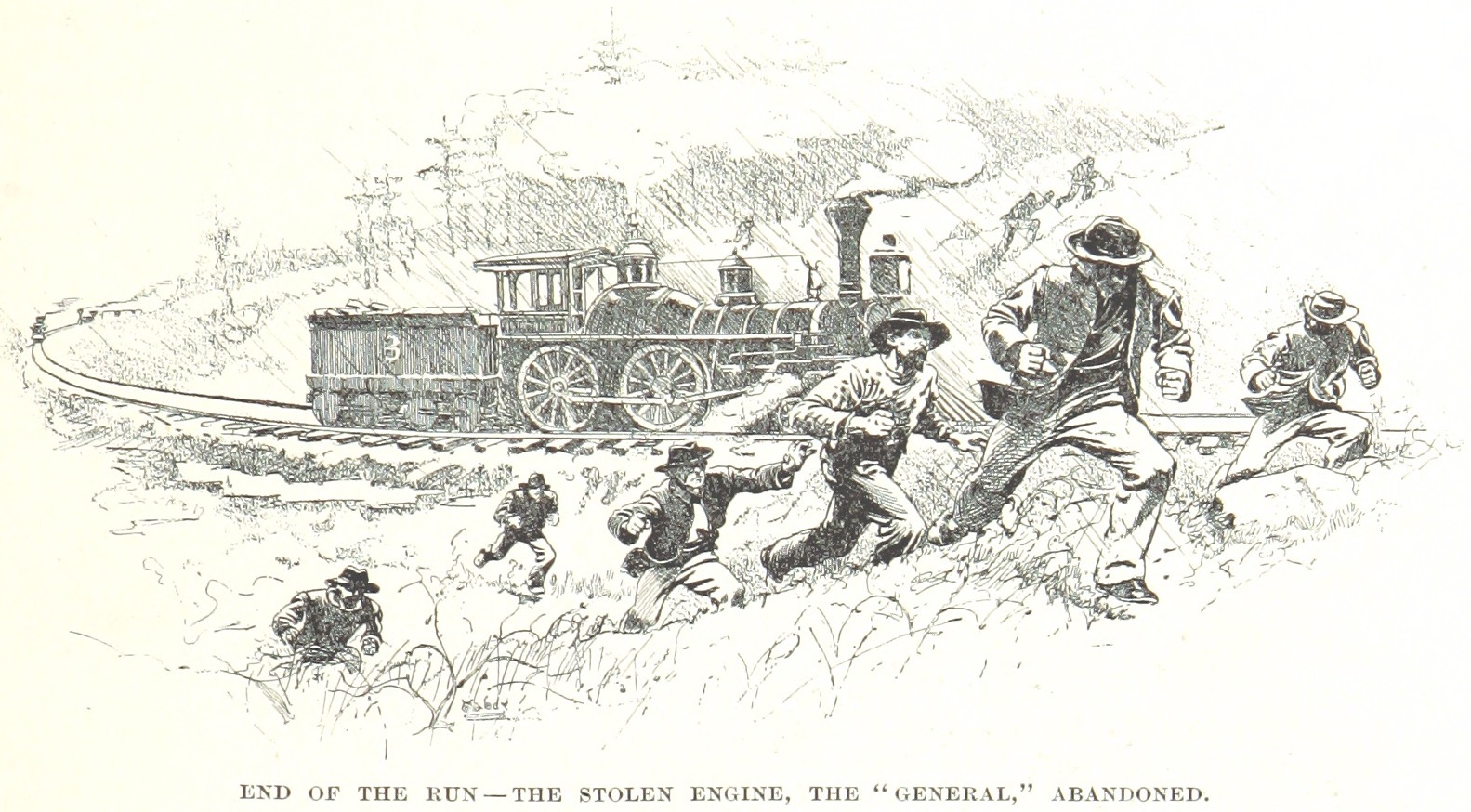
Two miles south of Adairsville, Fuller hit broken track where the raiders had torn up a rail. He abandoned his locomotive and continued on foot yet again until he encountered the southbound locomotive Texas near Calhoun. Andrews had bluffed the Texas crew into taking a siding, but Fuller took command and reversed the engine, running it tender-first in pursuit. From that point, the chase became relentless. The raiders cut telegraph wires and tried to burn bridges, but the April rain had soaked the timbers. They dropped crossties on the track behind them, but Fuller's crew cleared them. The two locomotives steamed through Dalton and Tunnel Hill. Just before the raiders cut the wire north of Dalton, Fuller managed to telegraph ahead to Chattanooga, warning of the stolen engine. Finally, at milepost 116.3 north of Ringgold, Georgia, just eighteen miles from Chattanooga, the General ran out of fuel. Andrews ordered his men to scatter into the woods. Every one of them was captured within two weeks.
The Rope and the Medal
Confederate authorities charged the raiders with acts of unlawful belligerency. Andrews, tried in Chattanooga and convicted as a spy, was hanged in Atlanta on June 7, 1862. Seven more raiders were executed on June 18, their bodies buried in an unmarked grave later relocated to Chattanooga National Cemetery. Eight of the remaining prisoners managed to escape, including two who floated down the Chattahoochee River to the Gulf of Mexico, where the Union blockade vessel USS Somerset rescued them. The last six were exchanged for Confederate prisoners on March 17, 1863. Three days later, the freed raiders arrived in Washington. On March 25, Secretary of War Edwin Stanton summoned them to his office and announced they would receive the newly created Medal of Honor. Private Jacob Parrott, who had been beaten as a prisoner, received the first one ever awarded. The raiders then met President Abraham Lincoln at the White House, starting a tradition for Medal of Honor recipients. As a civilian, Andrews was not eligible for the medal. It was not until July 3, 2024, that President Joe Biden posthumously awarded the medal to the last two previously unrecognized soldiers, Charles Perry Shadrack and George Davenport Wilson.
Iron Horses Preserved
Both locomotives survived the war and the century that followed. The General sits today in the Southern Museum of Civil War and Locomotive History in Kennesaw, Georgia, close to where the chase began. The Texas is displayed at the Atlanta History Center. William Pittenger, a corporal among the raiders, published the first account of the chase in 1863 under the title Daring and Suffering. The book went through multiple editions and, as one newspaper later claimed, found its way into half the old soldier households in the country. Buster Keaton turned the story into his celebrated 1926 silent comedy The General. Walt Disney's 1956 dramatic film The Great Locomotive Chase, starring Fess Parker as Andrews, was filmed on the Tallulah Falls Railway in North Carolina. Since 1979, the city of Adairsville has held The Great Locomotive Chase Festival every October. The railroad route itself is marked with historic sites from Kennesaw to Ringgold, a trail of depots, markers, and downtown districts that traces one morning's wild ride through the Georgia hills.
From the Air
The chase route follows the former Western and Atlantic Railroad corridor from Big Shanty (now Kennesaw, Georgia) at approximately 34.02°N, 84.62°W northward through Adairsville, Calhoun, Dalton, Tunnel Hill, and Ringgold to milepost 116.3 near the Tennessee border. The General is displayed at the Southern Museum in Kennesaw, near Cobb County International Airport-McCollum Field (KRYY). The Texas is at the Atlanta History Center, near DeKalb-Peachtree Airport (KPDK). Chattanooga Metropolitan Airport (KCHA) lies near the chase's intended destination. The railroad corridor and its tunnels are visible along the valley floors between the ridges of northwest Georgia. Recommended viewing altitude: 3,000-5,000 feet AGL to follow the route through the hilly terrain north of Atlanta.