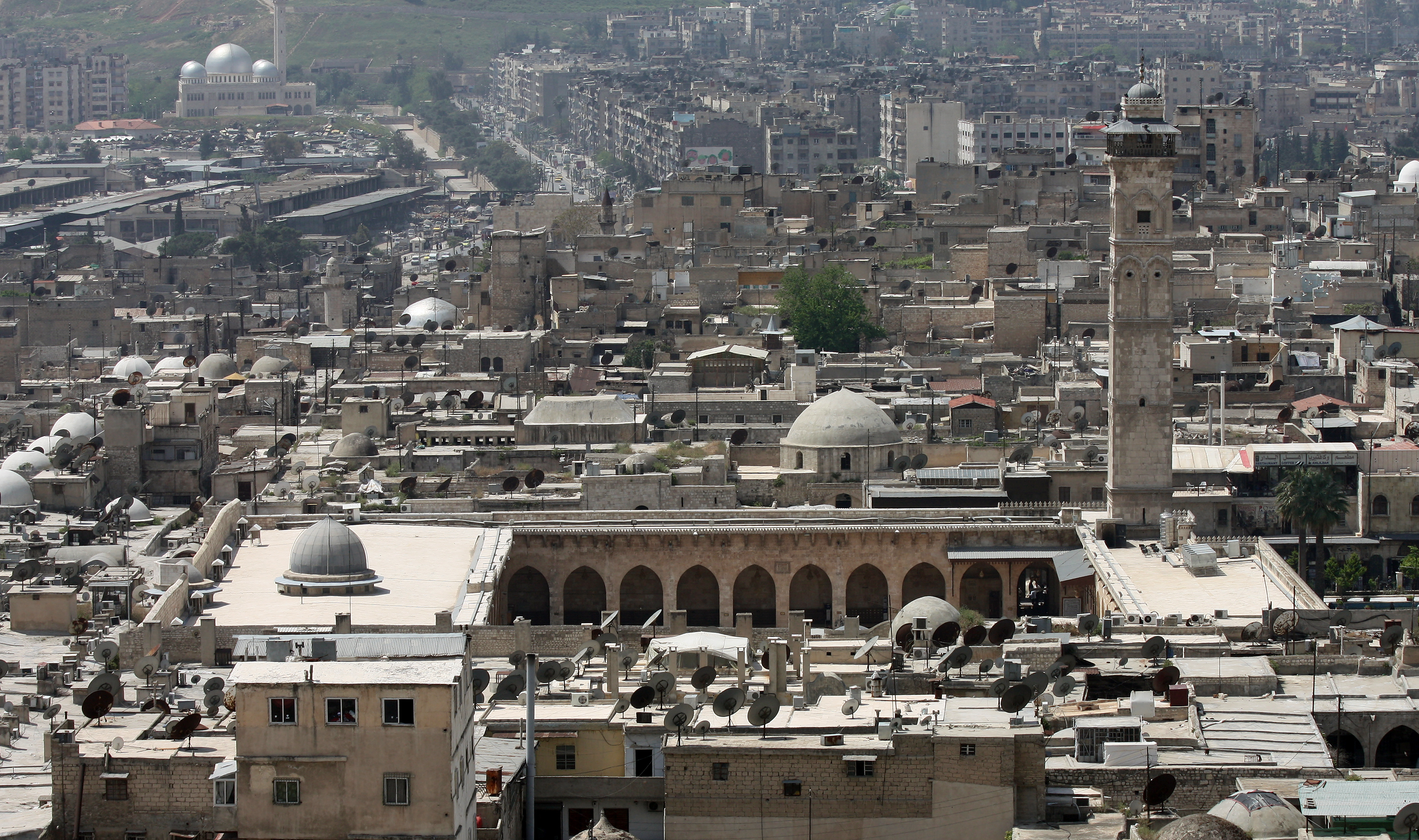
Great Mosque of Aleppo
The minaret fell on a day in April. Built in 1090, the 45-meter tower of the Great Mosque of Aleppo had stood for 923 years when it was destroyed during fighting in the Syrian Civil War in April 2013. Each side blamed the other. What was indisputable was the loss: according to the encyclopedia of Islamic art, that minaret was "quite unique in the whole of Muslim architecture." Carved Kufic and naskhi inscriptions decorated its entire surface, alternating with bands of stylized ornaments and muqarnas. The mosque it rose from -- also known as the Great Umayyad Mosque of Aleppo -- was the largest and one of the oldest in the city, first built during the Umayyad Caliphate in the early 8th century on ground that had been, in earlier centuries, a Greek agora and the garden of a Christian cathedral.
Agora, Cathedral, Mosque
The layers beneath the Great Mosque tell the story of Aleppo itself. During the Hellenistic period, the site was an agora -- a civic gathering place. Under Roman rule, it became the garden of the Cathedral of Saint Helena. When the Umayyad caliph Al-Walid I began construction of the mosque in 715, the land was still being used as a cathedral cemetery. His successor, Sulayman ibn Abd al-Malik, completed the work in 717. The mosque was built with deliberate echoes of the Great Mosque of Damascus: a hypostyle plan with a large marble courtyard surrounded by porticoes, and a courtyard floor of alternating black and white stone forming intricate geometric patterns. This architectural kinship was not accidental. The Umayyads were building a new civilization, and they wanted its mosques to speak with one voice.
The Minaret That Was Unique
In 1090, the Shia Muslim qadi of Aleppo, Abu'l Hasan Muhammad, commissioned the minaret at the mosque's northwest corner during the reign of Seljuk governor Aq Sunqur al-Hajib. The architect, Hasan ibn Mufarraj al-Sarmini, completed the work by 1094. The structure rose five levels to a crowning veranda, each level decorated with carvings that demonstrated continuity with pre-Islamic Syrian architectural traditions -- a minaret that was Islamic in function but drew on much older regional aesthetics. It was built of fine ashlar, and a muqarnas cornice divided the veranda from the shaft below. For nearly a millennium, it served as both a landmark and a summons to prayer, visible across the old city and from the citadel above.
Burned by Mongols, Looted by War
The mosque has a long history of violence. In 1281, Mongol forces burned the building, and the minbar was seized by the Armenians of Sis. The Mamluks, who controlled Aleppo from 1260 to 1516, made repairs and alterations, keeping the mosque functional through centuries of regional instability. But nothing in the building's long history of damage approached what happened between 2012 and 2016. The Syrian Civil War did not merely damage the Great Mosque; it gutted it. Parts of the walls collapsed. The prayer hall burned. Priceless historical artifacts -- including, reportedly, a box said to contain a strand of the Prophet Muhammad's hair -- were subject to looting. Rebels later claimed they had salvaged ancient handwritten Quranic manuscripts and hidden them for safekeeping.
The Shrine of Zechariah
The mosque's maqsurah -- a screened enclosure within the prayer hall -- housed a tomb of particular significance. It was believed to contain the remains of Zechariah, the father of John the Baptist, a figure revered in Islam, Christianity, and Judaism alike. The shrine was decorated with silver embroideries bearing Quranic verses from the chapter of Mariyam. The maqsurah itself was a square domed room, raised one step above the prayer hall floor and adorned with Kashan tiles covering every interior wall surface. A large arched gate with a bronze door screen controlled access. This interreligious resonance -- a Muslim mosque built on a Christian cathedral site, housing the tomb of an Old Testament prophet -- captures something essential about Aleppo's layered identity.
Rebuilding What Cannot Be Replaced
Syrians began restoration work even before the fighting fully ended. The effort has been slow and underfunded. Reports from 2024 indicated the mosque had been partially reopened, though other sources said repairs were still ongoing. In March 2025, the mosque was opened for the month of Ramadan only, and formal reconstruction commenced on 30 November 2025. The minaret will be rebuilt, but the question of what reconstruction means for a building like this is not simple. The ashlar stones can be recut, the muqarnas recarved, the calligraphy re-inscribed. What cannot be reconstructed is the continuity -- the fact that the original minaret had stood in place since 1090, accumulating weather, worship, and the passage of 923 years. What Aleppo builds now will be new. The city's task is to make it worthy of what was lost.
From the Air
Located at 36.20N, 37.16E in the al-Jalloum district of Aleppo's old city, near the entrance to Al-Madina Souq. The mosque is adjacent to the Citadel of Aleppo and within the UNESCO World Heritage zone of the Ancient City. Aleppo International Airport (OSAP) is approximately 10 km east. From altitude, the mosque's courtyard is visible as a light rectangle amid the dense urban fabric of the old city. The partially destroyed minaret site and reconstruction scaffolding may be visible from lower altitudes.