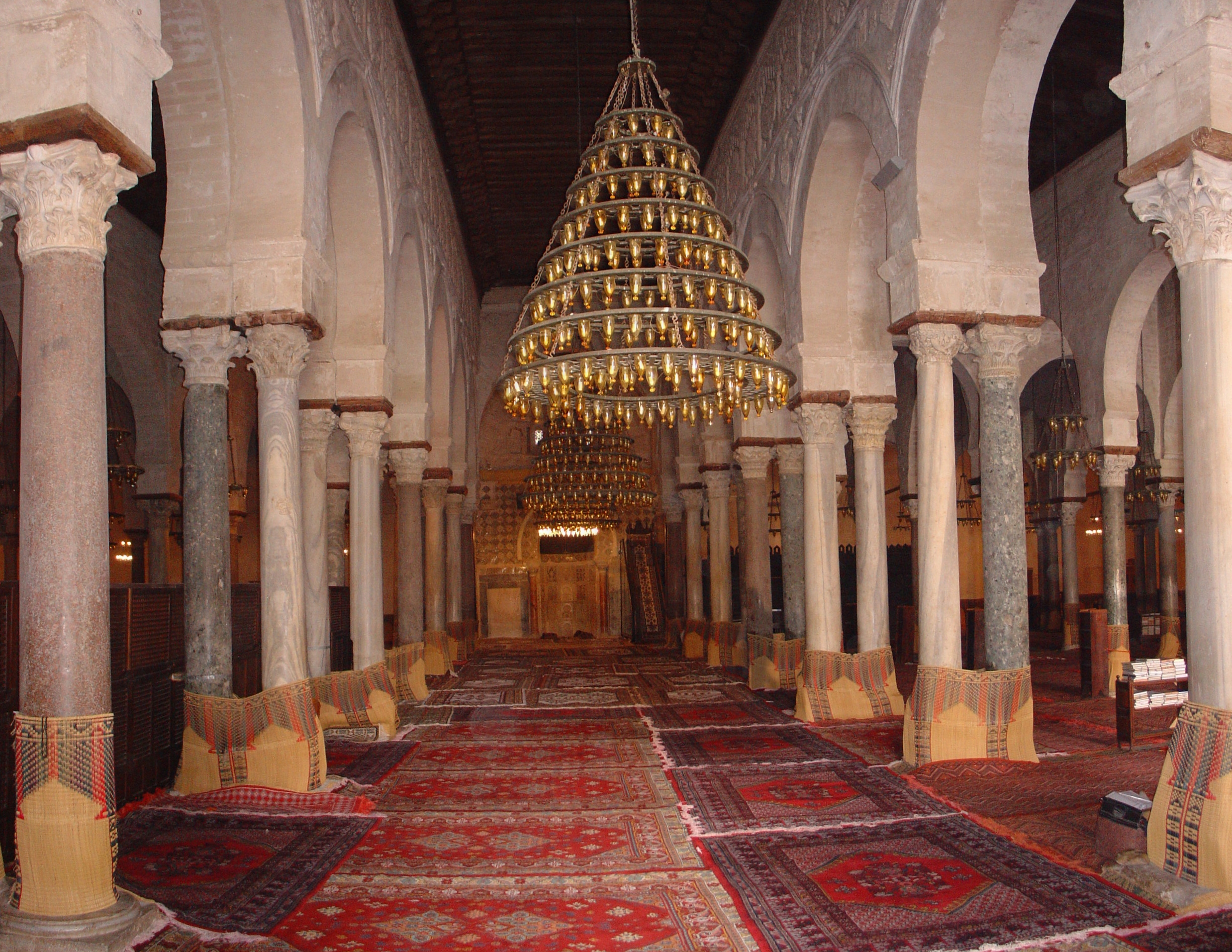
Great Mosque of Kairouan
Guy de Maupassant struggled to describe it. "The unique harmony of this temple," he wrote, "consists in the proportion and the number of these slender shafts upholding the building, filling, peopling, and making it what it is, create its grace and greatness." The Great Mosque of Kairouan contains over 500 columns, many salvaged from Roman and Byzantine ruins at Carthage, Sbeitla, and Chemtou. Their varied marble -- white from Italy, greenish and pink from Tunisian quarries -- creates a forest of stone in which no two trees are quite alike. This is the oldest mosque in the Maghreb, the prototype for an entire architectural tradition, and it holds artifacts that have been in continuous use for more than a thousand years.
The Oldest Standing Minaret
The minaret rises 31.5 meters from a square base measuring 10.7 meters on each side, centered on the northern facade of the mosque's enclosure. Its three tapering levels give it a form that became the template for every minaret in the western Islamic world, from Morocco to Andalusia. The base incorporates stone blocks bearing Latin inscriptions from the Roman period, probably reused during construction around 725 AD under the Umayyad governor Bishr ibn Safwan. The tower's interior staircase of 129 steps ascends beneath a barrel vault, while the south facade facing the courtyard is pierced with windows for light and ventilation. The other three facades have only narrow arrowslits -- the minaret served as a watchtower as well as a platform for the call to prayer. Despite its massive form and austere decoration, the tower achieves what architectural historians describe as a harmonious structure and majestic appearance.
A Courtyard That Catches Rain
The mosque covers approximately 9,000 square meters -- an irregular quadrilateral longer on its east side (127.6 meters) than its west (125.2 meters). The vast courtyard is paved in white marble slabs that slope subtly toward the center, where an ingenious rainwater collection system -- the impluvium, probably installed during the Muradid period (1686-1696) -- filters stormwater through horseshoe arches sculpted in white marble before feeding it into an underground cistern. A horizontal sundial dating to 1843 stands near the center, inscribed in Naskhi script, its purpose unchanged: determining the times of daily prayers. The surrounding porticoes display double rows of horseshoe arches supported by columns in various marbles, granite, and porphyry, all salvaged from Roman, Early Christian, and Byzantine monuments.
Lusterware, Teak, and Eleven Centuries of Prayer
The mihrab -- the prayer niche indicating the direction of Mecca -- is surrounded by 139 lusterware tiles arranged in a checkerboard pattern. Each tile is 21.1 centimeters square, and they date from the mid-9th century, though scholars still debate whether they were made in Baghdad or in Kairouan by a Baghdadi artisan. Their metallic sheen ranges from smoked gold to green gold, a polychrome palette unlike anything else in the early Islamic world. Beside the mihrab stands the minbar, a pulpit assembled from more than 300 pieces of finely carved teak wood. It is the oldest minbar still in its original location anywhere in the Islamic world, still in use after more than eleven centuries. Its panels display pine cones, grape leaves, lanceolate fruits, and geometric patterns that reference both Umayyad and Abbasid decorative traditions. All but nine of its original panels survive.
Fortress, Library, Living Monument
From the outside, the mosque resembles a fortress: its ocher walls are 1.9 meters thick, buttressed and towered, pierced today by nine gates though medieval geographers recorded about ten, named differently from those surviving. The fortress appearance is not accidental -- the mosque has served defensive purposes across its history. Inside, the prayer hall stretches 70.6 meters wide and 37.5 meters deep, divided into 17 aisles by rows of columns whose Corinthian, Ionic, and Composite capitals testify to the Roman buildings from which they were taken. The central nave is wider and higher than the others, creating a triumphal passage leading to the mihrab. A library near the maqsura holds a collection of calligraphic manuscripts dating to the late 9th century, including the oldest surviving corpus of Maliki legal literature. The Zirid-era maqsura, a cedar wood enclosure carved during the first half of the 11th century, is the oldest still in place in the Islamic world -- a private space for rulers to pray without mingling with the faithful.
From the Air
Located at 35.68°N, 10.10°E in the city of Kairouan, central Tunisia. The mosque compound is one of the largest structures in the old city, identifiable from the air by its rectangular enclosure and prominent square minaret. Recommended viewing altitude: 3,000-5,000 feet AGL. Nearest airports: Monastir Habib Bourguiba International (DTMB) approximately 60 km east, Enfidha-Hammamet International (DTNH) approximately 80 km northeast. Kairouan sits on the semi-arid central Tunisian plain.