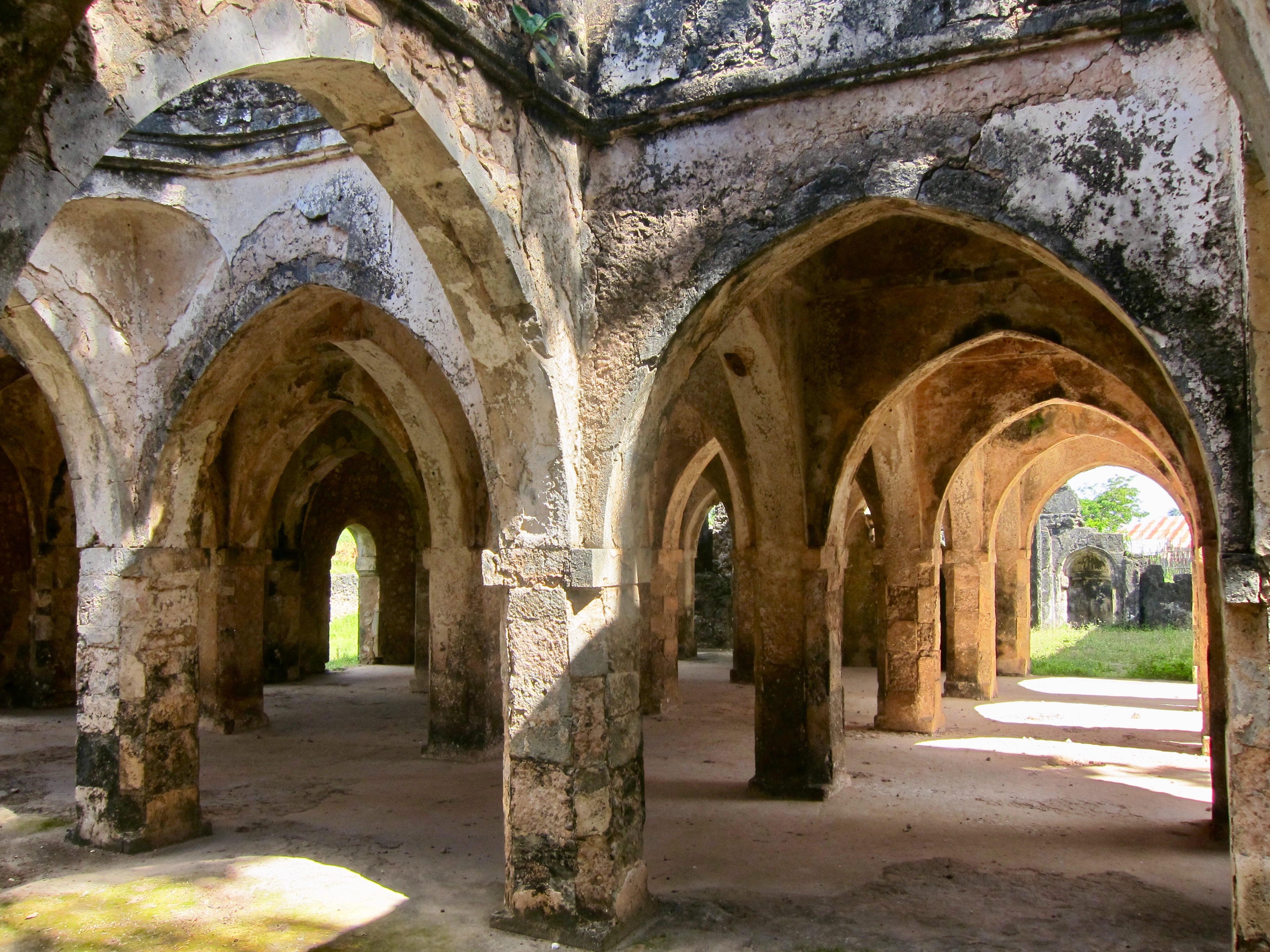
Great Mosque of Kilwa
When Ibn Battuta described the mosque at Kilwa in 1331, he claimed it was made entirely of wood. He was wrong. The walls were coral limestone, and they had been standing since at least the 11th century. But the great Moroccan traveler can perhaps be forgiven: by the time he arrived, Sultan al-Hasan ibn Sulaiman had just added a soaring domed extension to the south, and the interplay of timber beams, coral columns, and vaulted ceilings may have confused the eye. Within that same year, an earthquake collapsed much of the structure. The arched roof in the eastern section survived, protected by its claveaux construction. A single dome on the southeast corner -- possibly the mausoleum of the sultan himself -- remained standing. It still stands today.
A Mosque Without a Courtyard
The Great Mosque of Kilwa was unusual from the start. Most mosques of its era included a sahn -- an open courtyard for gathering before prayer. Kilwa's did not. Founded likely in the 10th century on the island of Kilwa Kisiwani, it was one of the first mosques on the Swahili coast to dispense with that convention entirely. The original northern prayer hall, dating to between 1131 and 1170, was a compact rectangular structure with load-bearing walls of squared coral limestone blocks. Three symmetrical entrances with vaulted ceilings led into a space where nine hexagonal columns -- originally carved from single coral stones, and later replaced with timber -- supported a flat roof of coral tiles embedded in mortar. Archaeological discoveries revealed that the roof's underside was decorated with concentric circles, and traces of red paint suggest the interior was once adorned in red and black.
The Sultan's Grand Extension
Between 1294 and 1302, the mosque was extended southward with a semicircular vault that served as the sultan's private prayer space. But the truly ambitious expansion came in the early 14th century under Sultan al-Hasan ibn Sulaiman, the same ruler who built the magnificent Palace of Husuni Kubwa nearby. His addition included the great dome that caught Ibn Battuta's attention during his 1331 visit. The southern extension followed the established pattern -- square bays divided by columns, no central courtyard -- but its scale dwarfed the original. The columns evolved over time: the original nine hexagonal wooden supports gave way to coral stone pillars, and by the 14th century, traces of octagonal pillars suggest further architectural refinement. The mihrab, indicating the direction of prayer, appears to be a later addition. Its design -- a pointed arch with capitals, pilasters, friezes, and a fluted half-dome vault -- differs markedly from the rest of the structure, hinting at Shirazi influence.
Coins in the Walls
The mosque yielded more than architecture. Pots of copper coins were found embedded within the walls themselves, all bearing the name Ali ibn al-Hasan. Because every coin carried the same ruler's name, they became the most convincing evidence for identifying the earliest sovereign of Kilwa. The coins were sealed into the masonry, placed there before the currency was in wide circulation -- proof that the stonework predated the coins' common use. An early inscription found at the site dated to 1269, marking the start of construction on the mosque's minaret. Together, the numismatic and epigraphic evidence allowed archaeologists to establish a rough timeline for the building's phases that aligned with -- and sometimes corrected -- the written chronicles.
Water Channels and Ablution
The western section of the mosque housed something easily overlooked amid the grand arches and coral columns: the ablution area. Essential to Islamic worship, it was where congregants performed ritual cleansing before prayer. Restoration work unearthed an intricate network of water channels made from baked clay, revealing a sophisticated water management system. On an island with no rivers and limited freshwater, where wells have been in use for over a millennium, engineering reliable water delivery to a congregational mosque was no small achievement. The system speaks to the practical ingenuity that matched Kilwa's architectural ambition -- a reminder that the builders of the Great Mosque were solving problems of climate and geography alongside questions of form and beauty.
Ruins That Refuse to Disappear
The mosque was abandoned during the 18th century, part of Kilwa's broader decline after Portuguese disruption and Omani conquest. For two centuries, the coral walls weathered salt air and tropical storms. Between 2005 and 2009, the Zamani Project documented the surviving structure using terrestrial 3D laser scanning, creating detailed digital records of what remains. The site sits within the UNESCO World Heritage Site of Kilwa Kisiwani, designated in 1981 and also listed as a National Historic Site of Tanzania. Today, the nine polygonal column bases of the original northern hall are still visible, rising from the rubble like the remnants of a forest. The lone southeastern dome -- whether mausoleum or prayer chamber -- endures as the most intact element of a building that once anchored the spiritual life of one of medieval Africa's wealthiest cities.
From the Air
Located at 8.96S, 39.50E on the island of Kilwa Kisiwani, off Tanzania's southern coast. Best viewed from 1,500-2,500 feet AGL approaching from the southeast, where the mosque ruins are visible among the broader archaeological complex. The Palace of Husuni Kubwa sits on a bluff to the northeast. Nearest airfield: Kilwa Masoko Airport (HTKI). The Indian Ocean coastline and mangrove-fringed harbor are prominent visual references.