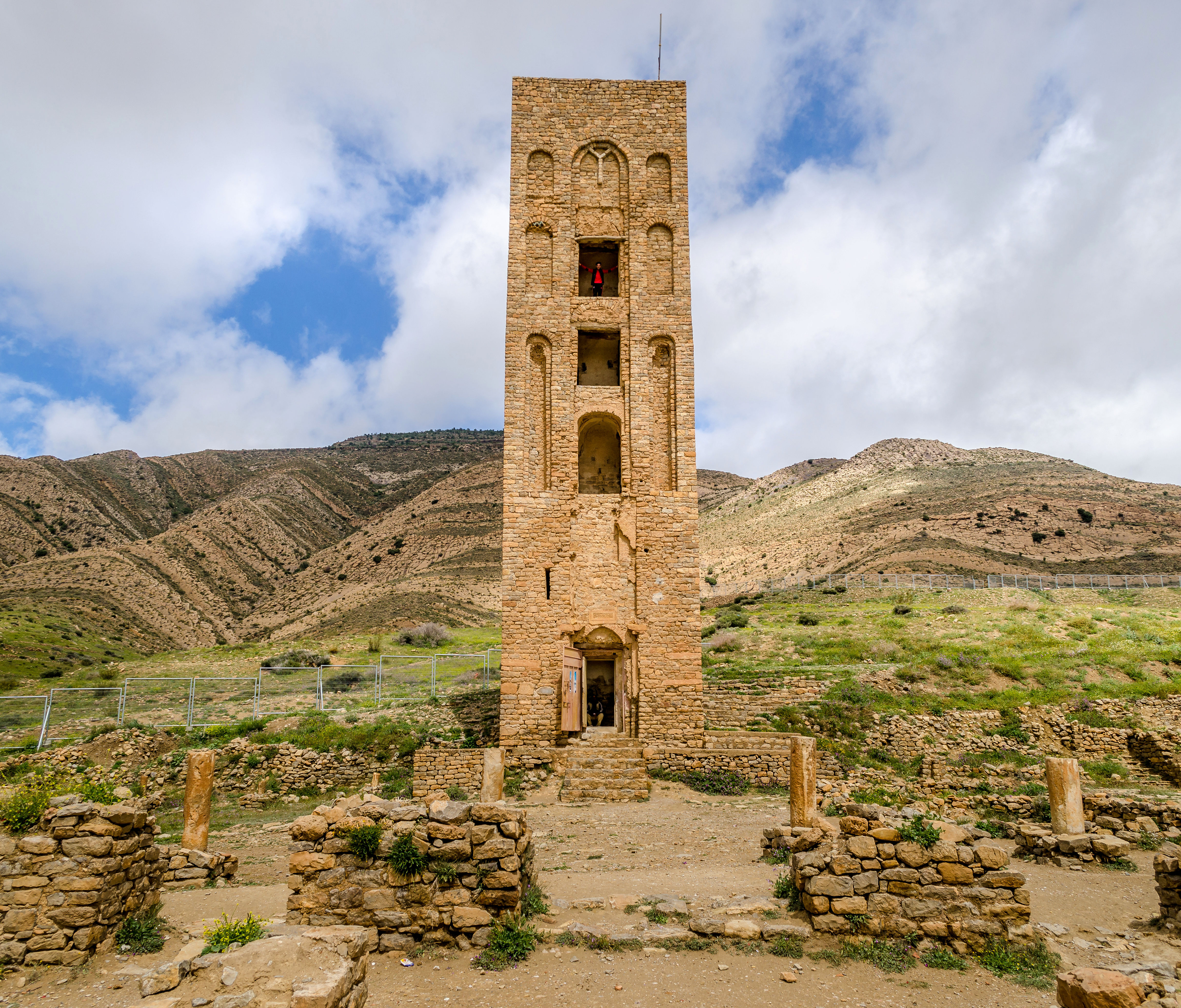
Great Mosque of Qal'at Bani Hammad
The Giralda in Seville is one of the most recognizable towers in the world. Few of its millions of visitors know that its decorative scheme -- ornamental registers arranged in vertical strips across the facade -- was not invented in Spain. The pattern first appeared on a minaret in the mountains of central Algeria, in a city that no longer exists. The Great Mosque of Qal'at Bani Hammad, now in partial ruins within a UNESCO World Heritage Site, introduced a design language in the early 11th century that would travel westward across the Islamic world and leave its mark on some of medieval architecture's most celebrated buildings.
The First Building
When the Hammadid emir Hammad ibn Buluggin founded his fortified capital city in the Hodna Mountains, the mosque was the first structure he built. This was standard practice in the establishment of Islamic cities, as the historian Ibn Khaldun noted: the congregational mosque came first, followed by the administrative center, then residential quarters. The Great Mosque of Al Qala'a was therefore not merely a place of worship but the cornerstone of a new political order. The Hammadid Emirate, an independent Berber dynasty that had broken away from the Zirids, needed a capital that announced its legitimacy, and the mosque's scale -- with a prayer hall measuring 53.2 meters long and 34.2 meters wide, thirteen arches, and naves perpendicular to the qibla wall -- delivered that announcement.
The Minaret That Changed Architecture
At the heart of the mosque's northern courtyard wall stands the minaret, currently reaching 25 meters (82 feet). Only its south-facing facade, overlooking the sahn, is decorated. What makes it extraordinary is the arrangement of that decoration: three vertical registers of ornament, a scheme that had no precedent in Islamic architecture. This pioneering design was later echoed in the Almohad minarets of the 12th century -- most notably the Giralda in Seville, the Kutubiyya Mosque in Marrakech, and the Hassan Tower in Rabat. The influence also appears in Zayyanid and Merinid mosques in Tlemcen, including the minaret of Mansourah Mosque, whose facade decorations show clear kinship with the Qal'at Bani Hammad original.
Courtyard and Cistern
The sahn -- the open courtyard that forms the heart of a traditional mosque -- spans 53.2 meters on its longer axis, encircled by a portico and paved with white tiles. At its center sits a cistern fed by a natural spring, measuring 11.15 meters long, 5.4 meters wide, and 2.8 meters high. The courtyard design reflects Hammadid urban planning at its most confident: monumental scale combined with practical engineering. Water management was central to life in the Hodna Mountains, and the cistern's integration into the mosque's sacred space elevated a basic infrastructure need into an architectural feature. The columns that once supported the prayer hall -- described by the French explorer Paul Blanchet as pink or white marble -- have since disappeared.
Ruin and Rediscovery
The mosque's decline followed the city's. When the Banu Hilal swept through the region, Qal'at Bani Hammad lost its importance and was eventually abandoned. The Great Mosque fell into ruins and remained buried until the colonial period, when General de Beylie led a three-and-a-half-month excavation in 1908. Between 1964 and 1972, the Algerian researcher Rachid Bourouiba unearthed more of the mosque's plan. The minaret was restored in 1974, and a UNESCO preservation program ran from 1976 to 1982, followed by an Algerian-Polish restoration mission in 1987. Emir Al Nacir had modified the mosque during his reign from 1062 to 1088, adding a second phase of construction. Today, the minaret stands as the most visible survivor of a city that once attracted poets, sages, and theologians from across the Maghreb.
From the Air
Located at 35.81N, 4.79E in the Hodna Mountains of M'sila Province, Algeria, at approximately 1,418 meters elevation. The minaret is the most visible surviving structure within the UNESCO World Heritage Site of Qal'at Bani Hammad. Best viewed at 3,000-5,000 feet AGL. Nearest airport: DABC (Mohamed Boudiaf Airport, M'sila), approximately 60 km southwest. The site appears as ruins on a mountain plateau northeast of M'sila.