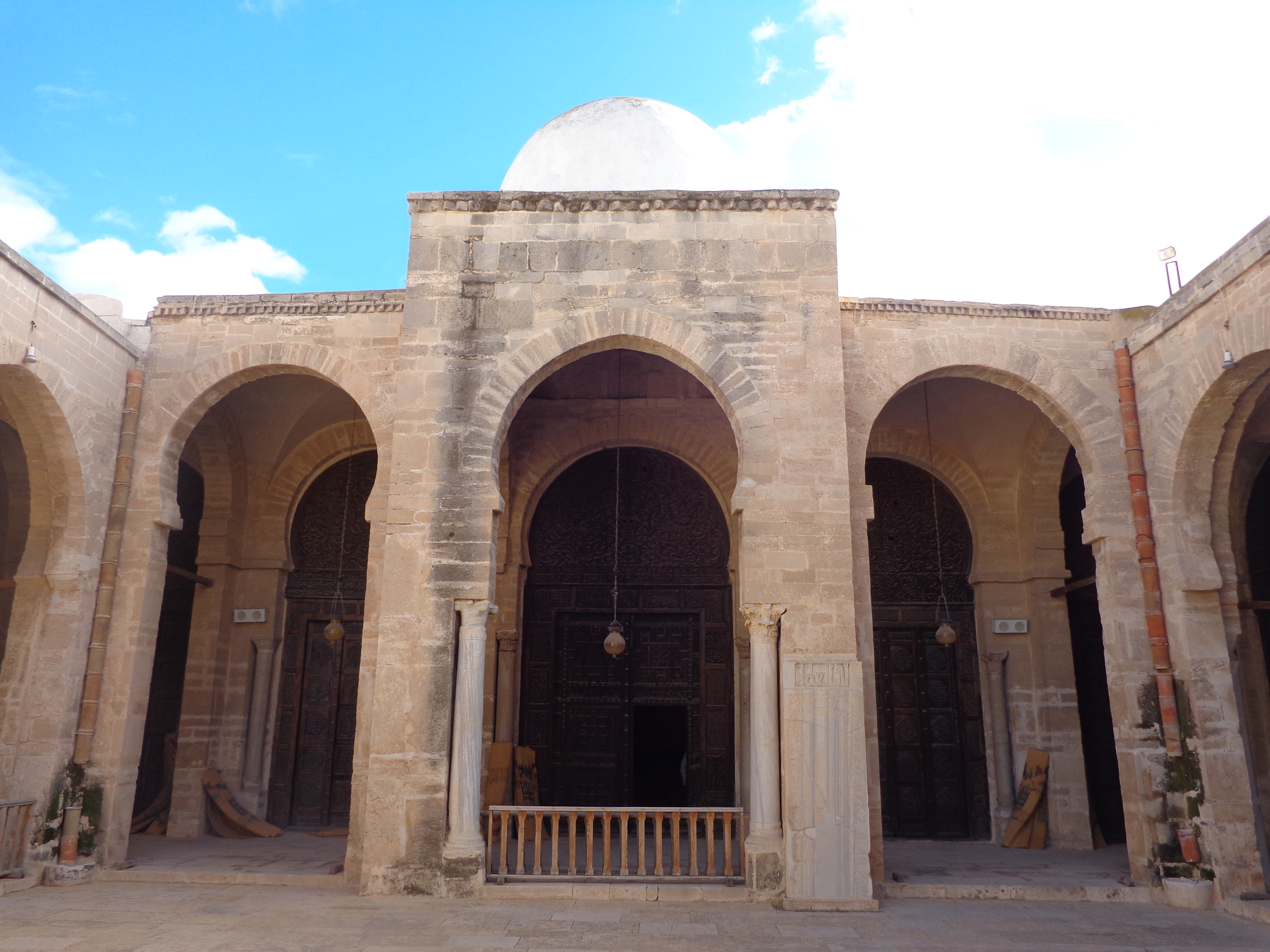
Great Mosque of Sfax
Look closely at the eastern facade of the Great Mosque of Sfax and you will find, set into the wall above a window, a marble panel carved with two peacocks facing each other against a background of foliate motifs. Above them runs a Greek inscription, partly chiseled away at some unknown date, that appears to invoke God, Christ, or the Virgin Mary. A Christian artwork, with figural imagery, embedded prominently on the exterior of a mosque. The incongruity is the point. This building has been accumulating contradictions and absorbing civilizations since the Aghlabid dynasty built it in the mid-ninth century, and it wears every one of them on its walls.
Heart of the City, Heart of the Faith
The mosque occupies the precise center of the old city of Sfax, a positioning that scholars have compared to the layout of Kufa, one of the earliest planned Islamic cities. From the moment of its construction, commissioned by the qadi Ali ibn Aslam al-Jabanyani, a student of the Maliki scholar Imam Sahnun, the mosque defined Sfax's urban geography. Markets and production centers clustered around it, and they still do. The building is simultaneously a place of worship and an economic anchor, the spiritual and commercial heart of the medina beating at the same location for more than eleven hundred years. Its centrality is not metaphorical. Every major artery in the old city radiates from or passes through the mosque's immediate vicinity.
Renovations That Rewrote the Plan
The mosque that stands today is not the one the Aghlabids built. In the tenth century, the Zirids, vassals of the Fatimid caliphs, reduced the building's size by suppressing its western half, leaving the minaret stranded at the corner of the courtyard rather than at the center of its northern side, where Aghlabid convention placed it. Repairs in 980 and 988 reshaped the interior. Later centuries brought re-enlargement, adding four western naves to the five surviving eastern ones. The prayer hall's nine aisles now run perpendicular to the qibla wall, divided by rows of arches resting on reused ancient columns, a common practice in Islamic architecture that physically incorporated the Roman and Byzantine past into the living fabric of the mosque. The original flat wooden ceilings gave way to masonry groin vaults. The eighteenth-century central mihrab, fluted on the inside and decorated with Kufic inscriptions, replaced an earlier Zirid mihrab that was walled off for years before being reopened.
A Minaret That Remembers Kairouan
The minaret is the building's most distinctive feature, a thick cuboid tower roughly twenty-five meters tall that the Zirids built around the original, much smaller Aghlabid minaret. Its design consciously evokes the ninth-century minaret of the Great Mosque of Kairouan rather than the contemporary Fatimid-Zirid style, a deliberate architectural statement. The tower rises in three tiers, the lowest three stories tall, pierced by a door and windows with mixtilinear shapes. Horizontal bands of decoration crown the shaft: triangular dentils, a frieze of recessed circles, an elegant Kufic inscription, and pierced merlons that recall the Mosque of Ibn Tulun and Fatimid mosques in Cairo. The summit is a lantern-like structure open on four sides, with engaged colonettes at its corners and a dome on top. French bombardment during the 1881 siege of Sfax damaged the minaret, and bombs fell again during World War II in 1942, but local contractors organized repairs each time.
The Peacocks and the Prayer
The eastern facade remains the mosque's most enigmatic element. Decorative horseshoe-arch niches frame doors and windows, some containing Arabic inscriptions. Scholars including Lucien Golvin and Georges Marcais have attributed this facade to the Zirid period, though its unusual character has invited debate. The Byzantine marble panel with its peacocks and Greek inscription is the facade's most provocative detail. How a Christian artwork with figural imagery came to be displayed on a mosque has never been satisfactorily explained. One theory points to Fatimid tolerance of unorthodox expression. Another suggests local patrons of Byzantine ancestry reused the panel. Since the inscription no longer names the Christian figure it originally honored, it may have been read as compatible with a broadly religious message. Whatever the explanation, the panel embodies the Great Mosque's deepest truth: that in Sfax, as across North Africa, civilizations did not simply replace one another. They built on top of each other, and sometimes inside each other.
From the Air
Located at 34.74°N, 10.76°E in the center of the old city (medina) of Sfax, Tunisia's second-largest city. The minaret is the most visible feature from the air. Sfax-Thyna Airport (DTTX) lies south of the city. Approach from the east over the Mediterranean for a view of the medina's dense urban fabric with the mosque at its center. Fly at 2,000-4,000 ft AGL. The contrast between the compact walled medina and the modern city spreading around it is striking from altitude.