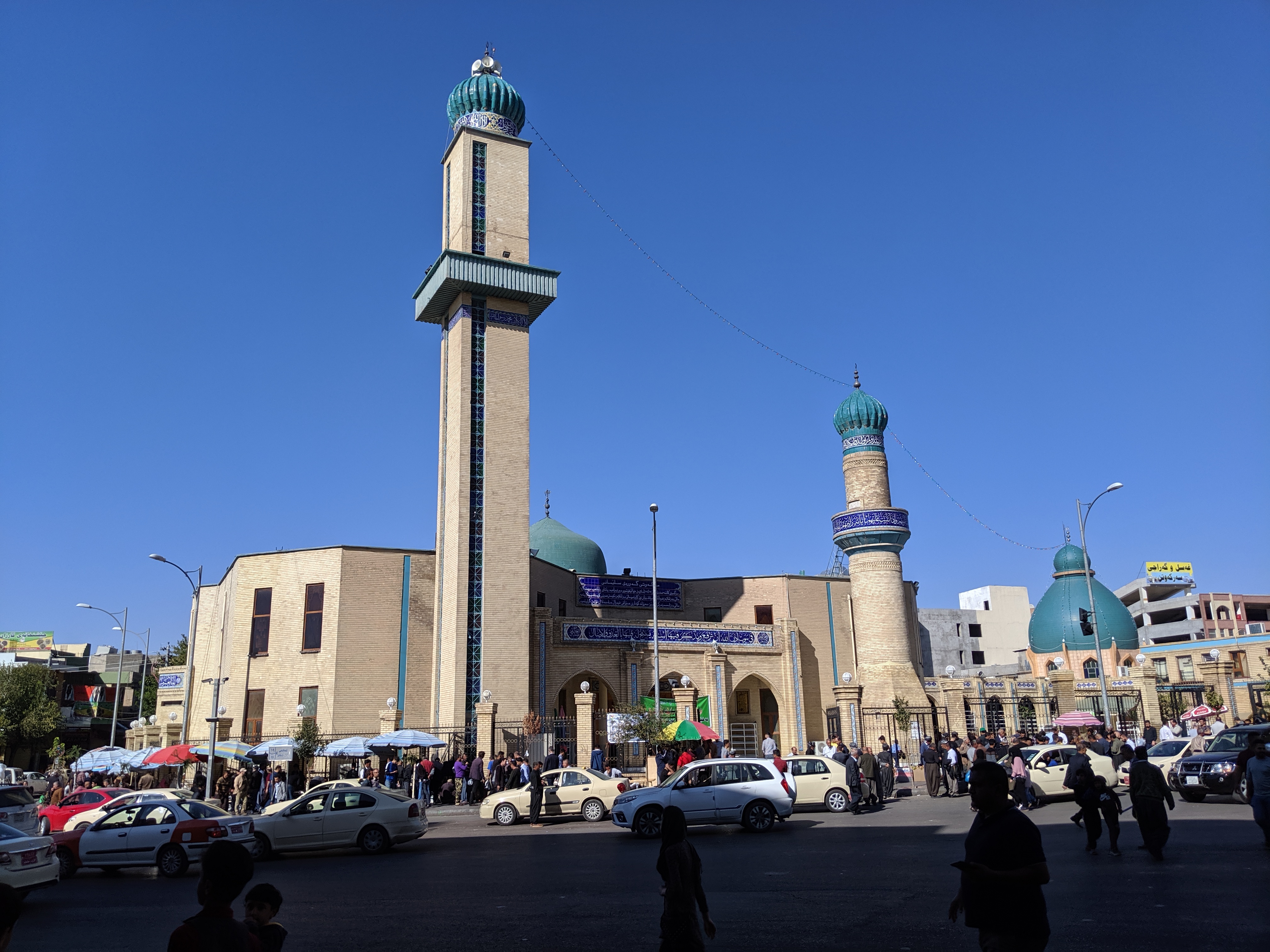
Great Mosque of Sulaymaniyah
The cafeteria is still open. That detail matters more than the architecture, more than the royal tombs, more than the Qur'anic verses carved into the facade. Since 1784, the Great Mosque of Sulaymaniyah has been feeding people who need a meal, a tradition that stretches unbroken from the founding of the mosque to this afternoon's lunch service. Also known as the Grand Mosque and the Sheikh Ahmad Mosque, it stands in the heart of Sulaymaniyah in the Kurdistan Region of Iraq, a building that has been demolished and rebuilt three times but has never abandoned its original purpose.
The Emir's Foundation
Ibrahim Pasha Baban, emir of the Baban principality, founded the mosque in 1784 and completed it the following year. Ibrahim Pasha was not building a monument to faith alone. He was building a city. Sulaymaniyah itself was his creation, and the mosque was its spiritual anchor. The Baban dynasty, a Kurdish ruling family that governed from their stronghold in this corner of what is now Iraq, understood that a city needs a center, and that center needs a purpose beyond prayer. The mosque was designed to serve: worship, education, charity. It contained the tomb of Haji Kaka Ahmad, a Kurdish cleric whose reputation rested on a simple act repeated endlessly. He fed the hungry. His cafeteria outlasted his lifetime, his dynasty, and the empire that once claimed sovereignty over these lands.
Three Rebuildings, One Blueprint
The original mosque was built of mud brick and clay, materials that do not forgive time. Rebuilding came in 1940, then again in 1950, and finally in 1968, when the structure was completely reconstructed in brick. Each rebuilding maintained the same layout and preserved certain details of the original design, a deliberate act of architectural memory. The result is a mosque that feels older than its physical materials because it is. The bones are mid-20th century. The plan is 18th century. You enter through the northern portal into a courtyard. A long hallway runs along the north side. A summer prayer hall opens to one side, with an adjacent room for religious teachers and a library holding valuable texts. The main prayer hall was expanded following a classical Islamic design that simultaneously evokes the older mud-brick structure, Qur'anic verses inscribed across its facade.
Tombs of Kings and Rebels
A pathway beside the prayer hall leads to the royal mausoleum of the Baban family, topped by a dome. But the most significant burial belongs to two men separated by generations and united by struggle. Haji Kaka Ahmad, the cleric who fed the poor, rests in a corner room within the mosque, his grave enclosed by a zarih, the ornamental metalwork cage that marks a revered burial in Islamic tradition. Nearby lies his grandson, Mahmud Barzanji, a figure of an entirely different kind. Barzanji fought against the British occupation of Iraq in the early 20th century, declaring himself King of Kurdistan in a bid for independence that the Royal Air Force ultimately crushed. Grandfather and grandson, one known for generosity and the other for defiance, share the same sacred ground.
A Living Institution
The mosque remains a working religious institution, not a museum. Daily prayers continue. The library serves scholars. And the cafeteria, Haji Kaka Ahmad's most enduring legacy, still operates. During Ramadan, it provides iftar meals to those who cannot afford their own. The mosque is currently supervised by Muhammad Shaykh Salar, himself a grandson of Haji Kaka Ahmad, maintaining a family connection to the institution that now spans centuries. In a city that has weathered Ottoman rule, British mandates, Ba'athist repression, and the upheavals of Kurdish autonomy, the Great Mosque of Sulaymaniyah has remained what it was designed to be: a place where people pray, learn, and eat together.
From the Air
Located at 35.56N, 45.44E in central Sulaymaniyah, Kurdistan Region of Iraq. The mosque sits in the old city center and is identifiable by its dome and minaret. Nearest airport is Sulaymaniyah International Airport (ORSU), about 8 km to the west. Best viewed below 3,000 feet AGL. The urban grid of Sulaymaniyah spreads across the basin with the Zagros foothills visible to the northeast.