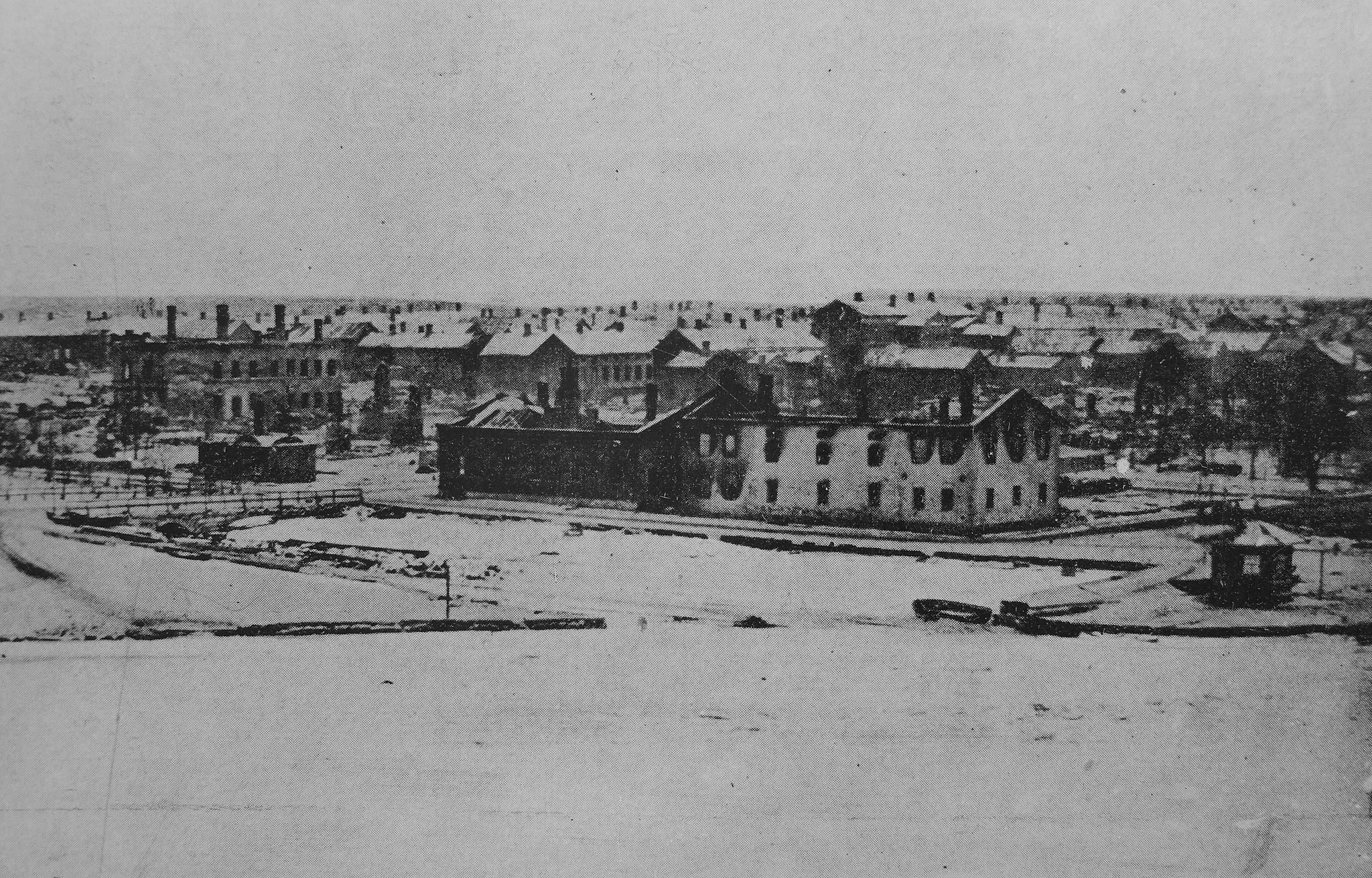
Great Oulu Fire of 1882
The pharmacist kept gasoline in the basement. In a wooden city built on the tar trade, where nearly every structure was timber and the November air was dry and cold, this was the kind of detail that mattered only once -- and catastrophically. On the evening of November 2, 1882, a fire broke out in the cellar of the pharmacy at the corner of Kirkkokatu and Pakkahuoneenkatu in downtown Oulu, Finland. The flammable materials stored below fed the flames with a ferocity that overwhelmed the city's fire brigade almost immediately. Before the night was over, 27 buildings had been reduced to ash.
A City That Kept Burning
Oulu's relationship with fire was old and brutal. The city had already suffered devastating conflagrations in 1652, when the flames consumed most of the young settlement including burghers' houses, the castle bridge, and island storage sheds. In 1705, twin fires struck in quick succession -- the first in July destroyed 105 houses in just two and a half hours, the second in August took 39 more along with outlying sheds. By the time the 1882 fire erupted, Oulu had been rebuilt in wood each time, a pattern repeated across Finnish and Scandinavian cities where timber was abundant and cheap but stone was not. The Great Fire of 1916 would eventually add another chapter, destroying nearly an entire city block and leaving 200 people homeless. Oulu burned because Oulu was made of wood, and wood was the material that had made Oulu rich.
Tar, Timber, and Flammable Wealth
By the late nineteenth century, Oulu was one of Finland's most important trading ports, and its wealth flowed from the interior forests. The city had been a major center for the export of wood tar since the eighteenth century, when Oulu and Gamlakarleby together handled two-thirds of Finland's entire tar output. Salmon fishing added to the river economy. The warehouses lining the Oulu River held the raw materials of this trade -- salt for curing, grain for provisioning, and the barrels of tar destined for the shipyards of Europe. These were exactly the buildings the 1882 fire consumed as it swept from the pharmacy down Hallituskatu and Pakkahuoneenkatu toward the waterfront, devouring the salt and grain warehouses along the Oulu River's shoreline. The city's commercial heart burned alongside its civic pride: the Seurahuone, Oulu's municipal social hall, was among the 27 structures lost.
The Line the Fire Brigade Held
The fire brigade fought a losing battle through the downtown blocks, but they managed one critical victory: they kept the flames from reaching the packhouse. In a city whose economy depended on the storage and shipment of goods, saving the packhouse meant saving the infrastructure needed to resume trade. The firebreak the brigade established along the waterfront held, and the conflagration burned itself out before it could jump to the districts across the river. The loss of 27 buildings was severe -- Oulu was not a large city -- but it could have been total. The experience reinforced lessons that Finnish cities had been learning and forgetting for two centuries: wooden cities need wider streets, stone firewalls, and regulations about what can be stored in basements.
Rebuilding on Familiar Ground
Oulu rebuilt, as it always had. The downtown blocks along Hallituskatu and Pakkahuoneenkatu rose again, though the rebuilt city began incorporating more stone and brick into its construction -- a trend that would accelerate after the 1916 fire finally drove the point home. The pharmacy corner where the 1882 fire started returned to commercial life, its dangerous cellar a memory absorbed into the city's long catalog of near-destruction. Today, Oulu is Finland's fifth-largest city and a center for technology and education, its wooden past largely replaced by modern architecture. But the street grid downtown still follows the paths that the fires of 1652, 1705, 1882, and 1916 cleared and re-cleared, each conflagration a surveyor's reset that shaped the city we see from the air today.
From the Air
Located at 65.01N, 25.47E in downtown Oulu, Finland, along the Oulu River near where it empties into the Gulf of Bothnia. The city center and river delta are clearly visible from altitude. Oulu Airport (EFOU) is approximately 15 km to the southwest. The city sits at the mouth of the Oulu River, with flat coastal terrain extending to the west and boreal forest inland. The downtown grid pattern -- shaped in part by successive fires -- is visible from low altitude.