Great Palace of Constantinople
Mehmed II walked through empty rooms on the day Constantinople fell in 1453, and according to Ottoman tradition the young conqueror murmured a couplet from the Persian poet Saadi as he passed beneath the cobwebbed arches: about the spider weaving its curtains in the palace of the Caesars, the owl singing its watch-song in the towers of Afrasiyab. He was looking at the Great Palace of Constantinople, once the throne-seat of the Eastern Roman Empire. Or what remained of it. By that morning, a century of Latin neglect, Palaiologan poverty, and slow demolition had reduced 690 years of imperial glory to roofless halls and rubble. The Sultan ordered the rest pulled down to make room for his new city.
The First Stones
When Constantine the Great refounded the old Greek colony of Byzantion as Constantinople in 330, he laid out a palace for himself in the southeastern corner of the peninsula, between the Hippodrome and the church that would become Hagia Sophia. The site was strategic and theatrical at once. From the imperial box in the Hippodrome the emperor could appear to his subjects through a passage that connected directly to the Palace of Daphne, his private quarters. From the sea walls below, the Bosphorus opened to the trade of the world. Six terraces stepped down a 33-meter slope from the upper city to the shoreline, and on each level the emperors built halls, chapels, gardens, baths, barracks, and reception rooms over a footprint that exceeded 200,000 square feet.
Justinian Rebuilds
In January 532, the chariot-racing factions of the Hippodrome rioted in the streets of Constantinople. The Nika Revolt nearly toppled the throne, killed thousands, and burned much of the palace and the original Hagia Sophia to the ground. Emperor Justinian I, whose wife Theodora is said to have stiffened his resolve when he was preparing to flee, crushed the uprising and then rebuilt on a scale meant to declare his survival. Justinian II and Basil I added their own wings later. Constantine VII restored what time had worn down. The throne room called the Chrysotriklinos, built by Justin II and renovated by Basil I, was where emperors received foreign ambassadors and where Byzantine ceremony reached its most refined choreography. The palatine chapel of the Theotokos of the Pharos held some of the most sacred relics in Christendom, including, by the 10th century, the Mandylion of Edessa.
Pavilions, Not a Palace
The Great Palace was never a single building. It was a small city: the Chalke Gate of bronze opening onto the Augustaion square; the barracks of the Scholae Palatinae guards immediately within; the reception hall of the Nineteen Couches where formal banquets were held; the Daphne with the emperor's bedchamber called the Octagon; the Triconchos with its semicircular antechamber known as the Sigma, built by the music-loving emperor Theophilos; the Nea Ekklesia with five gilded domes that became the architectural model imitated across the Slavic world after Byzantium converted Russia to Christianity. There was even a polo field, the Tzykanisterion, between the New Church and the sea walls. Down at the water, detached from the main complex, the seaside Boukoleon Palace of Theophilos opened onto its own private harbor.
The Slow Abandonment
By the 11th century, emperors had begun favoring the Palace of Blachernae in the city's northwest corner, closer to the land walls and the action of late Byzantine politics. The Great Palace remained the ceremonial heart of the empire, but the everyday court had moved out. Then came 1204. The Fourth Crusade, diverted from the Holy Land by Venetian commerce and Frankish ambition, sacked Constantinople. Boniface of Montferrat's soldiers stripped the palace. The Latin emperors who followed used the buildings but lacked funds to maintain them, and the last of them, Baldwin II, financed his court by stripping the lead from the roofs and selling it. When the Byzantines retook the city in 1261, the Palaiologos emperors found a wreck. They moved permanently to Blachernae and used the Great Palace's vaults as a prison. By 1490 even the Nea Ekklesia, then serving as an Ottoman gunpowder store, was struck by lightning and exploded.
What You Can See Today
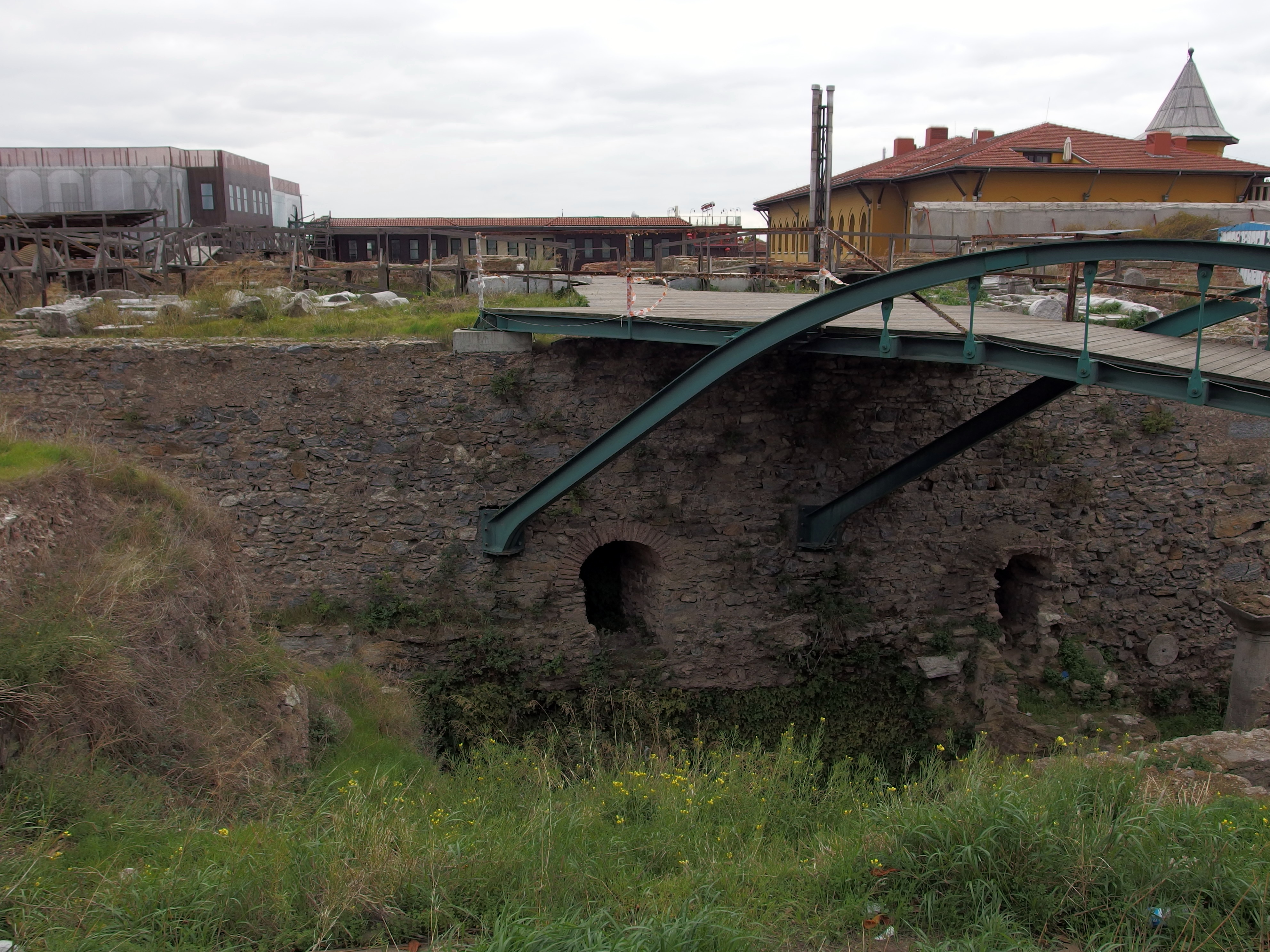
Sultan Ahmet I demolished most of what was left, including the remnants of the Daphne and Kathisma palaces, to clear ground for the Sultan Ahmed Mosque, the Blue Mosque, in the early 17th century. Less than a quarter of the palace's footprint has ever been excavated, because most of it lies sealed beneath the Blue Mosque and the Ottoman buildings around it. The most spectacular discovery came between 1935 and 1954, when teams from the University of St Andrews and David Talbot Rice's Walker Trust uncovered floor mosaics behind what is now the Arasta Bazaar. Those mosaics, scenes from daily life, mythology, hunting, and pastoral idyll, are now in the Great Palace Mosaic Museum. The Boukoleon Palace's seaside facade still stands in fragments along Kennedy Caddesi, the highway that runs the Marmara shore. Stand there and the imagination has to do almost all the work, but if you face north and look up the slope toward Hagia Sophia, you can sense the terraces that used to step down to the water, and the empire that ran them.
From the Air
Located at 41.006 degrees north, 28.978 degrees east, in the Sultanahmet district of Istanbul, Turkey. The site occupies the southeastern tip of the historic peninsula, between the Hippodrome and the Sea of Marmara, with Hagia Sophia immediately to the north. Istanbul Airport (LTFM) lies 35 kilometers northwest; Sabiha Gokcen (LTFJ) is 35 kilometers east. From the air the historic peninsula appears as a triangular promontory bounded by the Golden Horn to the north, the Bosphorus to the east, and the Sea of Marmara to the south. The Blue Mosque and Hagia Sophia are the unmistakable landmarks of the Great Palace's vanished footprint.