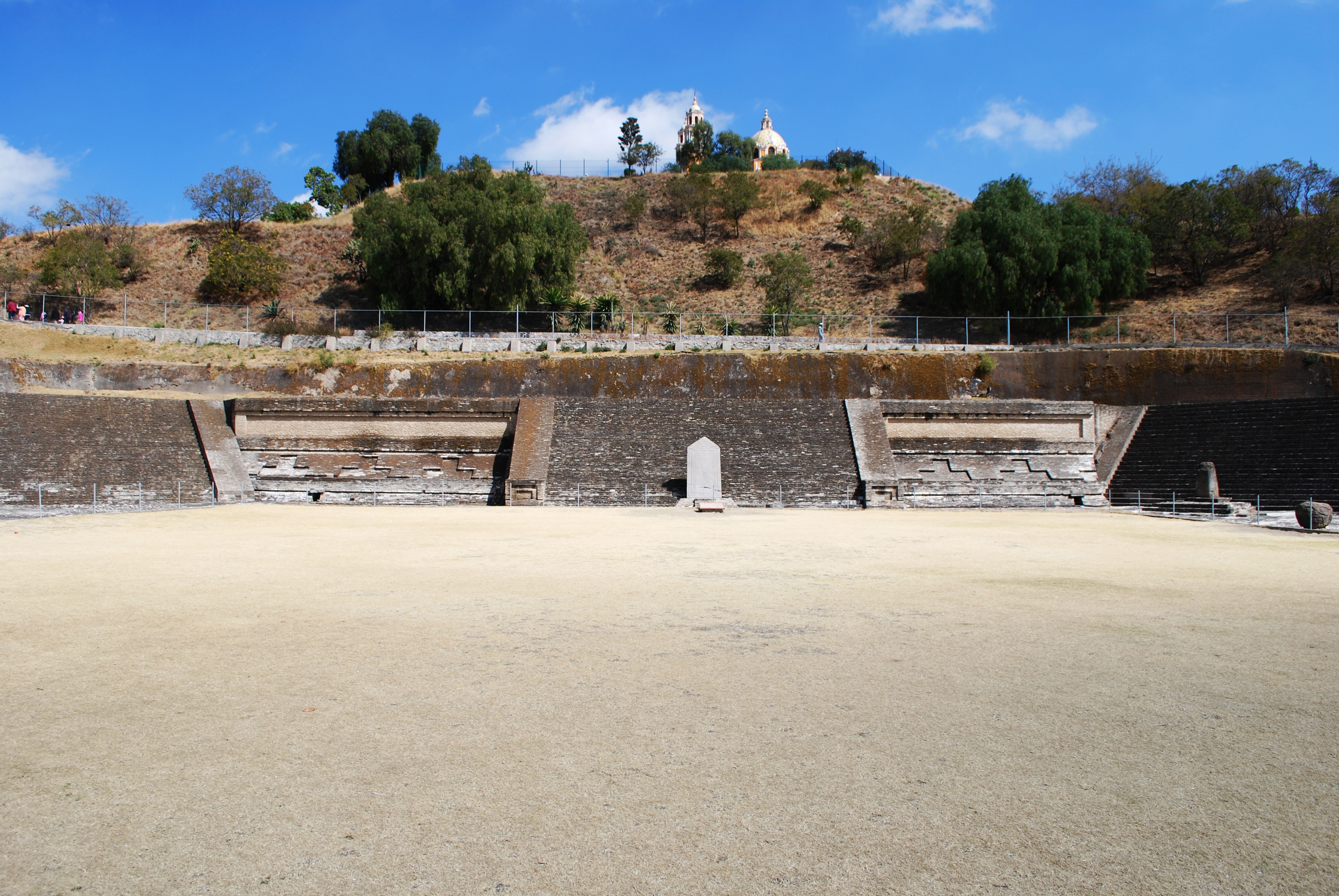
Great Pyramid of Cholula
From the air, it could pass for an ordinary hill. A broad mound of grass and trees rises above the streets of San Andres Cholula, its summit crowned by the white-and-yellow Iglesia de Nuestra Senora de los Remedios. But this is no hill. Beneath the surface lies the Great Pyramid of Cholula, known in Nahuatl as Tlachihualtepetl -- the "constructed mountain" -- and it is the largest pyramid by volume ever built. Its base covers roughly 94,500 square meters, more than twice the footprint of the Great Pyramid of Giza. The structure rises only 25 meters, but what it lacks in height it compensates for in sheer mass: an estimated 4.45 million cubic meters of adobe brick, accumulated over more than a thousand years of continuous construction.
A Thousand Years of Nesting Dolls
The pyramid was not built in a single campaign. Beginning in the third century BCE, successive cultures expanded the structure by encasing each previous version in a new shell of adobe and earth -- a construction method archaeologists liken to nesting dolls. At least six major building phases have been identified, spanning from the Preclassic period through the seventh century CE. The earliest layers feature talud-tablero architecture characteristic of Teotihuacan's influence, while later phases show Gulf Coast elements, particularly from El Tajin. At its peak, Cholula held an estimated 100,000 residents, making it one of the largest cities in pre-Columbian Mexico. The pyramid served as a temple traditionally associated with Quetzalcoatl, the feathered serpent deity, and drew pilgrims from across Mesoamerica. When the Toltec-Chichimecas conquered Cholula in the twelfth century, they shifted religious focus to a new temple, but the pyramid retained its sacred significance. Locals continued burying their dead around its base well into the Postclassic period.
Five Miles of Tunnels
In 1931, architect Ignacio Marquina began driving exploratory tunnels into the pyramid's interior. By 1954, those tunnels stretched approximately eight kilometers -- five miles -- through the layered structure, revealing murals, earlier construction phases, and the sheer complexity of the site. The most notable discovery was the "Mural of the Drinkers," a 57-meter-long painting depicting a ritual celebration with figures drinking pulque, a fermented agave beverage. The tunnels also exposed Building F, a stone stairway from between 500 and 700 CE decorated with a motif resembling a woven palm mat, created by sculpting individual stones and placing them like mosaic tiles. Over 400 human burials have been uncovered across the site, most dating to the Postclassic period, centuries after the pyramid ceased functioning as an active temple. The burials confirm what the Toltec-Chichimec codices describe: even abandoned, this place never stopped being sacred ground.
The Church on the Summit
When the Spanish arrived in the sixteenth century, they built the Iglesia de Nuestra Senora de los Remedios atop the mound -- whether they knew they were building on the hemisphere's largest pyramid is a matter of scholarly debate. The current church dates to the nineteenth century, after earlier structures were damaged by earthquakes. The result is one of the most striking juxtapositions in the Americas: a Catholic sanctuary sitting directly on a pre-Columbian temple platform, the two traditions layered as literally as the pyramid's own construction phases. Below, the archaeological zone fans out across an estimated 154 hectares, only a fraction of which has been excavated. Visitors can walk through sections of the tunnels, emerging into sunlight at the partially reconstructed south face of the pyramid, where the massive talud walls give some sense of the structure's original scale.
Hidden in Plain Sight
The pyramid's disguise is its own history. Centuries of abandonment allowed earth, vegetation, and erosion to transform its angular surfaces into the contours of a natural hill. The Spanish built roads and farms around it without recognizing what lay beneath. Today, the city of Cholula wraps around the mound on all sides, its streets and houses pressing close. From ground level, only the exposed south face -- excavated and partially reconstructed in the twentieth century -- reveals the structure's artificial origins. From the air, the truth is more legible: the mound's unnaturally symmetrical footprint, the precise alignment of its base with the cardinal directions, and the flat summit platform all betray human design. The site receives hundreds of thousands of visitors annually, yet the vast majority of the pyramid remains unexcavated, its interior layers still holding secrets that eight kilometers of tunnels have only begun to reveal.
From the Air
Located at 19.058N, 98.302W in the city of Cholula, just west of Puebla at approximately 7,050 feet elevation. From 3,000-5,000 feet AGL, the Great Pyramid appears as a broad, unnaturally symmetrical hill with a white church on its summit -- distinctly different from surrounding terrain. The partially excavated south face is visible as exposed stone. The volcanoes Popocatepetl (active, restricted airspace) and Iztaccihuatl rise dramatically to the west. Nearest major airport is Puebla's Hermanos Serdan International (MMHC/PBC), approximately 20 km east. Expect clear conditions in dry season; volcanic haze possible when Popocatepetl is active.