Great Siege of Gibraltar
For three years, seven months, and twelve days -- the longest siege ever endured by the British Armed Forces -- a garrison of roughly 5,000 men held the Rock of Gibraltar against the combined might of Spain and France. The siege began on 16 June 1779, when Spain entered the American Revolutionary War with one overriding objective: recapture the strategic fortress it had lost in 1704. What followed was a campaign of starvation, bombardment, and invention that culminated in the most spectacular amphibious assault of the eighteenth century -- and one of its most humiliating failures.
Hunger on the Rock
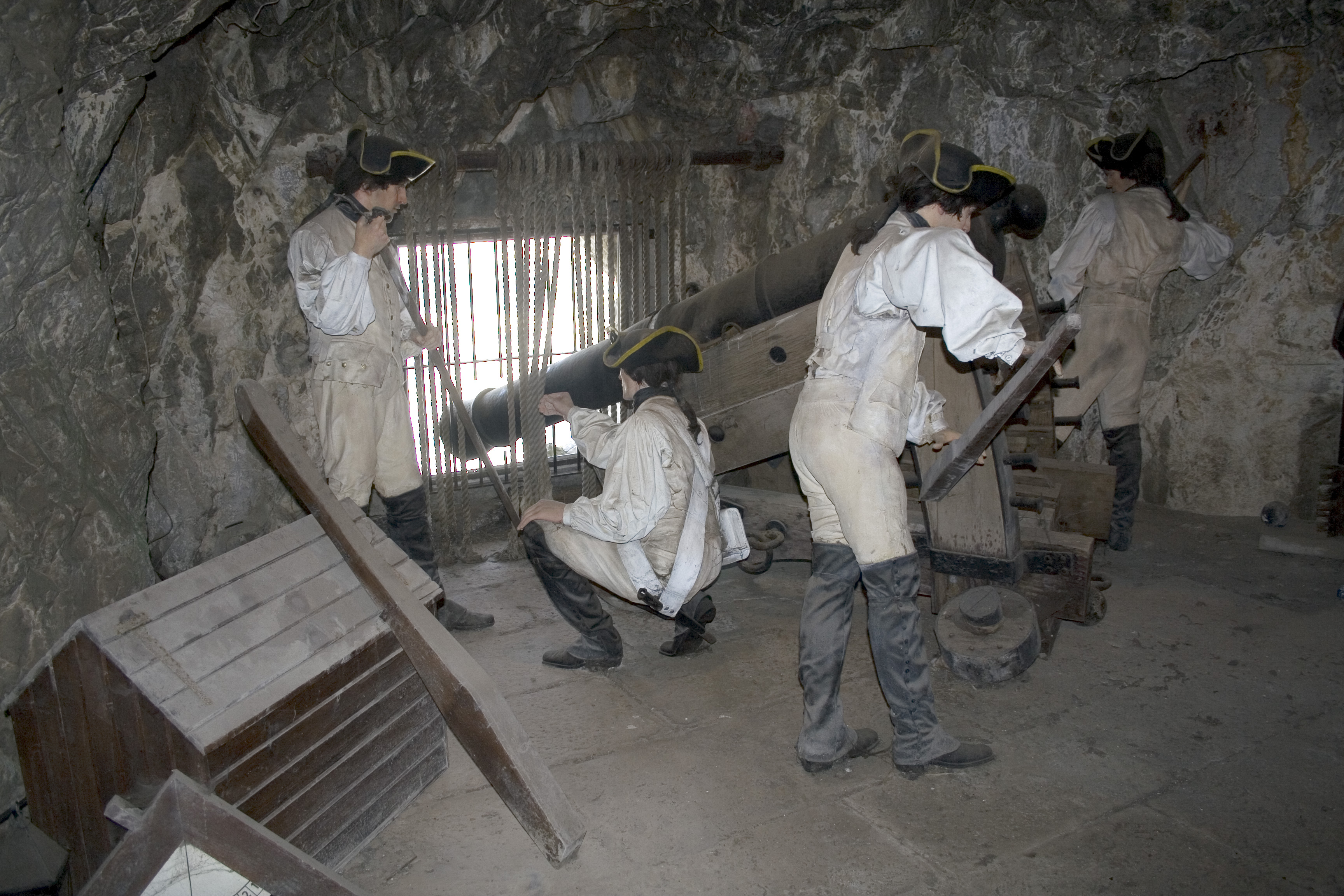
General George Augustus Eliott commanded a garrison that knew the siege was coming and had prepared accordingly. The main waterfront defense, the King's Bastion, held 26 heavy guns with casemates large enough to house a full battalion. But no amount of fortification could solve the problem of food. As winter 1779 set in, bread became so scarce it was reserved for the sick and for children. Salt meat and biscuits formed the bulk of rations, supplemented by the occasional four ounces of rice per day. Fuel ran out entirely; the garrison broke up old ships in the harbor for firewood, their salt-crusted timbers burning poorly. Scurvy swept through the troops. Yet morale held. The soldiers took their turns at duty and placed their faith in relief by sea, enduring cold and hunger with a stubbornness that would define the entire siege.
Relief and Defiance
That faith was rewarded twice. In January 1780, Admiral George Rodney's fleet fought through the Spanish blockade after defeating a Spanish squadron at the Battle of Cape St. Vincent, capturing five ships of the line and their supplies. He brought 1,052 fresh troops of the 73rd Highland Regiment along with an abundance of provisions. The following April, Vice Admiral George Darby's convoy of 29 warships and 100 store ships entered the bay virtually unopposed, though the frustrated Spanish opened a furious bombardment during unloading. The civilian population of about 1,000 departed with Darby's fleet, leaving the garrison with fewer mouths to feed and greater freedom to operate. The Spanish and French found it impossible to starve the Rock into submission.
The Midnight Sortie
On the night of 27 November 1781, having learned from deserters that a massive assault was imminent, Eliott launched a pre-emptive strike. Three columns of roughly 800 men each slipped out of the fortifications at two in the morning. The right column stormed the Spanish sentries with bayonets. A detachment of Hanoverians, lost in the darkness, stumbled upon the massive San Carlos mortar battery and attacked it anyway, taking the position after heavy fighting. The 73rd Highlanders charged along the seashore, overrunning the San Pascual and San Martin batteries. Total British casualties: two killed and 25 wounded. Spanish losses exceeded 100, with thirty taken prisoner. The garrison destroyed fourteen months of Spanish siege construction and spiked 28 guns and mortars. As the troops withdrew, massive explosions rippled through the Spanish lines behind them -- two million pounds' worth of damage in a single night.
Floating Fortresses, Red-Hot Shot
The climax came on 13 September 1782. French engineer Jean Le Michaud d'Arcon had designed ten floating batteries -- hulks with meter-thick timber walls packed with wet sand, pumped continuously with water to resist fire. Together they mounted up to 212 heavy guns, supported by 49 ships of the line, 40 gunboats, and 20 bomb vessels. Some 60,000 men in total faced the 5,000 defenders, while 80,000 spectators crowded the Spanish hills to watch what they expected to be a triumph. The batteries anchored near the British Mole and opened fire. At first, cannonballs bounced harmlessly off their armored hulls. But Eliott's gunners heated shot to furnace temperatures -- "hot potatoes," the garrison called them -- and fired them into the floating fortresses. By nightfall, the Pastora and Talla Piedra were burning out of control, their crews sending up distress rockets. The Grand Assault had become a catastrophe. The siege limped on until February 1783, but the outcome was settled. Gibraltar remained British.
From the Air
Located at 36.14°N, 5.35°W at the northern end of the Rock of Gibraltar. The isthmus where Spanish siege lines stood is clearly visible as the narrow flat area connecting the Rock to mainland Spain. Best viewed from the northwest at 2,000-3,000 ft AGL. Nearest airport: Gibraltar International (LXGB). The Bay of Gibraltar / Bay of Algeciras is the body of water to the west where the floating batteries attacked.