Great Siege Tunnels
The problem was a blind angle. In 1782, with French and Spanish forces pressing the Great Siege of Gibraltar into its fourth year, General George Augustus Eliott needed to mount a gun on a rocky spur called The Notch -- a projection on the northeast face of the Rock that commanded ground the existing batteries could not reach. The cliff face was vertical; building a path was impossible. Then Sergeant-Major Henry Ince of the Military Artificers proposed something no one had tried before: dig a tunnel straight through the limestone to reach it.
Sledgehammers and Gunpowder
Construction began on 25 May 1782, and the work was brutal. Thirteen men armed with sledgehammers and crowbars, aided by gunpowder blasts, took five weeks to carve just 82 feet of tunnel through solid Jurassic limestone. Fumes and dust from the blasting made breathing nearly impossible, so the diggers blasted a horizontal shaft to improve ventilation. This accidental opening produced an unexpected benefit: the hole in the Rock's face was immediately recognized as a perfect gun emplacement. Colonel John Drinkwater Bethune, who chronicled the siege in 1785, recorded the moment when necessity's side effect became a tactical revelation. Embrasure by embrasure, the tunnel walls sprouted openings that looked down on the Spanish siege lines below.
St. George's Hall
Work did not always go smoothly. Several tunnel drives veered off course in the latter part of 1782 -- one too deep inside the Rock, another dangerously close to its outer face. But a consistent direction was eventually found, and by the end of the siege four embrasures had been blasted overlooking enemy positions. When the tunnellers finally reached The Notch in the summer of 1783, the original plan for a single gun was abandoned. Instead, they hollowed out the spur into a broad chamber the diggers christened St. George's Hall, which was later armed with seven guns. By the end of 1783, the total construction length had reached approximately 908 feet. By 1790, after continued post-siege expansion, some 4,000 feet of tunnels honeycombed the Rock.
A Second Life in World War
The Second World War brought another frenzy of tunnelling. The objective this time was staggering: to make the Rock self-sufficient enough to house 16,000 men with a full year's supply of water, food, ammunition, and fuel. The original Great Siege Tunnels were pressed back into service. A concrete mounting pad installed in one embrasure suggests they may have powered searchlights. New extensions pushed in two directions -- the Holyland Tunnel, a long straight bore named for its orientation toward Jerusalem, cut through to the east side of the Rock, while a staircase linked the upper galleries to newer tunnels below, known as the Middle Galleries. The wartime tunnels, however, were excavated in haste, and unlike Ince's carefully crafted originals from the eighteenth century, they have crumbled and are no longer safely accessible.
Walking Through History
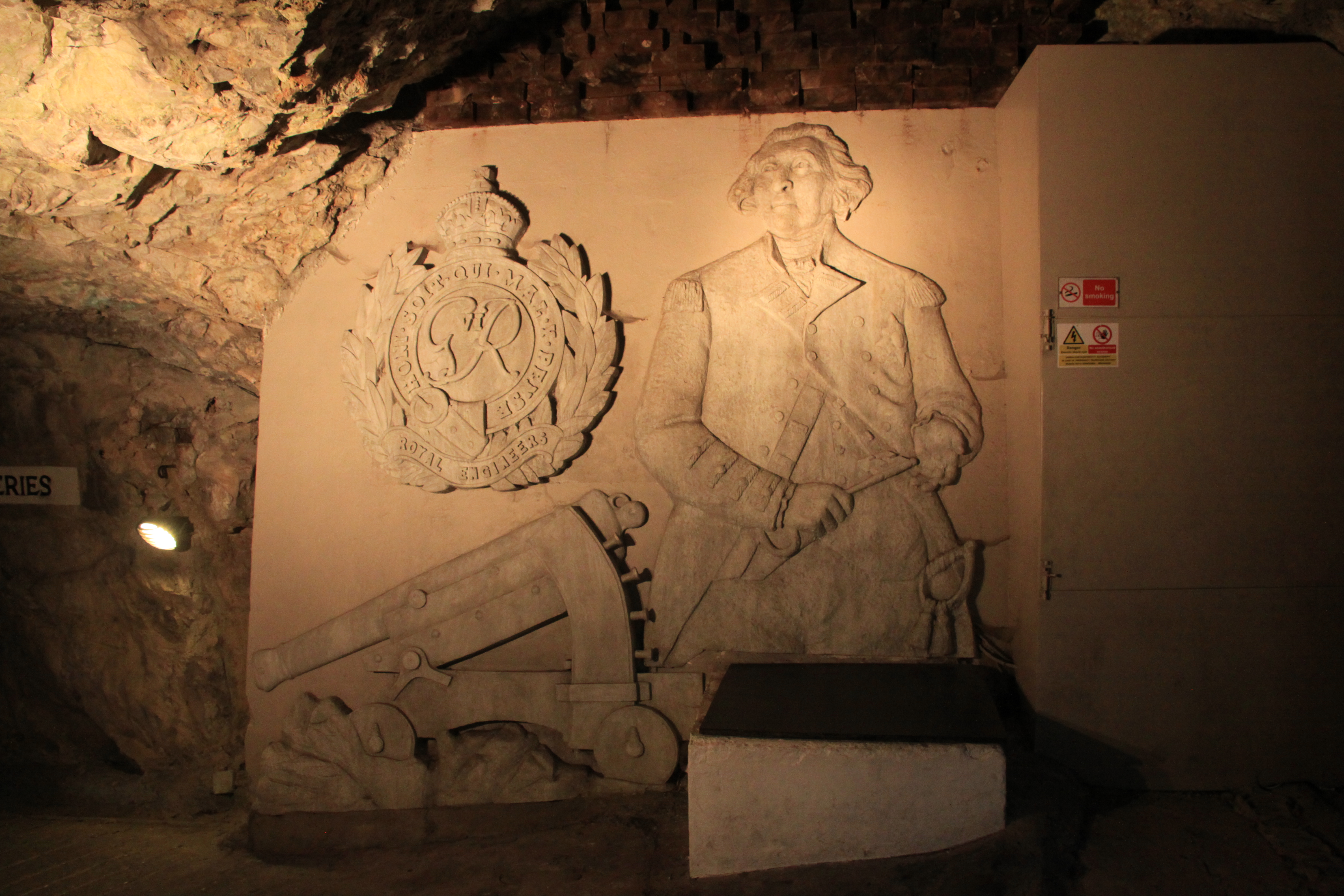
Today the Great Siege Tunnels are part of the Upper Rock Nature Reserve and rank among Gibraltar's most visited attractions. Visitors enter through a portal flanked by a concrete depiction of General Eliott, a Koehler Depressing Carriage -- the innovative gun mount that allowed cannons to fire at downward angles from the Rock's heights -- and the crest of the Royal Engineers. Inside, the galleries open onto the same views that eighteenth-century gunners once used to target Spanish positions: the Bay of Gibraltar, the narrow isthmus connecting the Rock to Spain, and the distant hills of the Iberian mainland. The tunnels stand as a monument to the ingenuity of a sergeant-major who solved an impossible engineering problem with nothing more than a bold idea and a willingness to blast through solid rock.
From the Air
Located at 36.145°N, 5.345°W on the northern face of the Rock of Gibraltar. The tunnel embrasures are visible as small openings in the sheer cliff face when viewed from the north or northwest. Best viewed from 1,500-2,500 ft AGL. Nearest airport: Gibraltar International (LXGB). The isthmus and Spanish border crossing are immediately north of the Rock.