The Weeping Time
It rained for two straight days. The people waiting inside the horse stalls at Ten Broeck Race Course near Savannah had no chairs, no beds, only hardwood floors and small portions of rice and beans. They were not spectators. They were the merchandise. On March 2 and 3, 1859, approximately 436 enslaved men, women, children, and infants were sold in what became known as the largest single slave auction in Georgia history. Contemporaries called it the Weeping Time, and the name has endured because it captures what no ledger of prices and transactions ever could.
A Gambler's Debt, Paid in Human Lives
The Butler family of South Carolina and Philadelphia had built their fortune on the labor of enslaved people at plantations on Butler Island and St. Simons Island, near Darien, Georgia. The patriarch, Major Pierce Butler, was among the wealthiest enslavers in the United States when he died in 1822, leaving his estate to his two grandsons. One of them, Pierce Mease Butler, proved a reckless steward. He speculated wildly, spent lavishly, and accumulated enormous gambling debts. The Panic of 1857 deepened his financial ruin. Trustees sold his Philadelphia mansion for $30,000 and liquidated other property, but it was not enough. The only remaining assets of sufficient value were the hundreds of human beings Butler claimed to own on his Georgia plantations.
Four Days in the Stables
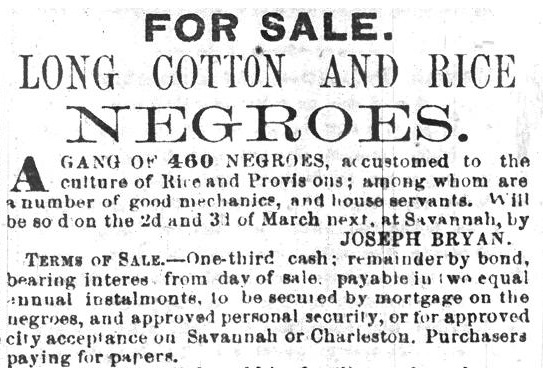
Savannah was chosen for the sale because of its proximity to the Butler estate and its status as a major slave-trading center. Advertisements ran daily in The Savannah Republican and The Savannah Daily Morning News: "For Sale, Long Cotton and Rice Negros. A gang of 460 negroes, accustomed to the culture of rice and provisions." The enslaved people were transported by steamboat and train to the Ten Broeck Race Course and housed in the stables for four days before the auction began, during which prospective buyers inspected them. Families were placed together in the same stall. The auction terms stipulated that families would not be separated, a provision that would later be violated with lethal consequences.
Two Days of Rain
About 200 buyers gathered on the first morning, though fierce rains delayed the start by two hours. Over two days, 429 of the 436 people listed in the catalog were sold. Those not sold were ill or disabled. Most were rice and cotton field workers, but among them were skilled coopers, carpenters, shoemakers, blacksmiths, and cooks. Prices for an individual ranged from $250 to $1,750. A journalist named Mortimer Thomson, writing under the pen name Q. K. Philander Doesticks, infiltrated the auction by posing as a buyer. His account, published in the New York Tribune under the title "What Became of the Slaves on a Georgia Plantation," provided one of the most detailed and searing records of a slave sale ever written, bringing national attention to the brutality of the event.
Broken Promises and Blood
The no-separation clause proved meaningless almost immediately. A Vicksburg trader named Tom Pate purchased a man, his wife, and his two sisters. Ignoring the agreement, Pate sold one sister to a fellow trader, Pat Somers, and the other to a private citizen in St. Louis. When Somers learned the sale violated the auction terms, he returned the woman and demanded a refund. The dispute ended with Somers shot dead. Ten days later, Somers's nephew killed Pate and was himself killed in the confrontation. The cycle of violence continued with further deaths, a grim coda to a transaction built on the premise that human beings could be property.
What the Ground Remembers
After the Emancipation Proclamation and the defeat of the Confederacy, some of those sold at the Weeping Time returned to Butler Island to work for wages, and some purchased land in the area. The Ten Broeck Race Course itself is gone, absorbed into the fabric of modern Savannah. But the memory persists. Two Georgia historical markers now stand as witness: one at 2053 Augusta Avenue in Savannah, erected in 2008 by the city and the Georgia Historical Society, and another on Butler Island. In 2022, researchers discovered an even larger auction of over 600 enslaved people in Charleston, South Carolina, but the Weeping Time remains the most documented and widely remembered sale, a stark record of what one man's debts cost four hundred and thirty-six others.
From the Air
The site of the former Ten Broeck Race Course is located at approximately 32.085N, 81.130W, in the eastern outskirts of Savannah. No physical trace of the racecourse remains visible from the air. The nearest airport is Savannah/Hilton Head International (KSAV), approximately 8 nautical miles to the northwest. The Savannah River and the distinctive grid pattern of Savannah's historic district provide reliable visual references.