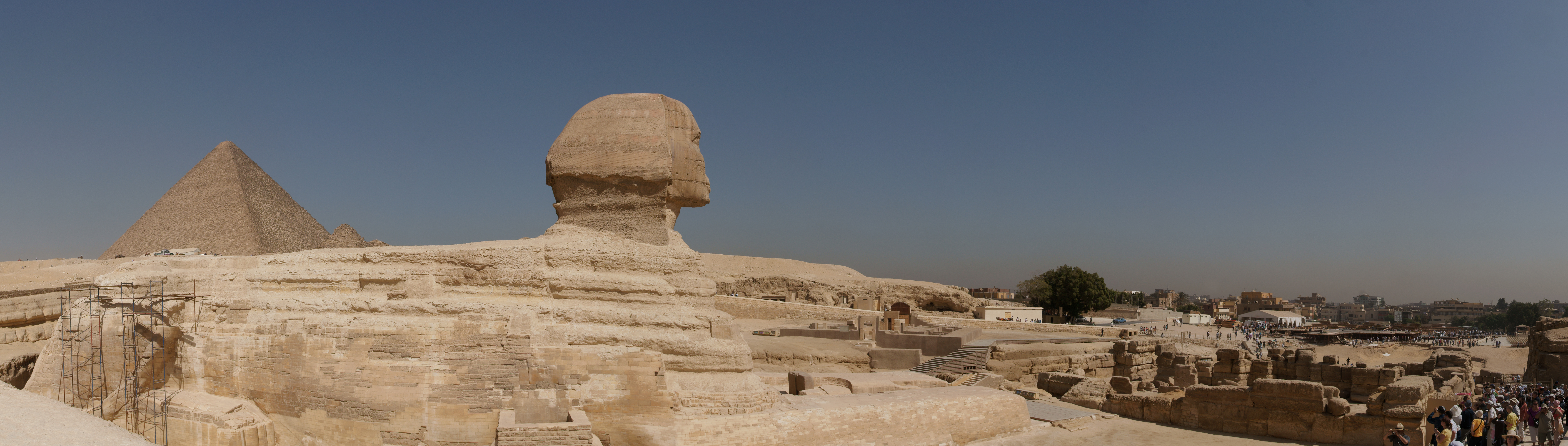
The Great Sphinx: The Face That Has Been Staring at the Sunrise for 4,500 Years
The Great Sphinx has been watching the sun rise over the Nile for 4,500 years. At 240 feet long and 66 feet high, it's the largest monolithic statue in the world - carved from a single ridge of limestone on the Giza plateau. The body is a lion; the face may be Pharaoh Khafre, or someone else entirely. The Sphinx has no inscriptions. No contemporary records describe its construction. It is almost certainly 4,500 years old, possibly older. Despite a century of study, its origins, purpose, and original appearance remain mysteries.
The Statue
The Sphinx was carved from the living bedrock of the Giza plateau, leaving a U-shaped quarry around it. The body is a recumbent lion facing east, toward the rising sun. The head - proportionally small, suggesting later recarving - wears the royal nemes headdress.
Originally, the Sphinx may have been painted in bright colors. A royal cobra (uraeus) once adorned its forehead; a ceremonial beard hung from its chin. Both have fallen away. The nose, famously missing, was probably broken by iconoclasts (Muslim or Christian sources vary) sometime in the medieval period, not by Napoleon's cannons as legend claims.
The Mystery
No contemporary inscription mentions the Sphinx's construction. Egyptologists attribute it to Pharaoh Khafre (c. 2558-2532 BC) based on circumstantial evidence: its position near Khafre's pyramid and valley temple, and a resemblance between the face and known Khafre statues.
But not everyone agrees. Some argue the erosion patterns suggest a much earlier date - possibly 10,000 BC, when Egypt was wetter. Others note the face doesn't closely match Khafre at all. Alternative theories range from scholarly (it depicts Khafre's father Khufu) to fringe (it was built by Atlanteans). The truth is we don't know who built the Sphinx or when, and we may never know.
The Burial
Throughout history, the Sphinx has spent more time buried than exposed. Sand dunes climbed its flanks and covered its body. Only the head emerged from the desert. The statue was excavated at least twice in antiquity, each time reburied by wind and time.
A granite stele between the Sphinx's paws - the 'Dream Stele' - tells of Prince Thutmose (later Thutmose IV) who napped in the statue's shadow around 1400 BC. The Sphinx appeared in his dream, promising him the throne if he cleared the sand. Thutmose complied and became pharaoh. The sand returned.
The Restoration
Modern excavation began in 1817 and was completed in 1936, fully exposing the Sphinx for the first time in millennia. What emerged was alarming: severe erosion, structural cracks, and entire sections of limestone flaking away.
The Sphinx's body is softer limestone than its head, and groundwater combined with wind have caused significant deterioration. Restoration efforts in the 20th century sometimes made things worse - cement patches trapped moisture and accelerated damage. Current conservation uses historically appropriate materials and focuses on stabilization rather than reconstruction.
The Symbol
The Sphinx has fascinated humanity for millennia. Greeks named it after their mythical creature (the Egyptian name is lost). Arabs called it 'Father of Terror.' Napoleon's soldiers sketched it. Nineteenth-century tourists climbed it. Agatha Christie wrote mystery novels in its shadow.
Today, the Sphinx anchors the Giza plateau alongside the pyramids, staring east toward Cairo's sprawl. Light shows illuminate it at night. Millions of photographs capture its enigmatic expression. Four and a half thousand years after unknown hands carved it from living rock, the Sphinx keeps its secrets, watching the sunrise as it always has.
From the Air
The Great Sphinx (29.97N, 31.14E) sits on the Giza plateau west of Cairo, Egypt. Cairo International Airport (HECA) is 35km northeast. The Sphinx is visible from the air at the base of the Giza pyramid complex, facing east. The three Great Pyramids are immediately behind it. The urban edge of Cairo approaches within meters. Weather is desert - hot and dry, with occasional sandstorms.