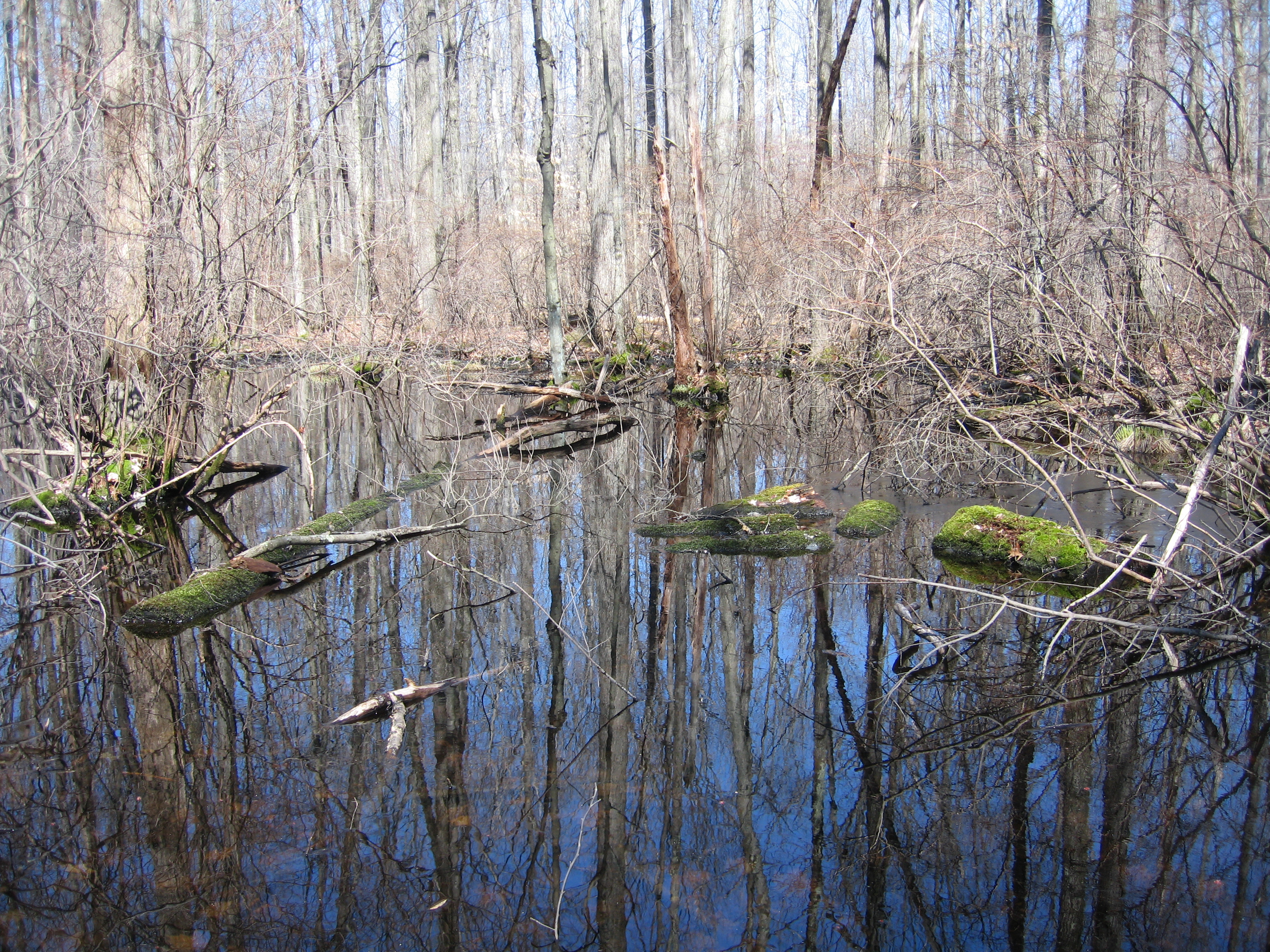
Great Swamp National Wildlife Refuge
On December 3, 1959, four women — Kafi Benz, Joan Kelly, Esty Weiss, and Betty White — were thrown out of a meeting at the Essex House in Newark. The meeting had been organized to build support for a new jetport to be constructed in the Great Swamp of Morris County. The four women were members of the Jersey Jetport Site Association, and their expulsion from the meeting made their campaign public. What followed was, in the words of Secretary of the Interior Stewart Udall, 'the greatest effort ever made by residents in America to protect a natural habitat.' Within a year, enough property in the core of the swamp had been purchased and donated to the federal government to qualify for protection as a national wildlife refuge.
What the Glacier Left Behind
The Great Swamp exists because of ice. Between roughly 15,000 and 11,000 years ago, the retreating Wisconsin Glacier pushed a moraine — a ridge of soil and rock rubble — ahead of its advance, plugging the natural drainage outlet for the watershed. Meltwater backed up into Glacial Lake Passaic, a body of water that stretched across 30 miles of what is now northern New Jersey. As the glacier continued retreating, a new outlet formed at a higher elevation, and the lake gradually drained. What remained in the lowest parts of the old lake bed was the Great Swamp: a wetland perched in the middle of one of the most densely populated regions in the United States, maintained by hydrology set in motion before humans arrived in the Americas.
The Fight to Save It
The Port Authority of New York and New Jersey, looking for a site for a major new regional airport in the late 1950s, identified the Great Swamp as a candidate. The swamp was undeveloped, relatively flat, and located close enough to New York City to be practical. What the Port Authority did not anticipate was the organized resistance of the people who lived nearby. The Jersey Jetport Site Association, connected to the broader North American Wildlife Foundation, organized a land-purchase campaign in 1960. In less than a year, the core of the swamp had been acquired and donated to the federal government. The initial donation totaled 2,600 acres — enough to qualify for protection. Congress designated the eastern half of the refuge as a wilderness area in 1968, making it the first wilderness area within the Fish and Wildlife Service. Stewart Udall formally dedicated the refuge on May 29, 1964.
What Lives Here Now
The Great Swamp National Wildlife Refuge now covers nearly 7,800 acres across the townships of Chatham, Harding, and Long Hill. It lies within the Northeastern coastal forests ecoregion and functions as a critical node in the migratory corridor along the eastern United States. More than 244 species of birds use it as a rest and feeding stop, or live here year-round. Deer, fox, muskrat, raccoons, frogs, snakes, turtles, and a wide variety of wildflowers and plants make up the permanent community. Occasionally, bear and beaver — animals hunted out of this landscape by earlier inhabitants — reappear. The Raptor Trust, a nonprofit bird-rehabilitation center located adjacent to the refuge and active since the late 1960s, specializes in eagles, hawks, and owls. Adjacent Lord Stirling Park, named for a Revolutionary War officer who lived in the area, offers boardwalks and observation blinds at the refuge's southwestern edge.
Swamp as Infrastructure
The Great Swamp does something that no airport could have done: it filters water. The wetland acts as a natural sponge during heavy rain events, absorbing floodwater and releasing it slowly, while simultaneously trapping sediments and contaminants that would otherwise enter the Passaic River watershed. The Great Swamp Watershed Association, founded in 1981, works to protect the entire 55-square-mile watershed surrounding the refuge. This is the unglamorous work of conservation — maintaining the ecological function of a landscape so that it keeps doing what it has done for ten thousand years. The citizens who bought those first acres in 1960 were thinking about birds and wilderness. They were also, without quite framing it this way, preserving the water infrastructure of northern New Jersey.
From the Air
Located at 40.708°N, 74.467°W in Morris County, New Jersey, approximately 25 miles west of Manhattan. The refuge is a prominent green expanse visible from altitude amid the suburban development of the New York metropolitan area. Nearest airports are Morristown Municipal Airport (MMU), approximately 7 miles north-northeast, and Somerset Airport (SMQ), about 12 miles southwest. The wetland character of the refuge — distinguishable by its darker, lower-canopy vegetation compared to surrounding upland forest — is visible from 2,000 to 3,500 feet MSL. Note: the area is below the approach and departure paths for MMU; check NOTAMs for traffic advisories.