Great Temple (Petra)
Nobody can agree on what to call it. For more than two thousand years, the massive complex south of Petra's Colonnaded Street has resisted a single label. Archaeologists who first explored its ruins in the 1890s assumed it was a temple. Later excavations revealed a 600-seat theatron at its heart, complete with gold leaf and colored stucco -- hardly standard worship furnishings. References to a boule, or city council, in nearby papyri suggest it may have served as Petra's parliament. The Nabataeans, it seems, built something that was all of these things and none of them, a structure as enigmatic as the desert civilization that raised it.
A Monument in Red, Yellow, and White
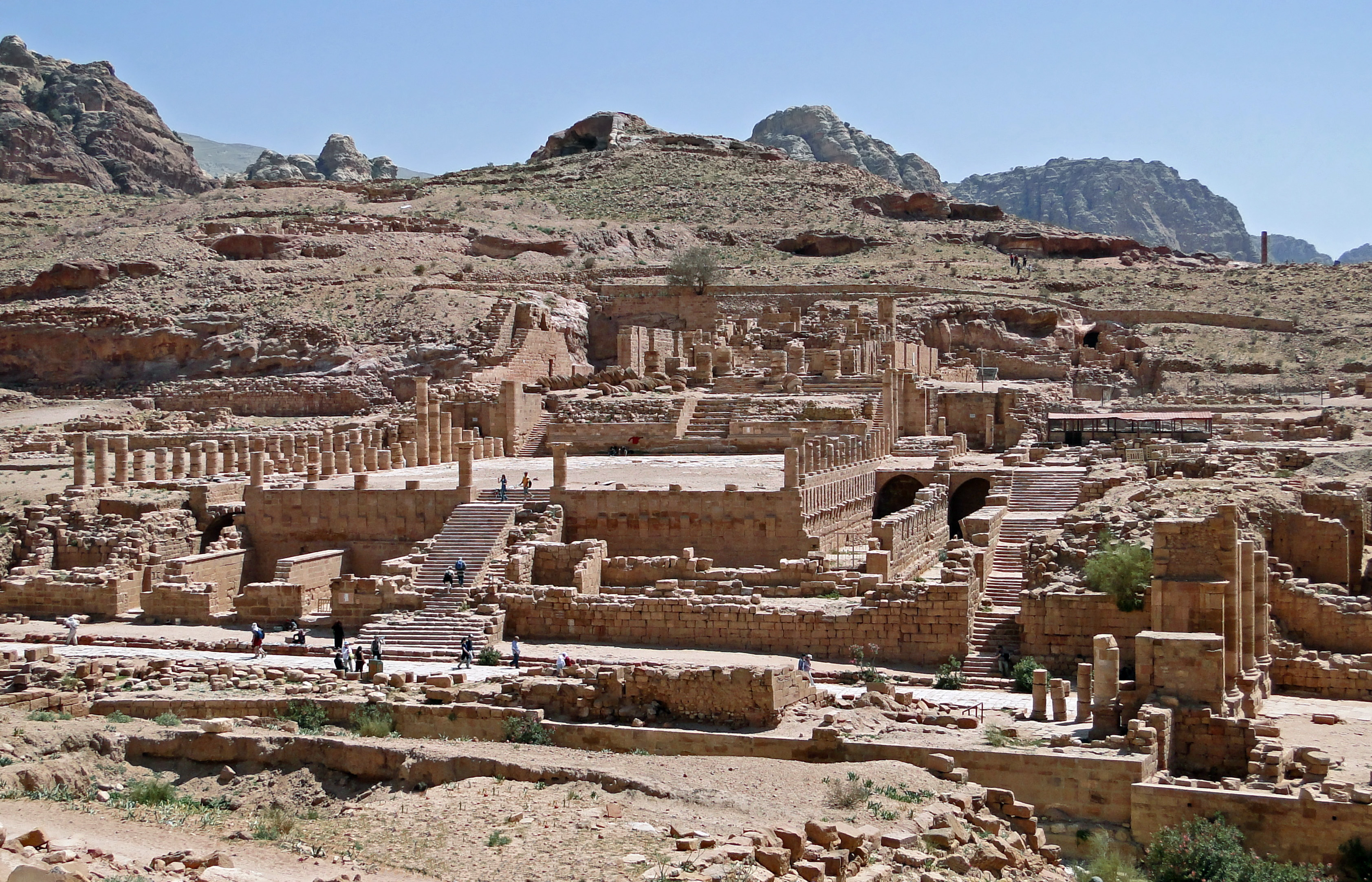
Covering roughly 7,560 square meters, the Great Temple is aligned on a northeast-southwest axis that traces the natural flow of the canyon. From the Colonnaded Street, visitors ascended a monumental stairway about 17 meters wide, climbing approximately 8 meters into a grand entrance called the Propylaeum. Beyond this gateway, the complex stepped upward through a Lower Temenos and then an Upper Temenos before reaching the temple proper. Four frontal columns, stuccoed in red, yellow, and white, once stood an estimated 20 meters tall -- comparable to the nearby Qasr al-Bint at 23 meters, though humbler than the Treasury's soaring 39-meter facade. The color would have been striking against the surrounding sandstone, a deliberate visual announcement that this building mattered.
The Theatron Within
What sets the Great Temple apart from Petra's other monumental buildings is what lies beyond those painted columns. Instead of a central cult chamber, excavators uncovered a semicircular seating area -- a theatron -- with roughly 600 seats. Traces of gold leaf and colored stucco suggest the interior was lavishly decorated. The seating area predates the stage, which means that for a time, spectators looked outward toward the Wadi Musa valley rather than at performers. Whether those gathered were worshippers, legislators, or audiences at civic ceremonies remains an open question. A Roman Imperial inscription in Latin, dated to the second century, was found in a western chamber, acknowledging the emperor by name and title -- evidence that the complex continued to function under Roman rule.
Water, Stone, and Devotion
Beneath the temple's floors, two enormous cisterns held approximately 59,000 and 327,000 liters of water respectively. These fed into a subterranean channel system running the length of the complex before joining Petra's citywide water distribution network. In a desert city where every drop was engineered, this infrastructure signaled both wealth and engineering ambition. Among the architectural fragments recovered were eight limestone relief panels depicting male and female busts -- tentatively identified as Apollo, Ares, Aphrodite, Tyche, and others. Votive figures, including one carrying a sword, were found in the southernmost passageway. Some researchers believe these may have been left by stonemasons asking deities to bless their work, or expressing remorse at altering natural rock formations -- a poignant glimpse into the spiritual anxieties of the builders themselves.
Babatha's Archive and the Question of Purpose
Among the most compelling clues to the Great Temple's function comes not from its stones but from papyri. The Babatha archive, a collection of legal documents belonging to a Jewish woman named Babatha who lived in the region during the late first and early second centuries, contains several references to a boule or council. This supports the interpretation that the complex served an administrative or civic purpose. Babatha's letters, dealing primarily with property transactions and legal disputes, have illuminated daily life in Nabataea and Roman Provincia Arabia. Combined with the Roman inscription found on site, the picture emerges of a building that evolved over time -- possibly beginning as a religious precinct under Nabataean king Aretas IV in the early first century and adapting to civic functions as Roman authority took hold.
A Puzzle in the Canyon
From the ruins of the Great Temple, you can see the Siq to the southeast, the Qasr al-Bint to the west, and the Lower Market to the east. It occupied the prime real estate of ancient Petra, and yet it refuses to reveal its full story. Martha Sharp Joukowsky of Brown University, who led excavations beginning in 1993, spent decades peeling back the layers. Corinthian acanthus capitals, floral friezes, Roman glass, ceramic figurines, coins, and lamps emerged from the rubble -- artifacts spanning centuries. The Great Temple may never surrender a single definitive identity. It may have been a place where the Nabataeans prayed, debated, celebrated, and governed, all within the same painted walls. In a city carved from living rock, perhaps that ambiguity is the point.
From the Air
Located at 30.33N, 35.44E in the heart of Petra's ancient city center, south of the Colonnaded Street. Best viewed at 3,000-5,000 feet AGL. The complex is visible as a large rectangular ruin among the canyon structures. Nearest airport is OJMF (Ma'an Airport), approximately 30 nm southeast. The surrounding terrain is rugged desert canyon at roughly 900m elevation.