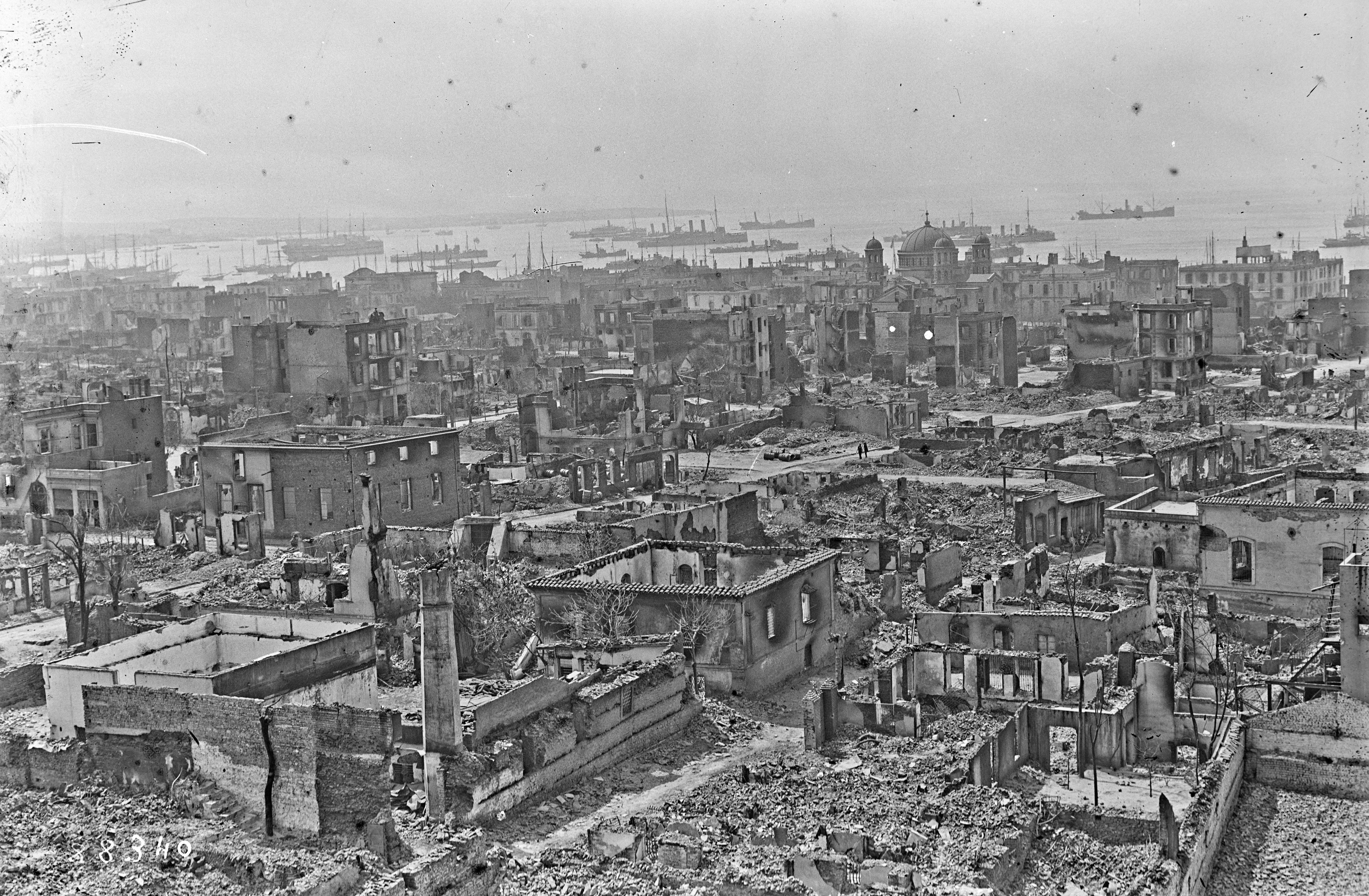
Great Thessaloniki Fire of 1917
Fifty-two thousand of the seventy-three thousand who lost their homes in Thessaloniki on the night of 18 August 1917 were Jewish. That number tells almost the whole story. For 425 years, since the Sephardic refugees had arrived from Spain in 1492 and Sultan Bayezid II had marveled at his good fortune to receive them, Thessaloniki had been one of the great Jewish cities of the world. Ladino was spoken in the streets. Sixteen of the city's 33 synagogues anchored neighborhoods that had grown unbroken across centuries. The fire took 16 of those synagogues. It took the seat of the chief rabbi and his entire archive. It took shops, presses, libraries, and the documents that quietly proved that families had lived here longer than the Ottoman Empire had existed.
Why It Burned So Long
It started in a kitchen, the way most catastrophes do, on the afternoon of 5 August in the old Julian calendar, 18 August in the new. The summer of 1917 had been one of the driest in memory. Thessaloniki was the operational hub for the Allied Macedonian Front during World War I, and the British, French, and Serbian forces stationed in suburbs around the city had requisitioned the water reserves for their camps and field hospitals. The municipal fire service, such as it was, did not exist as a coordinated brigade. A few private fire-fighting teams were owned by insurance companies and protected only their subscribers. When the wind shifted in the early hours of 19 August, two fronts of fire converged on the commercial heart of the city. Allied detachments trying to create firebreaks dynamited entire blocks and accidentally accelerated the spread. The French naval officer Dufour de la Thuillerie wrote in his report: I saw Thessaloniki, a city of more than 150,000 people, burn. The fire ran for 32 hours and ate one square kilometer down to the foundations.
The Sephardic Heart
The neighborhoods of the lower town, the commercial quarters near the waterfront, were where most of Thessaloniki's Jewish community lived and worked. They had built this city alongside Greek Orthodox neighbors and Muslim neighbors for generations. The fire did not discriminate by faith, but the topography of the burned zone meant that the Jewish quarters were the most thoroughly destroyed. Of about 7,695 shops in Thessaloniki, 4,096 burned. Seventy percent of the workforce became unemployed overnight. The Pallis Report identified the homeless by their religious communities: 52,000 Jews, 11,000 Muslims, 10,000 Greek Orthodox. The British set up tent camps for 7,000 displaced people. The French built another for 300 families. Together with Greek authorities they put 5,000 refugees on free trains to Athens, Volos, and Larissa. The American, French, and British Red Cross handed out food. None of it could rebuild what had been a layered, intricate way of life.
Insurance Wars
The total insured value came to about 3 million golden pounds against material losses estimated at 8 million. Most of the policies had been written by British firms, primarily North British and Mercantile Insurance, which faced 3,000 claims. Rumors flew that German agents had set the fire, or French ones, but the courts ruled the cause accidental, and under combined pressure from Greek and foreign authorities, the insurers eventually paid in full. The settlements arrived slowly though, sometimes after years of disputes, and many policyholders never saw the same value of property restored. The Venizelos government had announced within days of the fire that it would not allow the burned zone to be rebuilt as it had been. A new urban plan would replace it. For the families who had lost everything, that decision meant they could not simply return and rebuild. They had to wait for the city to redesign itself.
The Hebrard Plan
Minister of Transport Alexandros Papanastasiou established the International Committee for the New Plan of Thessaloniki and appointed the French architect and archaeologist Ernest Hebrard as chairman. Hebrard had been working in Greek Macedonia documenting Byzantine monuments when the war broke out, and he understood what kind of city Thessaloniki had been. His plan, delivered to the General Administration of Macedonia on 29 June 1918, redesigned the burned zone along Beaux-Arts European lines. He drew the great axis of Aristotelous Square, opening from the waterfront to the upper town, with grand buildings flanking it. He drew wider streets, regularized blocks, and modern infrastructure for transport and water. Some of his most ambitious proposals, including a vast civic plaza, were never fully realized for lack of funds. But Aristotelous Square exists, and walking it today you walk Hebrard's vision.
What Did Not Return
Within a few years of the fire, nearly half of the Jewish community had emigrated, mostly to France and the United States, with smaller numbers to Palestine. They left because their shops were gone, their homes were gone, and the rebuilt city was not designed for the way they had lived. The 1923 population exchange between Greece and Turkey then transformed Thessaloniki demographically again, bringing tens of thousands of Greek refugees from Asia Minor. The city's identity shifted. The Jewish community that remained, still substantial, faced one final catastrophe two decades later. In March 1943, the Nazi occupiers deported nearly 50,000 of Thessaloniki's Jews to Auschwitz. Fewer than 2,000 survived. Between the fire of 1917 and the deportations of 1943, the Sephardic Thessaloniki that had bloomed for four and a half centuries effectively ended. The Hebrard plan rebuilt the streets. Nothing rebuilt the community.
From the Air
Located at 40.635 degrees north, 22.94 degrees east, on the Thermaic Gulf in northern Greece. Thessaloniki Airport Makedonia (LGTS) lies 13 kilometers southeast of the city center. From the air Thessaloniki appears as a crescent of dense urbanization curving along the eastern shore of the Thermaic Gulf, climbing the slopes of Mount Hortiatis behind. The Aristotelous Square axis is visible as a wide boulevard running inland from the waterfront. Mount Olympus rises 80 kilometers to the southwest, often snow-capped through May.