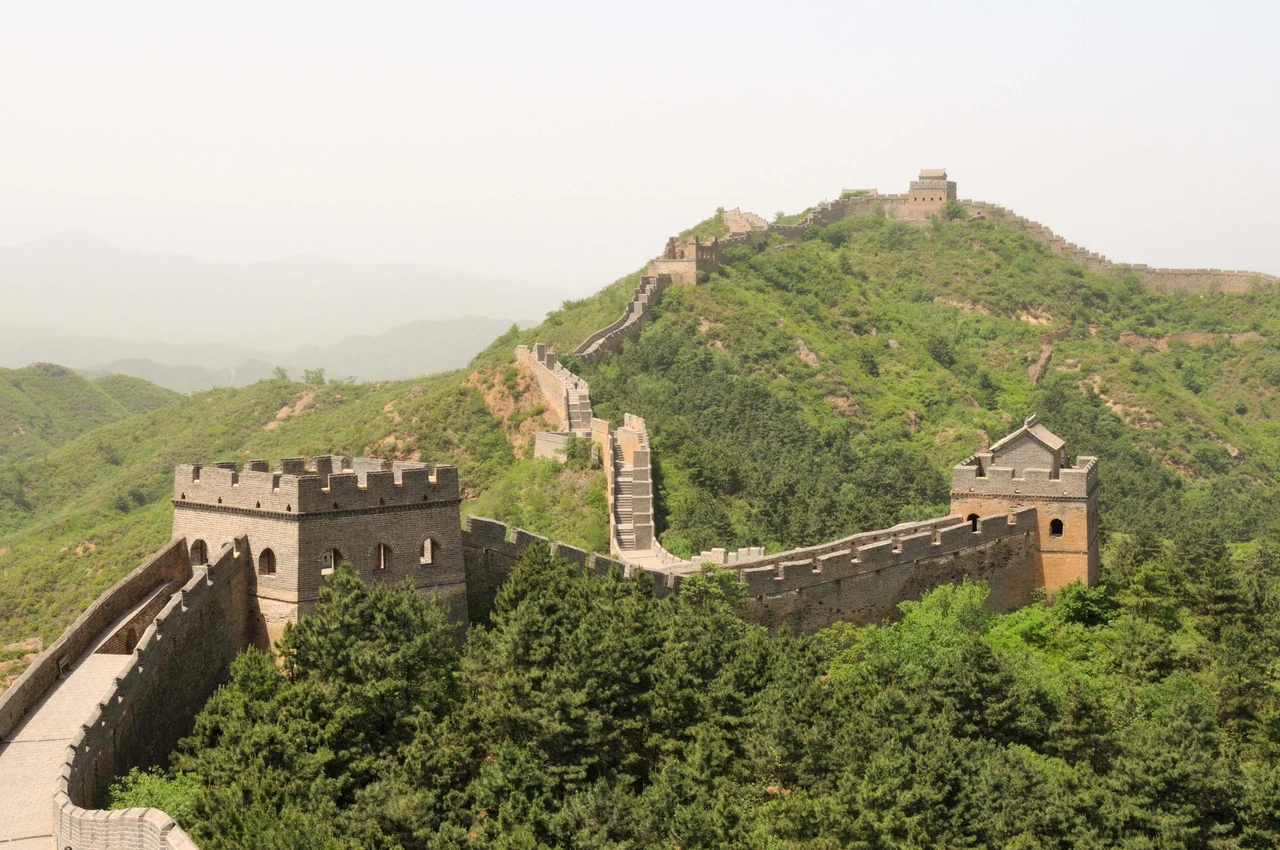

Great Wall of China
The builder of the wall's finest section at Huanghuacheng was beheaded for his trouble. Lord Cai had constructed it so meticulously, so painstakingly, that the authorities concluded he must be embezzling funds -- no legitimate project could demand such expense. They executed him. Centuries later, his section remains one of the best-preserved stretches of the Great Wall, its stones reflected in the lake that has since flooded part of the valley. The story captures something essential about this monument: the Wall has always consumed the people who built it, outlasting every dynasty, every emperor, every ideology that shaped its stones.
Four Walls, Twenty-Two Centuries
What we call the Great Wall is actually a series of walls built by different dynasties for different enemies. The First Great Wall was ordered by Qin Shi Huang Di in 214 BC, after he unified China and needed to stop Xiongnu raiders from the north. Half a million laborers spent thirty-two years raising it. The Qin Dynasty fell anyway, undone by internal pressures the wall could not address. The Han Dynasty saw the wall's value, rebuilt it, and extended it westward along the Hexi Corridor to protect the Silk Road traders -- creating the Second Great Wall. When the Jurchens conquered the north in 1115 and established the Jin Dynasty, they built a Third Great Wall in Heilongjiang and Inner Mongolia, complete with defensive ditches along its full length. The Mongols overran it anyway in 1234. It was the Ming Dynasty, rising from peasant rebellion in 1368, that built the wall we photograph today. Between 1368 and 1644, the Ming Dynasty built the Fourth Great Wall in its most recognizable form -- the stone ramparts, watchtowers, and crenellations that stretch across the mountains north of Beijing. A major phase of reinforcement between 1569 and 1570 saw general Qi Jiguang supervise the construction of 1,200 hollow brick watchtowers from Shanhaiguan to Changping.
A Monument That Nearly Vanished
When the Manchus took China in 1644 and formed the Qing Dynasty, the wall lost its strategic purpose. Stone and brick were hauled away for houses and local building projects -- a slow, practical dismantling that continued for centuries. The Cultural Revolution accelerated the process, with local governments actively encouraging communities to repurpose the wall's materials. By the time Deng Xiaoping launched a restoration campaign in 1984, large sections had been reduced to low ridges of packed earth. UNESCO declared the Wall a Cultural World Heritage Site in 1987, and the best-known sections were restored and opened to tourists. But most of the Wall's 21,000-kilometer total length still lies in the arid grasslands and deserts of Ningxia, Gansu, and Inner Mongolia, far from any tourist infrastructure -- crumbling, unrestored, and often difficult to distinguish from the terrain itself.
Badaling to the Wild Wall
The tourist experience of the Great Wall ranges from carnival to solitude, sometimes within the same day. Badaling, the most visited section near Beijing, is superbly restored and perpetually packed. Mutianyu offers the same quality of restoration with significantly fewer crowds and greener surroundings. Simatai, far from central Beijing, pairs its wall section with the reconstructed Gubei Watertown and offers night tours overlooking the illuminated village below. For those willing to travel further, the rewards multiply. Jinshanling in Hebei is the closest section outside Beijing. At Shanhaiguan, the Old Dragon's Head pushes the wall directly into the Bohai Sea. Wulonggou in Laiyuan County has never been restored at all -- its watchtowers stand in high density along a stretch that sees no crowds and charges no fees. At the western end of the wall, the fort at Jiayuguan -- nicknamed the Last Fort Under Heaven -- stands sentinel where the desert begins.
The Wall From Above
The geography of northern China changes dramatically along the Wall's path. In the northeast, it threads through the mountains of Liaoning and Hebei, where the famous tourist sections cling to steep ridges. Moving west, the landscape opens into the grasslands of Ningxia, the semi-arid loess plateau of Shanxi and Shaanxi, and finally the sand dunes of the Tengger Desert in Inner Mongolia. The Wall was engineered to follow the natural topography -- ridgelines, river crossings, passes between mountain ranges -- making it a visible thread stitching together the geology of northern China. Temperatures along its length swing from above 40 degrees Celsius in summer to minus 20 in winter. The wildlife is equally varied: Siberian tigers in the northeast, giant pandas in the southern reaches of Gansu and Sichuan, and cranes -- especially revered in Chinese culture -- breeding across multiple species from common to red-crowned. The Wall is, in the end, a geological and ecological transect as much as a military one.
From the Air
The Great Wall stretches approximately 21,000 km across northern China, but the best-preserved and most recognizable sections are north of Beijing near coordinates 40.42N, 116.08E. From altitude, the wall follows ridgelines and is most visible in the mountainous terrain of Hebei and northern Beijing. Beijing Capital International Airport (ZBAA) and Beijing Daxing International Airport (ZBAD) are the primary airports. The wall extends westward through increasingly arid terrain to Jiayuguan in Gansu Province (ZLJQ). Despite popular myth, the Wall is generally not visible from orbit with the naked eye, but from lower altitudes its watchtowers and ridgeline path can be traced clearly in good visibility.
Nearby Stories
- Tumubao 6.1 km away
- Wofo Temple 8.2 km away
- Cuandixia 9.3 km away
- 1679 Sanhe-Pinggu Earthquake 24 km away
- Snow Ruyi National Ski Jumping Centre 37 km away
- Gubeikou 38 km away
- Jinshanling 59 km away
- Simatai 92 km away