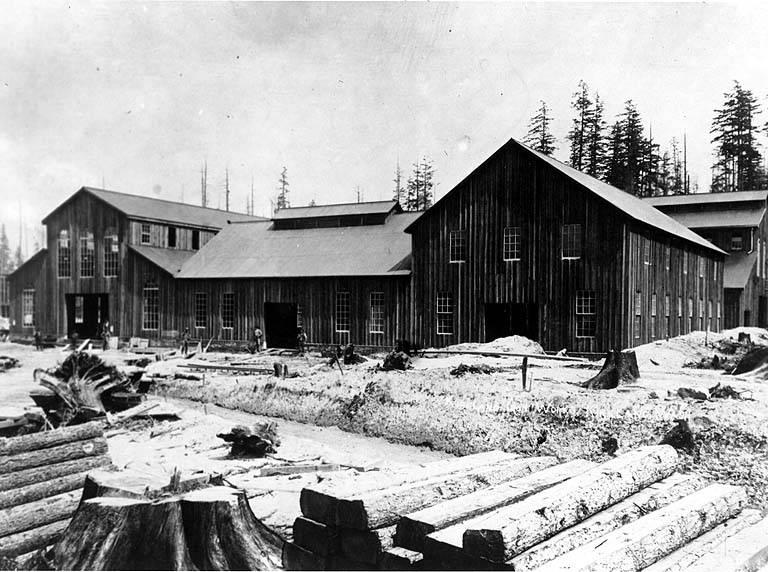
Great Western Iron and Steel Company
Somewhere beneath the parking lot of a Kirkland Costco lie the foundations of what was supposed to be the most important steel mill west of the Mississippi. In the late 1880s, Peter Kirk, an English steel industry veteran from Workington in Cumberland, looked at the iron ore deposits near Snoqualmie Pass, the coal seams in the Issaquah Alps, and the vast appetite of a railroad-hungry Pacific Coast, and saw his fortune. He would build an integrated smelter and mill on the shores of Forbes Lake, corner the market on Western steel, and transform a patch of Washington Territory forest into an industrial colossus. Kirk got as far as laying foundations, erecting buildings, and even attracting a visit from President Benjamin Harrison. Then the money vanished, and the greatest steel mill the Pacific Northwest never had became a cautionary tale about ambition, timing, and the fragility of boom-era capital.
An Ironmaster's Gamble
Kirk was no speculator chasing frontier dreams. He and his partners, including Member of Parliament Charles James Valentine, already operated the Moss Bay Hematite Iron and Steel Company in Workington, a serious enterprise that supplied rails across the British Empire. When Kirk visited Washington Territory in 1886, his company was shipping thousands of tons of rails for the Seattle, Lake Shore and Eastern Railway. The economics were absurd: finished steel traveling by ship from England to a region sitting on its own iron ore and coal. Kirk recognized the opportunity instantly. By August 1888, he and Seattle pioneer Arthur A. Denny, along with newspaper publisher Leigh S. J. Hunt, had incorporated the Moss Bay Iron and Steel Company of America, acquiring 120 acres around Forbes Lake. When that venture ran short of capital by late 1889, they reorganized as Great Western Iron and Steel with a million dollars in fresh funding. Newspapers predicted a "practical monopoly of the entire Pacific Coast" steel market.
A Mill Rises on Forbes Lake
Construction moved quickly through 1890 and into 1892. Workers cleared the forest around Forbes Lake, built a foundry, machine shops, pattern shops, and ore bunkers on the lake's east side. A sawmill churned out three million board feet of lumber. Miles of water pipeline connected Lake Washington and Forbes Lake to the site. Lakefront warehouses stored equipment and raw materials. A railroad depot went up at Piccadilly Street, ready for the Northern Pacific Railway connection that would feed raw materials in and carry finished steel out. President Harrison himself visited Kirkland in 1890, arriving aboard the sidewheeler Kirkland to inspect potential routes for the Lake Washington Ship Canal, which would have given the mill direct access to Pacific shipping lanes. An 1892 industry directory confirmed the progress: foundry complete, machine shops operational, ore bunkers ready. But one critical detail appeared in the same report, and again two years later. The coke stack had not been built. Without it, the mill could not actually make steel.
The Kirkland Ditch and the Panic
Everything Kirk's plan required beyond the mill itself failed to materialize. The Northern Pacific Railway connection stalled amid competition between Seattle and Tacoma for the railroad's favor. The Lake Washington Ship Canal, essential for moving finished goods to Pacific markets, was delayed after the Great Seattle Fire of 1889 consumed the city's attention and resources. Critics mocked the canal proposal as the "Kirkland ditch." Without rail access or waterway shipping, a steel mill in the forest was an expensive monument to wishful thinking. Then came the Panic of 1893, which swept across the American economy like a wildfire through dry timber. Investors who had pledged to buy stock defaulted on their subscriptions. Without that capital, Great Western could not finish construction or begin operations. A court judgment in June 1895 transferred all of the company's assets back to the land company from which the property had been purchased, marking the effective end of the enterprise. A scholar would later call it "the last major effort of private capital to erect an integrated iron and steel mill on the West Coast."
The City That Steel Built but Never Fed
Kirk's mill never produced a single ton of steel, but it produced something more durable: a city. The founders had platted Kirkland as a company town, laying out an 1888 street grid modeled on the Pullman District in Illinois, America's first planned industrial community. They gave the streets names that reflected their twin allegiances: American presidents like Monroe alongside English references like Piccadilly, Victoria, and Sheffield. Today, Kirkland's downtown still follows that original grid, and dual-named street signs display both the modern names and the Victorian originals. Peter Kirk's 1891 brick office building survives as the Peter Kirk Building, the oldest commercial structure on the Eastside of Lake Washington. The homes built for mill executives and workers still stand in their original lots. Walk through downtown Kirkland today and you are walking through the ghost of an industrial dream, its bones preserved in brick and asphalt while the city that grew over them became something its English founders never imagined: a lakeside technology suburb where the biggest local industry is the one headquartered in the Costco warehouse that may sit atop the mill's forgotten foundations.
From the Air
Located at 47.684N, 122.178W on the east side of Lake Washington in Kirkland. The former mill site lies between Forbes Lake and present-day 124th Avenue NE, now a suburban commercial area. Forbes Lake is visible as a small body of water east of the main Lake Washington shoreline. Nearest airports: Boeing Field/King County International (KBFI) 11nm south, Seattle-Tacoma International (KSEA) 19nm south, Kenmore Air Harbor (S60) 6nm north. Best viewed at 2,000-3,000 feet AGL to see the relationship between Forbes Lake, Lake Washington, and the Kirkland downtown grid.