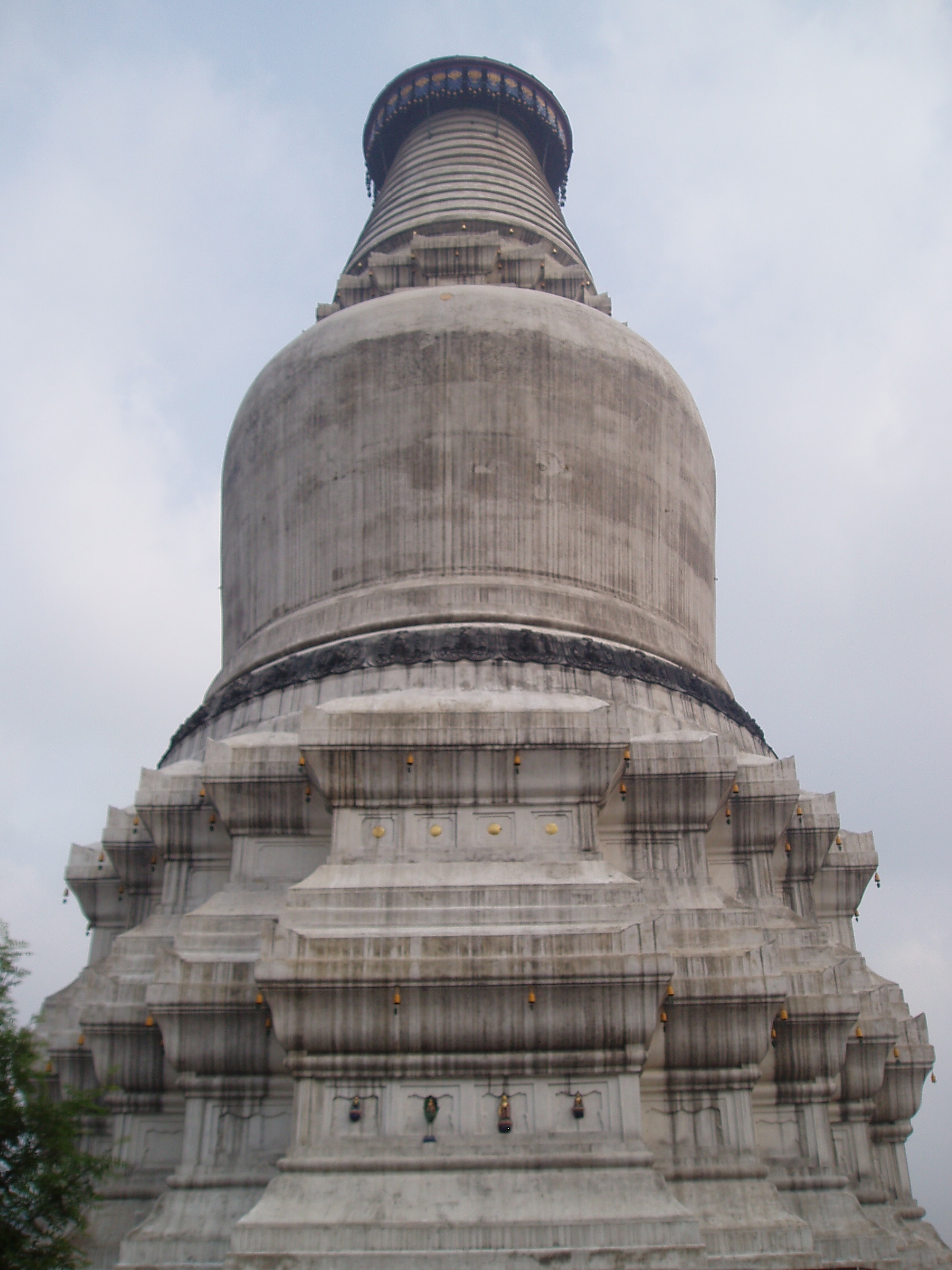
Great White Pagoda
Two hundred and fifty-two small bells hang from the gilded copper canopy at the top of the Great White Pagoda. When the wind sweeps through the valleys of Mount Wutai, the bells stir together, producing a faint metallic shimmer that drifts down over the temple rooftops below. The sound has been part of this landscape since the Ming dynasty, and it remains the first thing many pilgrims notice as they approach Tayuan Temple.
A Monument in White
The Great White Pagoda -- or Sarira Stupa, named after the Sanskrit word for Buddhist relic -- stands roughly 50 meters tall, making it the dominant structure in the entire Mount Wutai temple complex. Built of brick and coated in lime that gives it its distinctive white color, the stupa rises from a square base with a sumeru pedestal, its main body shaped like an inverted bowl in the classic Tibetan architectural tradition. The steeple above the bowl is tiered in thirteen levels, a number with deep significance in Buddhist cosmology. At the very top, the gilded copper canopy and bead crown catch the sun, creating a gleaming beacon visible from the surrounding peaks.
Zhang Juzheng's Legacy
The stupa was constructed during the Wanli reign of the Ming dynasty (1368-1644). A stone tablet at the site records its history, composed by Zhang Juzheng (1525-1582), one of the most powerful ministers in Ming dynasty history. Zhang served as Grand Secretary and effectively ran the empire for a decade, implementing fiscal reforms and military reorganizations that stabilized the dynasty. That a statesman of his stature composed the stupa's commemorative inscription speaks to the importance of Mount Wutai's temples in the political as well as spiritual life of imperial China. Patronage of Buddhist sites was both an act of devotion and a demonstration of imperial legitimacy.
The Heart of Mount Wutai
The Great White Pagoda sits within the grounds of Tayuan Temple, in the central area of Taihuai Town. But it functions less as a feature of one temple and more as the visual anchor for the entire Mount Wutai complex. Dozens of temples spread across the surrounding valleys and hillsides, and from nearly any vantage point, the white stupa marks the center. It has become the symbol of Mount Wutai itself -- the image that appears on tourism materials, pilgrimage guides, and in the memories of the millions who visit. The name sarira refers to relics of the Buddha or Buddhist saints, and the stupa is understood to contain such relics, adding a layer of sacred significance to what is already the most recognizable structure in one of China's holiest Buddhist landscapes.
From the Air
Located at 39.01N, 113.59E within the Tayuan Temple complex on Mount Wutai, Shanxi Province, China. The Great White Pagoda at approximately 50 meters tall is the most prominent single structure in the temple valley and is visible from considerable distance due to its white lime coating. Elevation approximately 1,700 meters. Nearest airports: Wutai Mountain Airport (ZBWT) at roughly 50 km and Taiyuan Wusu International Airport (ZBYN) at approximately 230 km southwest. Recommend 2,000-4,000 feet AGL for best viewing. The white tower amid green mountain terrain is a strong visual landmark.