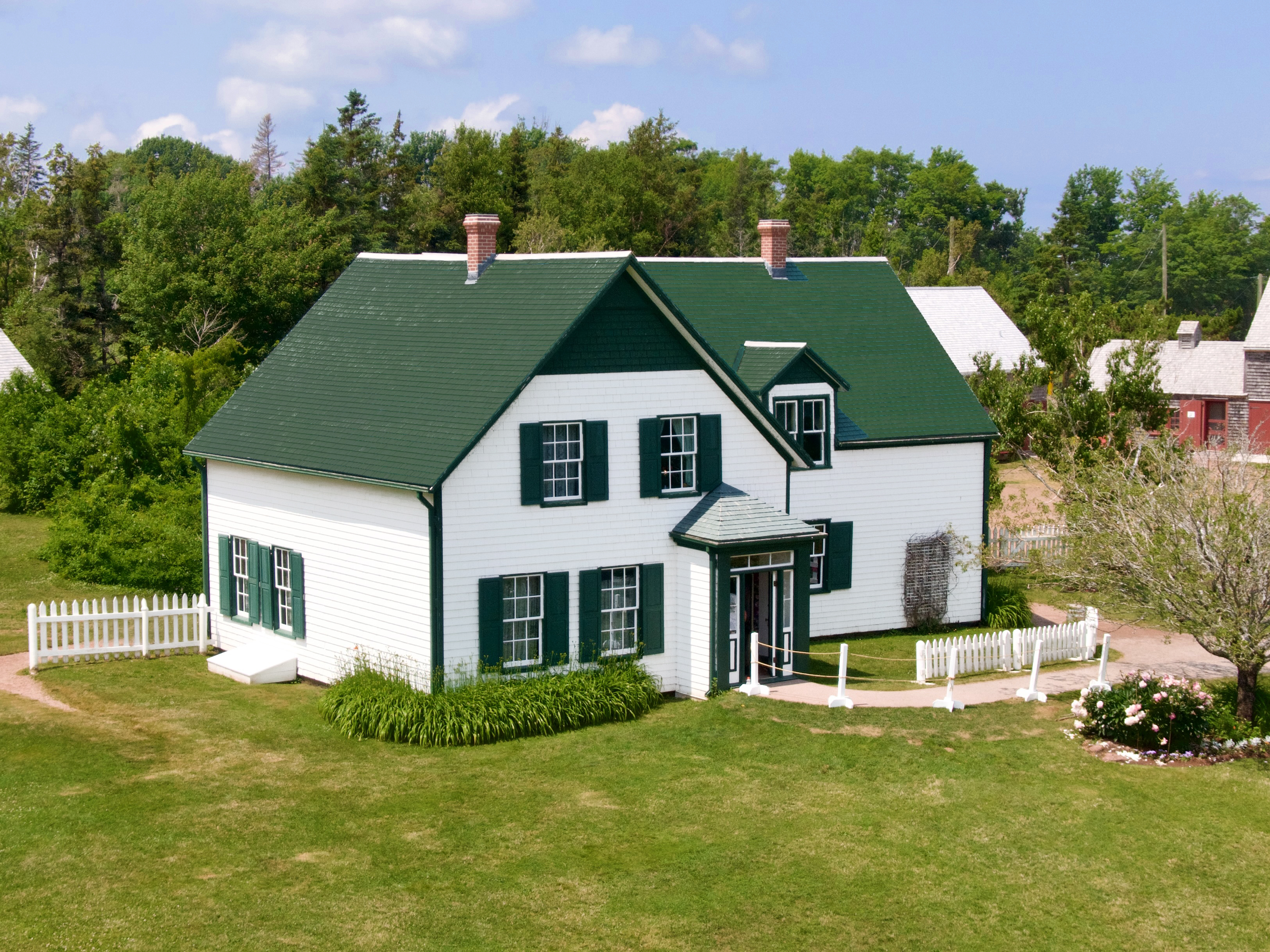
Green Gables Heritage Place
The green paint was an afterthought. When the Canadian government purchased this modest Cavendish farmhouse in 1936, the gables were not actually green -- they were whatever color the MacNeil family had last bothered to apply. But fiction had already claimed the building, and so the government painted it to match the novel, giving a real house the identity of an imaginary one. It is a strange reversal: a place becoming its own story. Yet that is exactly what happened at Green Gables Heritage Place, where the line between Lucy Maud Montgomery's imagination and the Prince Edward Island landscape she drew from has been blurred beyond recovery.
The Girl Who Lived Next Door
Lucy Maud Montgomery did not live at Green Gables. She lived nearby, raised by her maternal grandparents after her mother died and her father moved west. The MacNeil cousins who owned Green Gables were her neighbors, and she visited often enough that the farmhouse, its surrounding woods, and its quiet lanes became the raw material for the novel she published in 1908. Anne of Green Gables -- the story of an orphan girl sent by mistake to an elderly brother and sister who had wanted a boy -- became an immediate sensation. Montgomery drew heavily on the landscape around her: the brook she called the Lake of Shining Waters, the avenue of birch trees she named Lovers' Lane, the spruce grove she turned into the Haunted Wood. The farmhouse itself, built by the MacNeils in the 1830s and expanded in the 1870s, became the most famous fictional address in Canadian literature.
From Farmhouse to Shrine
Interest in the property grew slowly but persistently after the novel's publication, and by the time the government acquired Green Gables in 1936, it had already become a destination. The initial plan was modest: furnish it with period-appropriate pieces and present it as a generic example of 19th-century island farm life. But visitors did not come to see a generic farmhouse. They came for Anne. By the 1970s, the government gave in and began refurbishing the rooms to match Montgomery's descriptions. Anne's bedroom appeared on the second floor, complete with the puffed sleeves she coveted. The parlour took shape according to the novel's details. In 1985, Green Gables received its official designation as a Federal Heritage Building, recognized both as genuine 19th-century architecture and as a literary landmark. The larger property, including the ruins of Montgomery's actual childhood home, became a National Historic Site in 2004.
An Unexpected Bridge to Japan
Montgomery could not have predicted that her red-haired orphan would become a cultural phenomenon in Japan. Anne of Green Gables was translated into Japanese in 1952, and the character struck a deep chord -- so deep that a 1979 anime adaptation became one of the most beloved animated series in Japanese television history. Japanese tourists began arriving on Prince Edward Island in significant numbers, and the connection grew into something more than literary tourism. In 2019, when a new interpretive centre opened north of the Green Gables farmhouse, Princess Takamado of Japan attended the grand opening. In 2021, Green Gables received the Japanese Foreign Minister's commendation for promoting mutual understanding between Canada and Japan. The 2,400-square-foot farmhouse -- white-shingled, L-shaped, five bedrooms -- had become an unlikely bridge between two cultures separated by an ocean.
Walking Montgomery's World
The trails are what make Green Gables more than a house museum. Lovers' Lane still runs through a canopy of birch and maple, dappled light falling on the path exactly as Montgomery described it. The Haunted Wood trail winds through a stand of old spruce, dark and close even at midday. Balsam Hollow drops through fragrant evergreens toward a brook. These are not reconstructions or themed walkways -- they are the actual places Montgomery walked as a girl, the landscapes she folded into her fiction with only the thinnest of fictional disguises. The surrounding property includes a historic schoolhouse, farm outbuildings, and the interpretive centre designed by Root Architecture, which wraps around a central courtyard and houses exhibitions on Montgomery's life and literary legacy. Montgomery herself is buried in the Cavendish cemetery, adjacent to the property, within sight of the green gables she made famous.
From the Air
Located at 46.49N, 63.39W on PEI's north shore near Cavendish. The farmhouse sits within Prince Edward Island National Park. From the air, look for the distinctive red clay coastline along the Gulf of St. Lawrence and the green parkland south of Cavendish Beach. Nearest airport: Charlottetown Airport (CYYG), approximately 40 km southeast. Best viewed at 2,000-3,000 feet AGL following the north shore coastline.