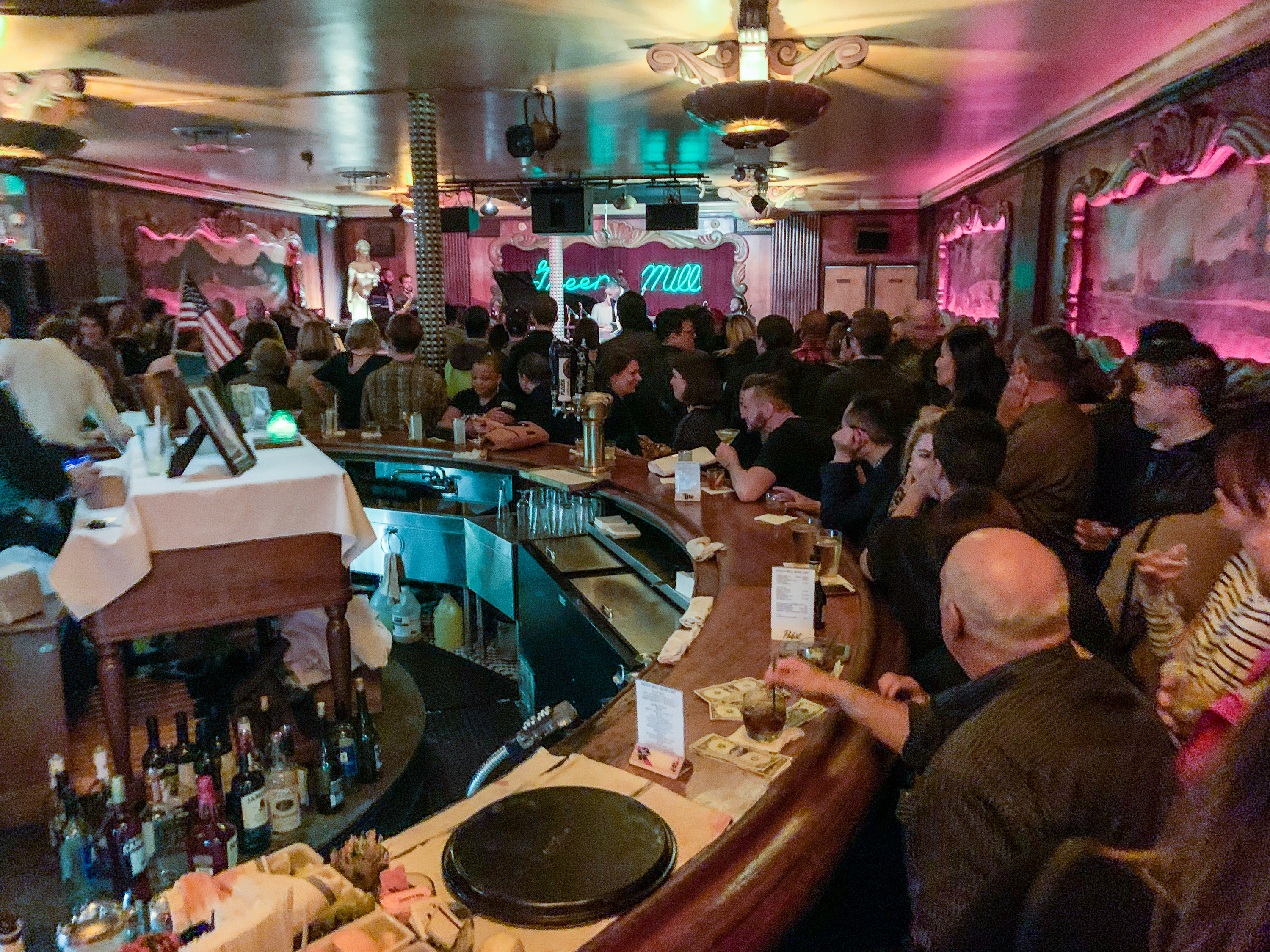
Green Mill Cocktail Lounge
Whenever Al Capone walked through the door, the bandleader stopped whatever he was playing and launched into Gershwin's "Rhapsody in Blue." The booth Capone favored still sits in the Green Mill Cocktail Lounge, strategically positioned with sightlines to both the front and back entrances -- a practical seating choice for a man with enemies. More than a century after its founding as a beer garden on Broadway in Chicago's Uptown neighborhood, the Green Mill remains one of the most celebrated jazz clubs in America, a place where the walls remember Prohibition, throat-slashings, and the birth of the poetry slam, and where the bartender will still tell you to shut up if you talk during a set.
From Beer Garden to Green Mill
The story begins in the late 1890s with Pop Morse's Roadhouse, a saloon founded by Charles E. "Pop" Morse at the corner of Lawrence Avenue and Broadway, then called Evanston Avenue. The location was strategic: mourners and visitors from the nearby Graceland and Saint Boniface cemeteries needed somewhere to drink. Around 1910, real estate developer Tom Chamales took over and transformed the property into the Green Mill Gardens, choosing the name as a nod to Paris's Moulin Rouge -- the Red Mill -- but switching the color to green to distance the establishment from a nearby red-light district. The beer garden featured a large open courtyard with a stage for live entertainment. Located just four blocks from Essanay Studios, the early film company that employed Charlie Chaplin, the Green Mill attracted entertainers and celebrities from its earliest days.
Speakeasy Rules
When Prohibition arrived in 1920, the Green Mill adapted rather than closed. In 1921, the federal government and the City of Chicago filed lawsuits against the establishment for selling alcohol and allowing music and dancing past 1 a.m. The federal suit was dismissed, but the Green Mill Gardens briefly shut down in 1923 and the western half of the property -- the garden courtyard that gave the club its name -- was sold to Balaban and Katz, the theater chain. The club reopened as the Montmartre Cafe under former manager Henry Horn. But it was the mob that truly defined the Green Mill's Prohibition identity. Jack "Machine Gun" McGurn, one of Al Capone's top enforcers, held a financial interest in the club. Capone himself was a regular, and the establishment operated as a speakeasy where patrons could buy illegal liquor while jazz musicians performed. Beneath the bar, a network of tunnels originally built to transport coal for the building's boilers were reportedly used by the mob to store and traffic bootleg alcohol.
The Night They Cut Joe E. Lewis
The Green Mill's most notorious episode came on November 9, 1927. Joe E. Lewis, a young cabaret singer and comedian, had been the club's star attraction for a year. When his contract expired, Lewis signed with a rival venue, the Rendezvous Lounge, directly defying the Outfit's expectation that performers stayed where they were told. McGurn warned Lewis he would never live to open at the Rendezvous. Lewis opened anyway on November 2. A week later, three men broke into his room at the Commonwealth Hotel, slashed his throat ear to ear, fractured his skull, and partially severed his tongue. Lewis survived, but his singing voice was destroyed. He had to relearn how to speak. He eventually returned to performing as a nightclub comedian. McGurn was never formally charged, but Capone himself reportedly gave Lewis $10,000 to help cover his medical bills -- the boss's way of expressing regret without admitting responsibility. The story later inspired the 1957 film The Joker Is Wild, starring Frank Sinatra.
Dark Years and Resurrection
After Prohibition ended and World War II reshaped American nightlife, the Green Mill drifted. The Batsis brothers purchased it in 1940 and sold it in 1960 to Steve Brend, who had worked for Jack McGurn as a youth and was known as the "Mayor of Uptown" for his gregarious storytelling. Under Brend's long ownership, the Green Mill declined from a nightlife destination to a neighborhood bar where day drinking and drug use replaced live jazz. Between 1927 and 1932, the club had already cycled through multiple closures, ownership transfers, and name changes -- including "Ye Old Green Mill" and "Lincoln Tavern Town Club" -- and by the 1980s, it seemed headed for permanent obscurity.
The Mill Reborn
Everything changed in 1986 when Dave Jemilo, a South Sider and former owner of the bar Deja Vu, purchased the Green Mill and poured his energy into revitalization. Jemilo restored the club's identity as a serious jazz venue, booking top performers and enforcing a house rule that would become legendary: during sets, patrons are expected to silence their phones and refrain from talking. It is not a suggestion. That same year, the Green Mill began hosting the Uptown Poetry Slam, one of the first competitive spoken-word events in the country. The slam still takes place monthly. The club's cinematic resume grew alongside its musical reputation, appearing in films from Thief (1981) to High Fidelity (2000). In Star Trek: Voyager, the character Tom Paris calls it a "genuine speakeasy." The Green Mill has outlasted Prohibition, the mob, decades of neglect, and the relentless churn of urban nightlife. It remains exactly what it has always been: a dark room where the music matters more than anything else.
From the Air
Located at 41.969N, 87.660W in Chicago's Uptown neighborhood, on Broadway near the intersection with Lawrence Avenue. The Green Mill is a single-story storefront in a dense urban commercial strip, not individually visible from altitude, but Uptown is identifiable by its position about 5 miles north of the Loop along the lakefront. Nearby landmarks from the air include Graceland Cemetery (the large green rectangle one block west) and Montrose Harbor on the lakefront to the east. Nearest airports: Chicago O'Hare International (KORD), approximately 10nm northwest; Chicago Midway International (KMDW), approximately 13nm southwest. Wrigley Field (home of the Cubs) is approximately 1nm south and serves as a useful visual landmark.