Green Park Estate, Jamaica
Two marble plaques flank the front door of Green Park Great House. One reads "Green Park Plantation Manor." The other: "Built in 1764 by William Atherton." What neither plaque mentions is the roughly 800 people whose forced labor made the building possible - the men, women, and children who cut sugarcane, distilled rum, and built the stone walls of what became the third-largest estate in Trelawny Parish. Green Park's story stretches from Oliver Cromwell's 1655 invasion of Jamaica to a Wall Street crash that finally killed its sugar economy, a span of three centuries in which the estate changed hands, expanded relentlessly, and consumed human lives at industrial scale.
A Regicide's Reward
Green Park's origins trace to an act of royal vengeance. When the English seized Jamaica in 1655, Cromwell granted land to James Bradshaw, son of John Bradshaw - the judge who signed King Charles I's death warrant. Adjoining parcels went to the Barrett family under Charles II in 1660. For nearly a century, the property remained a cattle farm called Green Pond, passing through various owners until the 1760s, when Kingston merchant Thomas Southworth renamed it Green Park and began converting it to sugar production. He died shortly after starting construction on the main residence in 1764. The estate fell to William Atherton, another Kingston merchant, who would transform it into something far larger and more brutal than Southworth ever envisioned.
The Fortress in the Cane Fields
Atherton built the Great House as a fortress - British colonial authorities required defensible structures in case of Spanish attack or slave revolt. He purchased the neighboring Bradshaw Estate in 1771, expanding Green Park to over 1,315 acres. A second sugar mill went up in 1773, powered by a stone windmill and supplemented by oxen. By the time the estate was fully operational, it ranked third among Trelawny Parish's 88 plantations, with a workers' village of more than 30 buildings. Green Park resembled a small town: an industrial compound for sugar and rum production, surrounded by housing where movement and expression were tightly controlled. Of the estate's 1,315 acres, 400 were devoted to sugarcane, producing around 400 hogsheads of sugar annually. Atherton left Jamaica for the United States in 1783, then retired to Prescot Hall in St. Helens, England, in 1787 - managing his Jamaican operations from a comfortable distance while close to 800 people remained enslaved on his properties.
Lives in the Ledger
An estate journal from January 1823 records four children born to enslaved women at Green Park: David Barrett, whose mother was Ann; Charles Barrow, whose mother was Susan; Sally Campbell, whose mother was Sarah; and Olive Richards, whose mother was Peggy. These names survive because they were property entries, not birth announcements. The plantation's three-tiered gang system sorted enslaved people by perceived physical ability. The first gang - the youngest and strongest - cut cane under punishing conditions. The second gang handled less strenuous tasks, their bodies already worn by labor or injury. The third consisted of children and elderly workers. Overseers administered beatings, torture, and worse at their discretion. Beyond the fields, enslaved people worked as blacksmiths, masons, carpenters, and domestic servants in the Great House. By 1816, the Atherton family's combined holdings at Green Park and nearby Spring Vale Pen held 795 people in bondage. When someone escaped, the overseer placed newspaper advertisements describing the runaway's body markings - as in 1810, when a notice sought the return of a Portuguese man identified only as "Lust."
Comfort at a Distance
Eleanora Atherton became co-proprietor of Green Park in 1823, sharing ownership with her sister Lucy Willis. Whether she ever attempted to improve conditions for the 800 enslaved people she jointly owned remains unknown. What is documented is the contrast: Atherton, a spinster, was habitually seen traveling in a sedan chair around Manchester, England, while the people whose labor funded her comfort endured forced servitude thousands of miles away. The Atherton heirs held the estate until 1910, when Walter Woolliscroft, the estate manager, purchased it. The Wall Street crash of 1929 sent sugar prices into freefall. Woolliscroft went bankrupt. Green Park Estate finally closed in 1957, its sugar economy dead after three centuries.
The Recluse and the Ruins
Ray Fremmer was an unlikely heir to Green Park's legacy. A World War II veteran from Boston, an eccentric amateur historian and archaeologist, he purchased the Great House before 1960 with a vision of restoring it as a slave heritage museum. He wrote a book on Jamaica's heroes in 1963 and led the 1965 excavation of figures from the Morant Bay rebellion. In 1970, he survived a home invasion that left one assailant dead; charged with murder, he was later acquitted. Fremmer spent decades working alone on the property, unearthing tools, beads, and human remains dating back centuries. He grew increasingly reclusive as the years passed. When he died on the property in 1990, the Great House was given to the people of Jamaica. Today it stands in ruins - neither the museum Fremmer imagined nor the fortress Atherton built, but a crumbling monument to the wealth that slavery created and the difficulty of reckoning with what remains.
From the Air
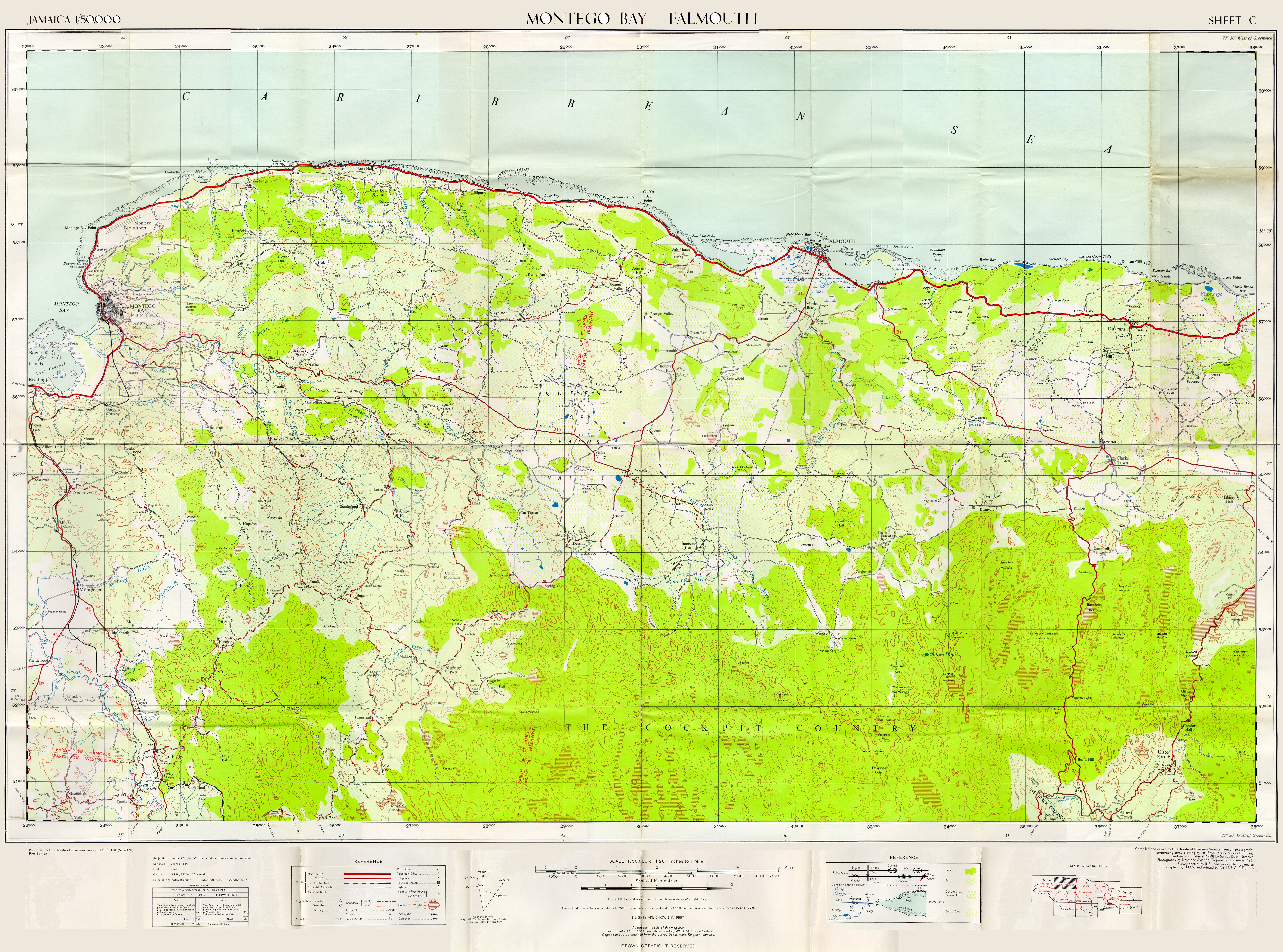
Located at 18.50N, 77.74W in Trelawny Parish, south of Falmouth on Jamaica's north coast. The estate sits inland from the coast in the foothills approaching Cockpit Country. Look for the remnants of the Great House and stone windmill amid tropical vegetation. Nearest major airport: Sangster International Airport (MKJS) in Montego Bay, approximately 30 km to the northwest. Ian Fleming International Airport (MKBS) at Boscobel is farther east. Expect tropical conditions with warm temperatures year-round and afternoon convective activity.